
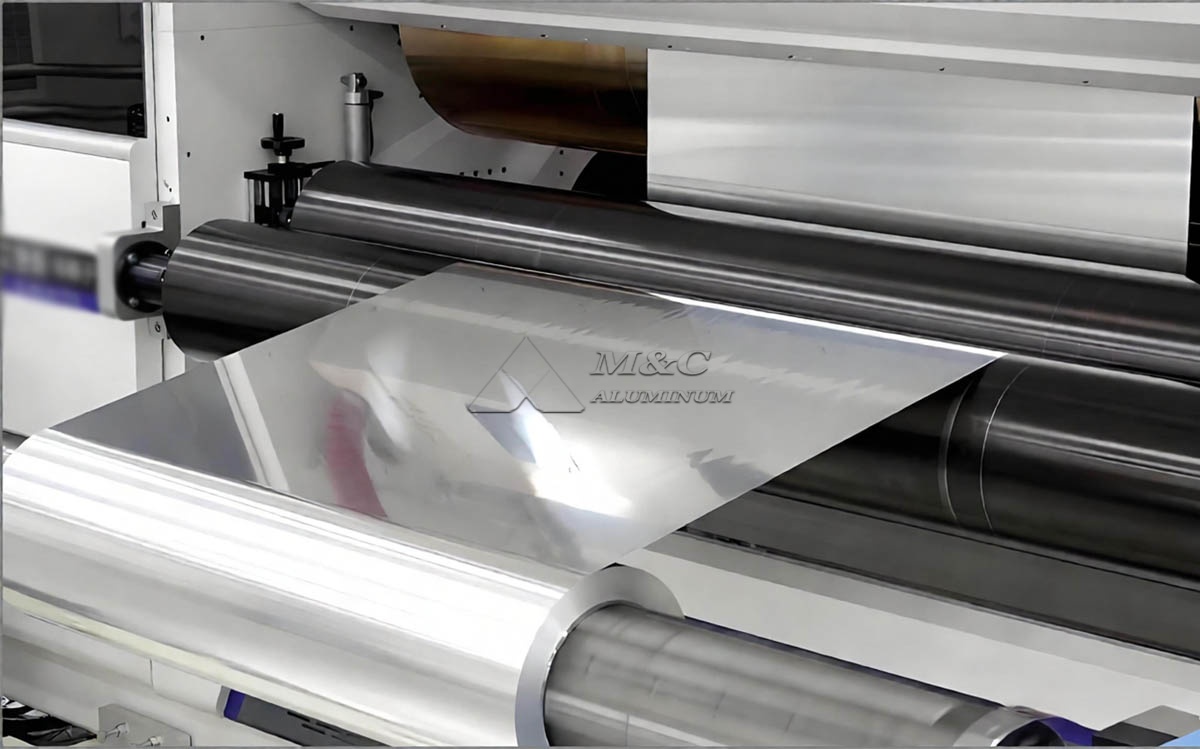
As a professional aluminum foil manufacturer, we produce thin aluminum foil for lithium battery cathode applications where consistent thickness, clean surfaces, controlled mechanical properties, and stable winding performance are required. Battery-grade aluminum foil serves as the cathode current collector in lithium-ion cells, providing an electrically conductive substrate for active materials such as lithium iron phosphate, lithium nickel manganese cobalt oxide, and lithium cobalt oxide.
In modern battery production, the aluminum foil is not simply a base material. Its quality directly affects electrode coating uniformity, adhesion, electrical resistance, calendering behavior, and cell manufacturing efficiency. Our production process is designed to supply reliable lithium battery aluminum foil in coils for battery manufacturers, electrode coating lines, and energy-storage material processors.
Role of Aluminum Foil in Lithium Battery Cathodes
Lithium-ion battery cathodes require a lightweight, highly conductive, and corrosion-resistant current collector. Aluminum is widely selected because it has suitable electrochemical stability at the higher operating potentials of cathode materials. Compared with copper foil, which is generally used for anodes, aluminum foil provides lower density and dependable performance in cathode electrode systems.
Thin aluminum foil for lithium battery cathode manufacturing performs several important functions:
It carries the cathode active-material coating during slurry application.
It provides a continuous conductive path between the cathode coating and the cell tab.
It supports electrode handling, drying, calendering, slitting, winding, and stacking processes.
It contributes to stable internal resistance and power output in the finished cell.
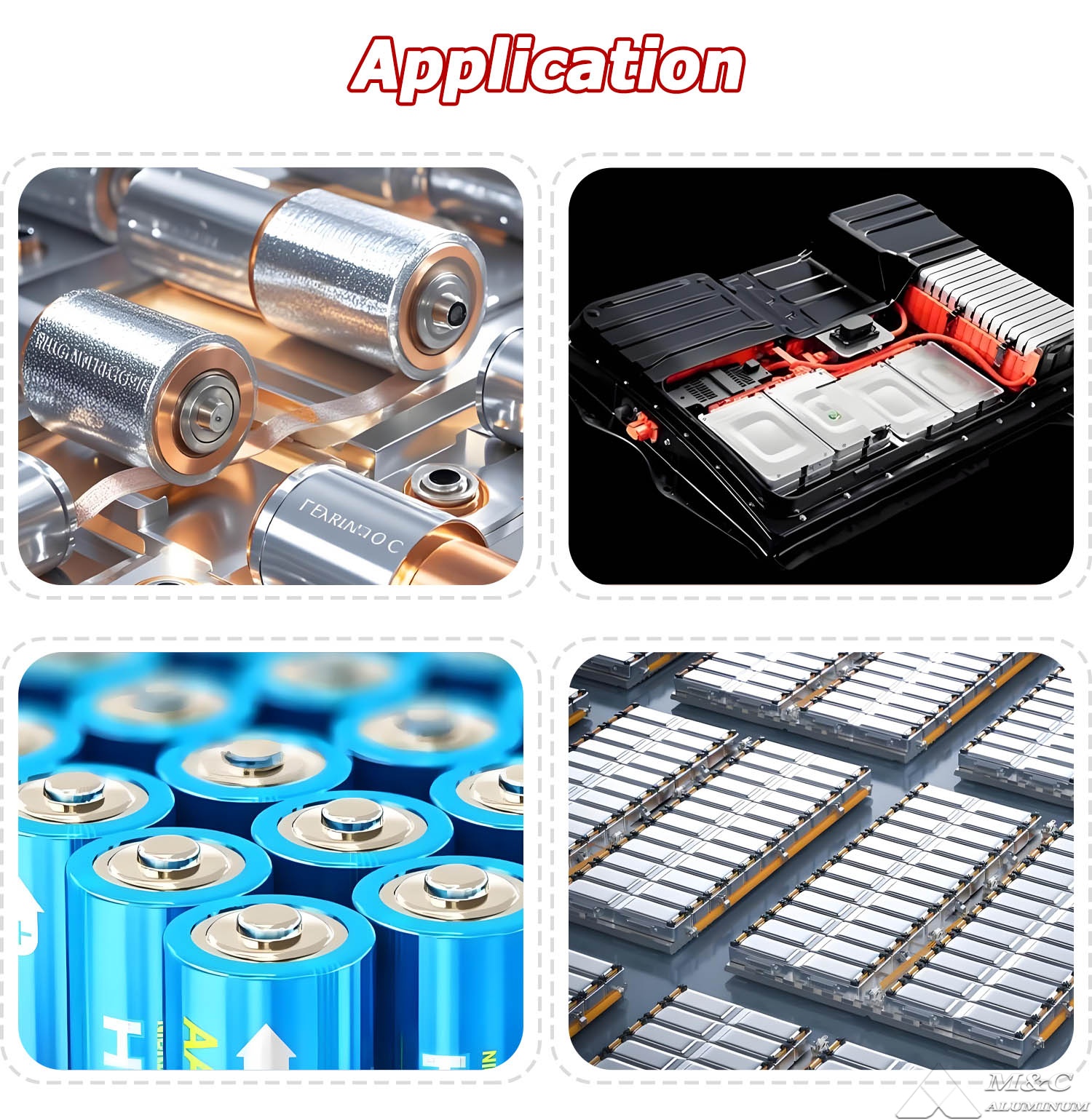
It helps reduce the overall weight of EV batteries, consumer cells, and energy storage systems.
The foil must therefore be engineered not only for chemical composition but also for surface cleanliness, pinhole control, tensile strength, elongation, flatness, and edge quality.
Alloy Selection for Battery Aluminum Foil
Our battery cathode current collector foil is commonly manufactured from high-purity aluminum alloys in the 1xxx series. These alloys are selected for their electrical conductivity, formability, low impurity level, and compatibility with electrode coating operations.
The most common material grades include 1235, 1050, 1060, and 1100 aluminum foil. For customers requiring material selection based on conductivity, mechanical strength, or coating-line processing conditions, we provide controlled production specifications and mill test documentation.
1235 Aluminum Foil is frequently used for battery-related applications because it offers high aluminum content, reliable rolling performance, and good electrical conductivity. We also manufacture 1060 Aluminium Foil for customers requiring a high-purity aluminum substrate with stable quality across wide coil widths.
Typical Technical Parameters
The following table shows typical parameters for thin aluminum foil used as a lithium battery cathode current collector. Final specifications can be adjusted according to the battery cell design, electrode coating method, and customer processing equipment.
| Parameter | Typical Range | Notes |
|---|---|---|
| Alloy | 1235, 1050, 1060, 1100 | Selected according to conductivity and processing requirements |
| Temper | O, H18, H19 | O temper is common where high formability is required |
| Thickness | 10 to 25 microns | Common battery foil thicknesses include 12, 15, 16, 18, and 20 microns |
| Thickness tolerance | As agreed by specification | Controlled across coil width and length |
| Width | 100 to 1,650 mm | Slit coils available for electrode production lines |
| Coil inner diameter | 150 mm, 300 mm, 505 mm | Customized to unwinding equipment |
| Coil outer diameter | Up to 1,200 mm | Subject to thickness, width, and coil weight |
| Surface condition | Clean, oil-controlled, smooth | Suitable for cathode slurry coating |
| Tensile strength | According to alloy and temper | Confirmed by mechanical testing |
| Elongation | According to alloy and temper | Important for handling and calendering |
| Pinhole control | According to thickness and agreement | Critical for thin-gauge foil reliability |
| Electrical conductivity | High conductivity aluminum base | Supports low-resistance current collection |
Manufacturing Process for Thin Battery Aluminum Foil
Our manufacturing begins with qualified aluminum ingots and carefully controlled melt chemistry. We use a production route that includes melting, casting, homogenization, hot rolling, cold rolling, intermediate annealing, final rolling, slitting, inspection, and packaging. Each stage is managed to maintain stable coil properties.
Melt and Casting Control
The chemical composition of the aluminum melt is controlled to reduce unwanted impurities that may affect electrical conductivity, rolling behavior, or surface performance. Stable cast slabs provide the basis for uniform rolling and consistent foil quality.
Precision Rolling
Thin aluminum foil production requires accurate rolling force control, tension management, and roll surface condition. During cold rolling and final foil rolling, we monitor thickness variation and surface appearance to meet customer requirements. For lithium battery aluminum foil, thickness consistency is particularly important because variation may affect cathode loading and electrode density.
Annealing and Temper Adjustment
Annealing is used to achieve the target temper and mechanical behavior. The required temper depends on the downstream process. Soft annealed foil can offer better handling and formability, while harder tempers may be selected for specific high-speed production lines. We adjust thermal processing according to the required tensile strength and elongation range.
Slitting and Edge Quality
After rolling, coils are slit to the required width. Clean slit edges are important in battery electrode production because burrs, edge cracks, and loose particles can interfere with coating, winding, or stacking operations. Our slitting process is controlled to maintain stable width, smooth edges, and appropriate coil winding quality.
Surface Requirements for Cathode Coating
The surface of lithium battery aluminum foil must support uniform application of cathode slurry. A typical slurry contains active material, conductive carbon, binder, and solvent. If the aluminum foil surface contains excessive rolling oil, dust, moisture, scratches, or surface defects, coating adhesion and electrode consistency may be affected.
As a factory supplier, we control key surface-related factors including:
Residual rolling oil within the agreed range.
Cleanliness suitable for electrode coating operations.
Uniform surface appearance across the coil.
Low particle contamination risk through controlled handling.
Stable wettability for the customer's slurry formulation.
Limited scratches, dents, wrinkles, and telescoping.
Surface requirements should be discussed together with the coating method. Slot-die coating, comma-bar coating, gravure coating, and other electrode processes may have different expectations for foil tension, surface condition, and coil geometry.
Quality Inspection and Traceability
We apply quality control from raw material receipt through finished coil shipment. Each production batch can be inspected according to the agreed technical specification. Standard inspection activities may include thickness measurement, width measurement, tensile testing, elongation testing, visual surface inspection, pinhole evaluation, coil shape inspection, and packing verification.
For export orders, we provide material documentation that may include a mill test certificate, packing list, commercial invoice, certificate of origin where applicable, and coil identification labels. Coil labels can include alloy, temper, thickness, width, net weight, gross weight, coil number, production batch, and customer purchase order reference.
Traceability is important for battery material buyers because cathode current collector foil is typically processed in large volumes and used in tightly controlled cell manufacturing systems. We maintain production records to support consistent supply and quality review.
Key Considerations When Purchasing Battery Cathode Foil
When sourcing thin aluminum foil for lithium battery cathode production, purchasers should evaluate more than nominal thickness. The following points should be confirmed before mass supply:
Foil thickness and tolerance: The target thickness must match cathode design requirements and electrode loading calculations.
Alloy and temper: The selected grade should provide the required conductivity, strength, and elongation.
Surface cleanliness: Residual oil and contamination limits should be compatible with the coating process.
Coil dimensions: Coil width, inner diameter, outer diameter, and maximum coil weight must fit the customer's equipment.
Slitting quality: Edge burr control and coil winding quality are necessary for stable electrode processing.
Inspection standard: Both parties should agree on test methods, sampling plans, and acceptance criteria.
Packaging method: Battery foil requires moisture-resistant and damage-resistant export packaging during transportation.
Packaging and Export Delivery
Our finished battery aluminum foil coils are protected with inner wrapping, moisture barriers, reinforced outer packaging, and wooden pallets or wooden cases as required. Packaging is designed to reduce the risk of moisture exposure, compression damage, edge impact, and coil deformation during sea, air, rail, or truck transport.
For international customers, we can arrange coil weight and packaging configuration according to container loading conditions and receiving-site handling capacity. This helps improve unloading efficiency while protecting thin-gauge aluminum foil during long-distance delivery.
Conclusion
Thin aluminum foil for lithium battery cathode applications is a precision material that must deliver stable conductivity, controlled thickness, clean surfaces, and reliable coil performance. As an aluminum foil manufacturer, we produce battery-grade foil with specifications adapted to cathode coating, calendering, slitting, winding, and stacking requirements.
By controlling alloy composition, rolling accuracy, annealing conditions, surface quality, and final inspection, we support battery manufacturers seeking consistent lithium battery aluminum foil for EV batteries, consumer electronics, and energy storage applications. Technical specifications can be customized according to your cathode formulation, equipment configuration, and finished-cell performance requirements.