
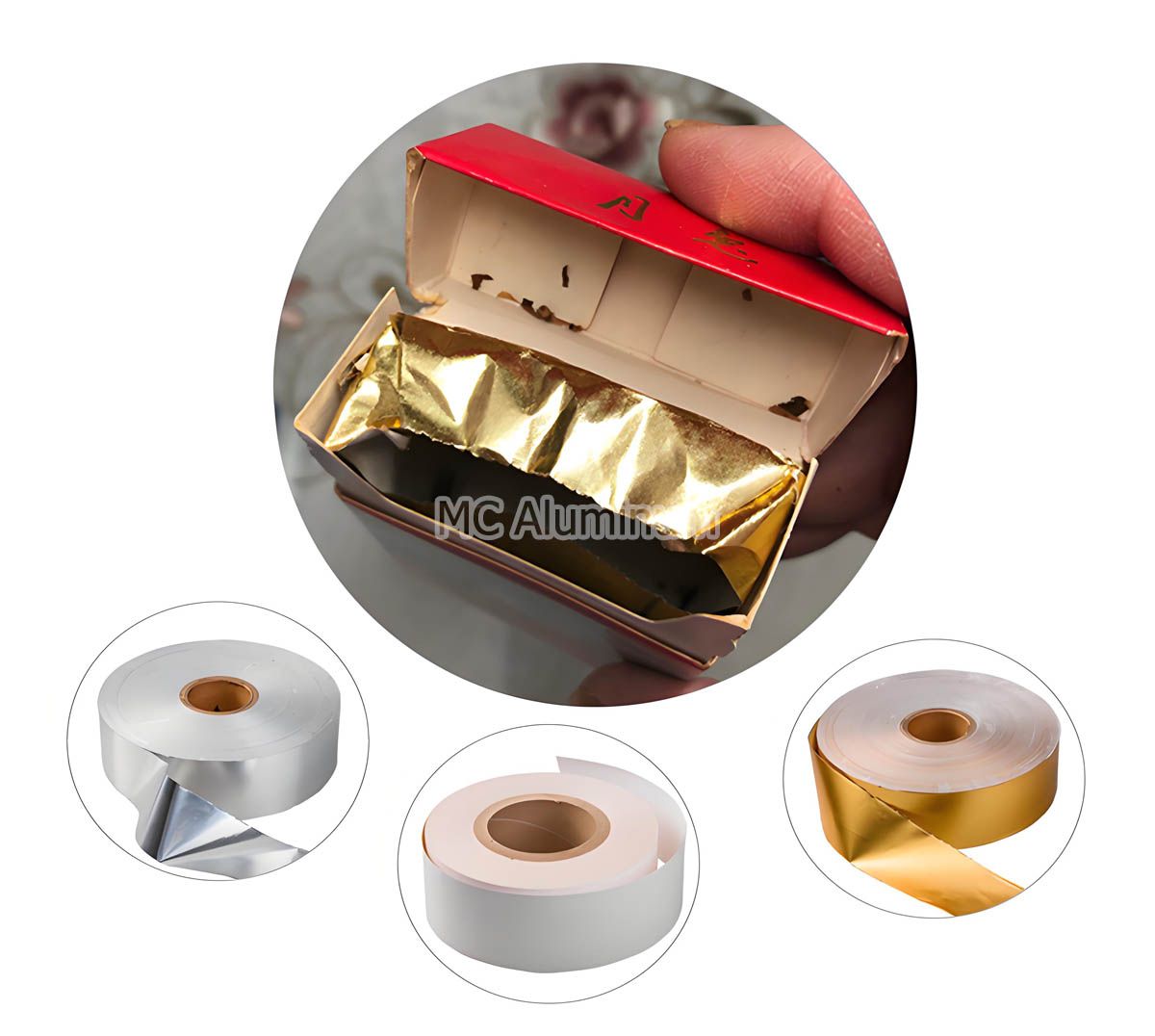
When you tear open the seal of a cigarette pack, the first thing you see is the shiny metallic inner liner paper. Many people instinctively call it "tin foil," but in modern industry, this material is actually aluminum foil and its composite material.
In the early days, tin foil was indeed used for tobacco packaging. However, due to its high cost and tendency to produce an unpleasant odor, it has long been replaced by aluminum foil. Today, cigarette inner liners are usually made by bonding aluminum foil with base paper using adhesives. In the industry, this material is known as aluminum foil laminated paper.
Core Structure
Aluminum Foil Layer
Usually made of 1235 alloy or 8011 alloy in O temper (fully soft temper). The foil is extremely thin, typically ranging from 0.006 mm to 0.007 mm.
Paper Layer
Special inner liner paper is used, offering good folding performance and absorbency.
Lamination Technology
The aluminum foil and paper are firmly bonded through wet lamination or wax lamination, ensuring that the material does not delaminate on high-speed cigarette packaging machines.
Why Is Aluminum Foil Used as the Inner Liner?
1. Excellent Barrier Performance: Aroma Retention and Moisture Resistance
The flavor, moisture, and volatile substances in tobacco determine the smoking experience. Aluminum foil has almost 100% barrier properties. It effectively blocks external moisture from entering and causing mildew, while locking in the tobacco aroma and preventing it from evaporating. This helps ensure consistent quality from the first cigarette to the last.
2. Light and UV Protection
Ultraviolet rays can accelerate the oxidation and degradation of tobacco oils. As a metallic layer, aluminum foil completely blocks light, preventing physicochemical reactions caused by light exposure and extending the shelf life of cigarettes.
3. Good Processability and "Dead Fold" Property
Aluminum foil has a unique dead fold property, meaning it does not spring back like plastic film after being folded. This feature is essential for cigarette packaging. It allows the inner liner to wrap the cigarettes tightly and remain flat and well-shaped during high-speed packaging, where machines may produce hundreds of packs per minute.
4. Cost-Effective and Safe
Compared with other high-performance materials such as polyester film, aluminum foil has a lower manufacturing cost and can be recycled. It is non-toxic, odorless, safe, and hygienic, meeting food-grade requirements.
5. Compatible with Printing and Decoration
The surface of aluminum foil is smooth and uniform, making it suitable for high-precision printing and hot stamping. This provides an elegant visual effect for premium cigarette brands.
Common Aluminum Foil Materials
In the field of cigarette inner liners, two main types of aluminum foil are commonly used: 1235 aluminum foil and 8011 aluminum foil.
| Alloy | Temper | Thickness | Width | Elements | Advantages |
| 1235 | O | 0.006–0.0065 mm | 300–1800 mm | Aluminum content ≥99.35% | Excellent softness and superior surface quality |
| 8011 | O | 0.006–0.0065 mm | 300–1800 mm | Contains trace Fe and Si elements | Slightly higher strength than 1235 aluminum foil; suitable for some premium or special process requirements |
Production Process of Cigarette Inner Liner Packaging
1. Casting and Cold Rolling
High-purity aluminum ingots, such as 1235 or 8011, are melted and cast into aluminum coils. Then, through multiple cold rolling passes, the aluminum material is gradually rolled down to a thinner gauge.
2. Foil Rolling and Doubling
When the aluminum foil becomes very thin, a double-rolling process is usually adopted to prevent breakage and improve production efficiency. Two layers of foil are stacked and rolled together. The side in contact with the steel roller becomes bright, while the side where the two foil layers contact each other forms a matte surface.
3. Annealing
The aluminum foil is placed in an annealing furnace, where it is heated at a specific temperature for a long period and then slowly cooled. This process eliminates internal stress caused by cold rolling and makes the foil extremely soft, giving it the dead fold property required for cigarette packaging.
4. Surface Degreasing and Coating
As a material that comes into contact with tobacco, the aluminum foil surface must reach Grade A wettability through high-temperature annealing or chemical degreasing, ensuring there is no residual oil. Then, depending on requirements, a thin layer of protective lacquer or anti-counterfeiting coating may be applied to improve wear resistance and printing adhesion.
5. Lamination
This is the stage where aluminum foil and paper are combined into one material.
Wet Lamination:
A water-based adhesive is used to bond the aluminum foil and liner paper online, followed by drying in an oven.
Wax Lamination:
Molten paraffin wax is used as the adhesive. Inner liners produced by this process feel softer when opened and offer better moisture-proof sealing. This process is preferred by many premium cigarette brands.
6. Precision Slitting
Finally, the wide laminated roll is sent to a slitting machine. According to the specific packaging machine model used by the cigarette factory, the material is precisely slit into narrow rolls, usually 80 mm to 115 mm wide, and rewound without joints.
FAQ
1. What is the typical thickness of cigarette aluminum foil?
Cigarette aluminum foil common thickness is 6-9 microns (μm), which balances barrier performance, flexibility, and cost.
2. Is cigarette inner liner aluminum foil environmentally friendly?
Aluminum foil itself is highly recyclable. However, composite structures such as paper + aluminum are more difficult to separate and recycle. Therefore, the industry is exploring more environmentally friendly solutions.
3. How are the "bright side" and "matte side" of aluminum foil inner liners formed?
This is caused by the double-rolling process. When producing ultra-thin aluminum foil, two layers of foil are stacked and rolled together to prevent breakage. The side in contact with the steel roller becomes very bright, while the side where the two foil layers touch each other forms a uniform matte finish. This is a normal process characteristic and does not affect barrier performance.
4. Why are some inner liner papers gold while others are silver?
The base material is silver-white aluminum foil. The gold color is usually achieved by applying a light-gold protective lacquer or printing a gold coating on the foil surface. This is mainly for decorative purposes, allowing the packaging to match different brand design styles.