
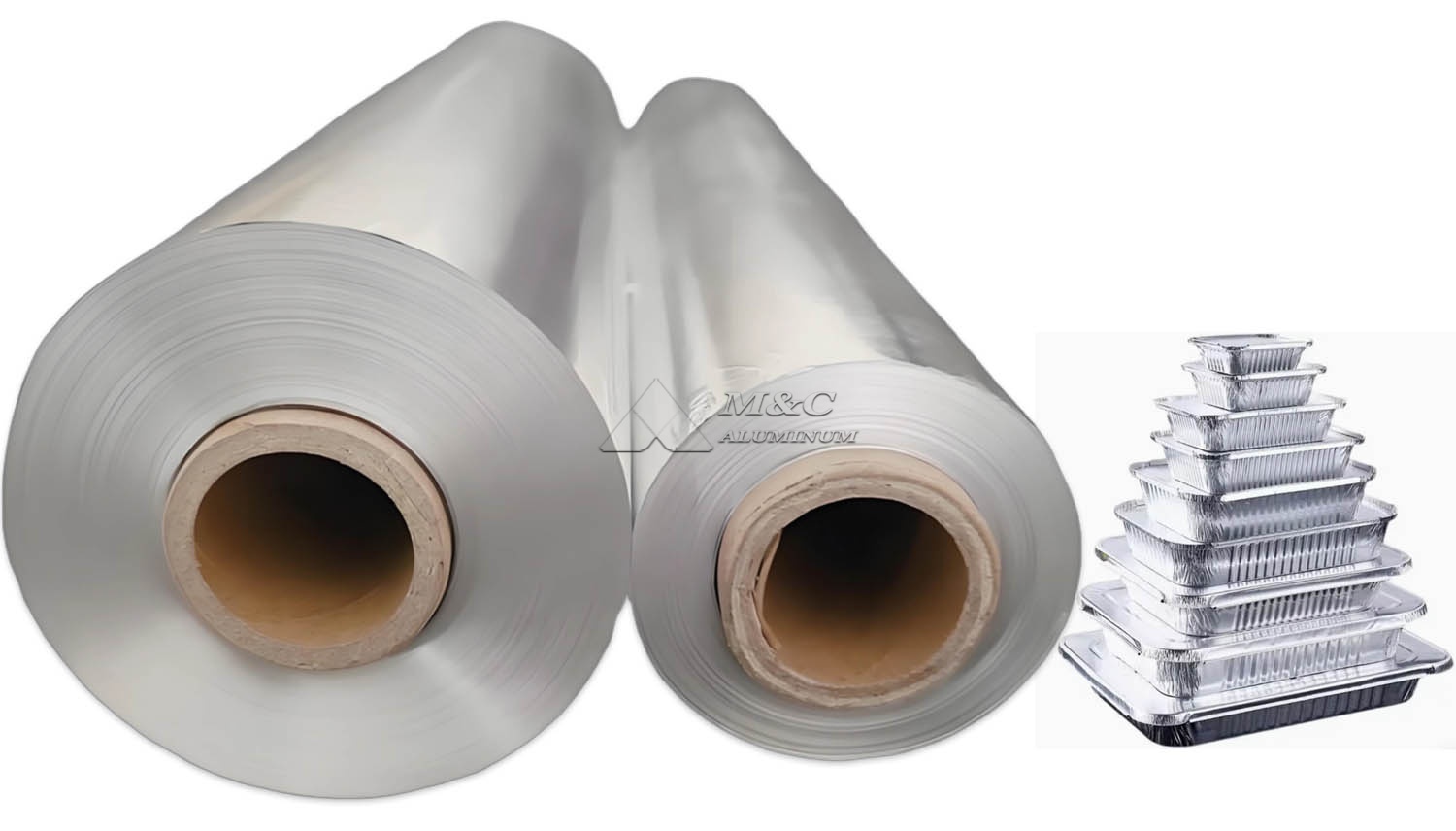
As an aluminum foil manufacturer, we produce 3003 aluminum foil for food container making with controlled chemical composition, stable mechanical properties, and surface quality suitable for high-speed forming. Food container manufacturers require foil that can be stamped, pressed, curled, and stacked efficiently while maintaining tray strength, dimensional consistency, and food-contact reliability. For this application, 3003 aluminum foil is one of the most widely used alloy options due to its balanced formability, corrosion resistance, and mechanical strength.
Our production focuses on aluminum foil stock for disposable food containers, airline meal trays, takeaway containers, baking pans, lunch boxes, barbecue trays, and related aluminum foil food packaging products. Depending on the forming depth, container shape, press speed, and required rigidity, we supply 3003 aluminum foil in suitable tempers such as H22, H24, and O, with customized thickness, width, coil ID, surface condition, and mechanical performance.
Why 3003 Aluminum Foil Is Used for Food Containers
3003 aluminum alloy is an Al-Mn series alloy. Compared with pure aluminum foil, 3003 aluminum foil has higher strength while retaining good ductility and processing performance. The manganese content improves the alloy strength and stability, making it suitable for containers that must withstand forming pressure, filling, sealing, heating, transportation, and end-user handling.
For aluminum foil food container making, the material should not crack during stamping or wrinkle excessively during deep drawing. It also needs enough stiffness after forming, especially for large trays or multi-compartment containers. 3003 aluminum foil provides a practical balance between elongation and yield strength, which helps container factories reduce breakage, improve forming yield, and produce trays with cleaner edges and better appearance.
We manufacture 3003 Aluminum Foil according to customer processing requirements, including automatic press lines, multi-cavity molds, smooth wall containers, wrinkle wall containers, and coated or lubricated container foil. For factories producing standard takeaway trays, 3003 H24 is commonly selected. For deeper containers or more complex shapes, H22 or O temper may be used after confirming forming trials.
Manufacturing Route in Our Factory
As a direct producer, we control the process from raw material selection to finished foil inspection. The manufacturing route generally includes melting, casting, homogenization, hot rolling or continuous casting and rolling, cold rolling, intermediate annealing, foil rolling, slitting, final annealing if required, inspection, and packaging.
During production, rolling reduction, annealing temperature, strip shape, surface cleanliness, and mechanical properties are closely monitored. For food container foil, control of oil residue, surface defects, pinholes, edge quality, and coil tension is especially important. Any unstable factor may affect the performance of downstream container forming machines.
We use process records to ensure batch traceability. Each coil can be checked against production parameters, inspection results, and packaging data. This is important for international buyers who need consistent quality across repeat orders rather than only one qualified sample shipment.
Typical Technical Parameters
The following table shows common technical parameters for 3003 aluminum foil for food container making. Actual specifications can be customized according to container size, mold design, and forming equipment.
| Item | Typical Range or Requirement |
|---|---|
| Alloy | 3003 |
| Temper | O, H22, H24, H26, customized by application |
| Thickness | 0.030 mm to 0.200 mm |
| Common Thickness | 0.040 mm, 0.050 mm, 0.060 mm, 0.070 mm, 0.080 mm, 0.090 mm, 0.100 mm |
| Width | 100 mm to 1600 mm, slit to order |
| Coil ID | 76 mm, 152 mm, 300 mm, 405 mm, or customized |
| Surface | Mill finish, one side bright, both sides bright, degreased, lubricated, or coated if required |
| Edge Quality | Trimmed edge, burr controlled for forming and slitting |
| Pinholes | Controlled according to thickness and customer standard |
| Wettability | Suitable for coating, printing, or lubrication when required |
| Application | Food trays, lunch boxes, baking pans, takeaway containers, airline trays |
| Packing | Export wooden case or pallet, moisture-proof wrapping |
Chemical Composition Reference
The controlled chemical composition of 3003 aluminum foil contributes to stable performance during rolling and container forming.
| Element | Typical Standard Range |
|---|---|
| Al | Balance |
| Mn | 1.00 percent to 1.50 percent |
| Fe | Max 0.70 percent |
| Si | Max 0.60 percent |
| Cu | 0.05 percent to 0.20 percent |
| Zn | Max 0.10 percent |
| Other Each | Max 0.05 percent |
| Other Total | Max 0.15 percent |
The actual composition is controlled within applicable standards and customer specifications. Stable alloy chemistry is essential for mechanical consistency, especially when customers use high-speed container production lines.
Mechanical Properties and Temper Selection
Food container manufacturers should select temper according to the container design. A shallow tray usually needs higher rigidity and less springback. A deep-drawn or complicated shape usually needs better elongation. The following values are typical references, not final guarantees for every specification.
| Temper | Tensile Strength | Elongation | Typical Use |
|---|---|---|---|
| O | Lower strength, high ductility | High | Deep drawing, complex container shapes |
| H22 | Medium strength, good formability | Medium to high | Deeper trays, balanced forming performance |
| H24 | Higher strength, stable rigidity | Medium | Standard food containers and takeaway trays |
| H26 | Higher hardness | Lower | Containers requiring higher stiffness, subject to mold testing |
Before bulk production, we recommend confirming thickness and temper through sample forming. Container geometry, corner radius, lubrication, forming speed, and mold condition can influence the final result. Our technical team can provide matching recommendations based on the target product drawing or existing trial data.
Surface Quality Requirements for Container Foil
The surface condition of 3003 food container foil directly affects forming stability and finished container appearance. We control the foil surface to reduce rolling marks, black lines, oil stains, oxidation marks, scratches, bright spots, and other visible defects that may affect downstream production.
For uncoated aluminum foil food containers, a clean mill finish is commonly used. For applications requiring color coating, printing, or heat-seal compatibility, the foil surface must have suitable cleanliness and surface energy. If customers require lubricated foil for easier forming, the lubricant type and dosage should be compatible with the intended food packaging process and applicable regulations.
Coil shape is also important. Poor flatness can cause feeding deviation, wrinkling, or unstable tension on press lines. Our slitting process controls width tolerance, edge burrs, telescoping, and coil alignment to support continuous forming operations.
Advantages for Food Container Production
3003 aluminum foil offers several practical advantages for food container manufacturing. First, it has good corrosion resistance in normal food packaging and storage environments. Second, it conducts heat efficiently, making it suitable for ovenable trays and baking pans. Third, it is lightweight but strong enough for disposable and semi-rigid container applications. Fourth, it is recyclable, which supports aluminum packaging circularity.
For container factories, material utilization and production continuity are often more important than theoretical alloy performance alone. A stable 3003 aluminum foil coil helps reduce shutdowns, tearing, uneven forming, and rejected trays. We therefore focus not only on nominal thickness and alloy, but also on coil-to-coil consistency, surface cleanliness, and reliable mechanical properties.
Our Container foil supply can be adapted for different end markets, including catering, supermarkets, food processing plants, bakery packaging, and ready meal packaging. We can provide trial coils before large-volume supply when a customer is developing a new container model or changing from another alloy.
Comparison With 8011 Aluminum Foil
8011 aluminum foil is also widely used for food containers, household foil, and packaging. Compared with 8011, 3003 aluminum foil usually provides higher strength and better rigidity under similar thickness and temper conditions. This makes 3003 suitable for containers that require stronger sidewalls, better shape retention, or larger dimensions.
8011 may be chosen when cost, softness, or specific forming behavior is preferred. 3003 is often selected when the container must resist deformation during filling, transport, or reheating. In some projects, customers test both 3003 and 8011 before final selection. As a manufacturer, we can supply alloy comparison samples and adjust temper and thickness to help determine the most economical and stable solution.
Applications of 3003 Food Container Foil
3003 aluminum foil for food container making is used in many pressed and formed packaging products. Typical applications include rectangular takeaway trays, round baking containers, multi-compartment meal trays, airline food trays, pie pans, barbecue trays, pet food trays, and disposable catering containers. It can also be used for lids or matched foil components depending on the required strength and sealing method.
For ovenable food packaging, aluminum has a practical advantage because it maintains dimensional stability under normal baking and reheating conditions. For chilled and frozen meals, 3003 aluminum foil containers provide barrier protection and help maintain package integrity during storage and distribution.
Quality Inspection Before Shipment
Every shipment is inspected according to order requirements. Standard inspection items include alloy verification, thickness measurement, width tolerance, surface appearance, pinhole inspection, mechanical testing, edge quality, coil condition, and packaging check. For export orders, we provide mill test certificates and packing lists. If customers require additional standards, we can discuss third-party inspection or project-specific quality documents.
Packaging is designed for long-distance sea or land transportation. Coils are wrapped with moisture-proof materials, protected against impact, and fixed on wooden pallets or in wooden cases. Proper packaging reduces the risk of oxidation, edge damage, and coil deformation before the material reaches the customer production site.
Ordering Information
To quote and produce accurately, we usually require alloy, temper, thickness, width, coil ID, surface requirement, edge type, annual demand, and intended container design. If the buyer has a drawing, sample container, forming trial report, or current material specification, this information helps us recommend a more accurate 3003 aluminum foil solution.
As a factory, our objective is to supply stable, process-ready 3003 aluminum foil for food container making. Through controlled rolling, reliable inspection, and export packaging, we support food container manufacturers in achieving consistent forming performance, finished tray quality, and long-term supply stability.