
In new energy vehicles, photovoltaic inverters, industrial frequency converters, and printed circuit boards for a wide range of consumer electronics, it is common to see small cylindrical electronic components—aluminum electrolytic capacitors.
These components perform critical functions such as filtering, energy storage, coupling, bypassing, and voltage smoothing. Among the various raw materials used in capacitor manufacturing, aluminum foil accounts for approximately 30% to 60% of the total material cost. In this sense, high-quality aluminum foil is the "heart" and foundation of an aluminum electrolytic capacitor.
Aluminum Foil: The Core Material of Aluminum Electrolytic Capacitors
An aluminum electrolytic capacitor typically consists of an anode foil, cathode foil, separator paper, electrolyte, casing, and sealing structure. Among these components, aluminum foil is the core material used to form the electrodes.
Based on its function, aluminum foil for capacitors can generally be divided into the following types:
Anode aluminum foil: Used to form the dielectric oxide film. It is a key material determining capacitor voltage resistance and capacitance.
Cathode aluminum foil: Used as the negative electrode current collector or cathode material. It affects equivalent series resistance (ESR), ripple current capability, and electrical conductivity.
Etched foil / corrosion foil: Aluminum foil that has been electrochemically etched to create a large number of micro-pores on the surface, increasing the effective surface area.
Formed foil: Aluminum foil that has undergone anodic oxidation, creating a stable aluminum oxide dielectric film on its surface.
In an aluminum electrolytic capacitor, the actual insulating dielectric is the aluminum oxide film on the surface of the aluminum foil-namely, the aluminum oxide (Al₂O₃) film.
This film has excellent dielectric properties and enables high capacitance within a relatively small capacitor volume. Therefore, aluminum foil is not simply a metal substrate; it is a functional material that directly participates in the capacitor's energy storage and charge-transfer processes.
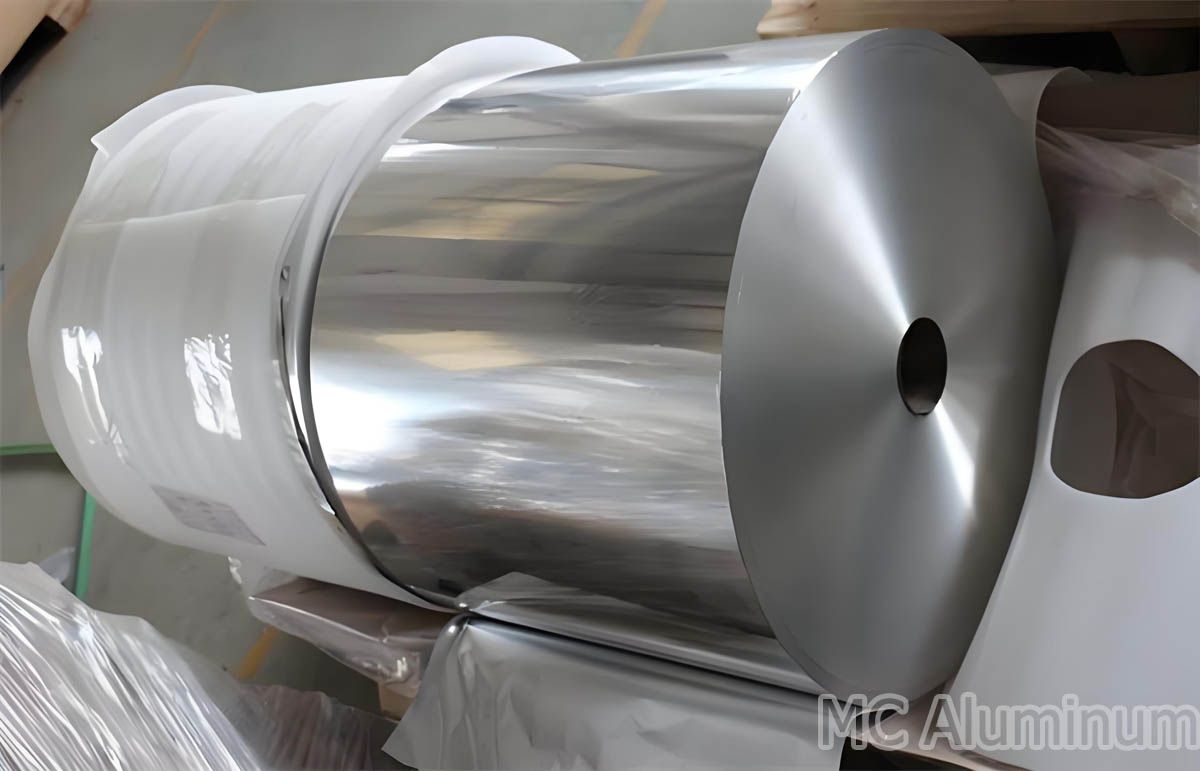
Common Aluminum Alloys for Electrolytic Capacitor Foil
Aluminum foil for electrolytic capacitors generally requires high material purity.
Common capacitor aluminum foil grades include:
1235
1060
1070
1100
Different grades and material systems can be selected according to capacitor type, etching method, forming voltage, operating temperature, and product design requirements.
High-purity aluminum helps reduce the negative effects of certain impurity elements on electrochemical behavior. It also supports the formation of a stable and uniform aluminum oxide dielectric film.
Typical Technical Parameters of Aluminum Foil for Electrolytic Capacitors
| Item | Typical Range / Selection |
| Alloy | 1235 / 1060 / 1070, etc. |
| Temper | O, H18, etc. |
| Thickness | Approx. 0.01–0.20 mm, customized by application |
| Width | 100–1,600 mm |
| Length | 1,000–16,000 mm |
| Surface | Clean, smooth, controlled surface condition |
| Form | Coil / Roll |
| Application | Anode Foil / Cathode Foil |
| Processing | Etching / Forming / Winding |
| Inspection | Chemical composition, dimensional, and surface inspection |
| MOQ | 3 tons |
Working Principle of Aluminum Foil in Electrolytic Capacitors
The operating principle of an aluminum electrolytic capacitor can be understood as a process of storing and releasing electrical charge.
When voltage is applied to the capacitor, a thin aluminum oxide film acts as the dielectric layer between the electrodes. This dielectric film enables electrical charge to accumulate and be stored. When the circuit requires current, the stored charge can be released rapidly.
1. Charge Storage Process
When voltage is applied, an electric field is established between the aluminum foil electrode and the electrolyte system. Charge accumulates across the aluminum oxide dielectric layer, creating capacitance.
The etched structure of the aluminum foil is especially important because it significantly increases the effective contact area. A larger effective surface area allows more charge to be stored within the same physical volume.
2. Charge Release Process
When the circuit requires instantaneous current, the aluminum electrolytic capacitor quickly releases the stored charge.
This rapid discharge capability makes aluminum electrolytic capacitors highly suitable for applications such as power supply filtering, DC-link circuits, frequency converters, automotive electronics, LED drivers, UPS systems, and industrial control equipment.
Core Advantages of High-Quality Aluminum Foil for Electrolytic Capacitors
1. High Purity and Low Impurity Content
High-purity aluminum foil contains fewer harmful impurities, helping reduce defects in the oxide film. This can lower leakage current and improve dielectric strength, voltage resistance, and overall capacitor reliability.
2. High Specific Capacitance
High-quality foil can form a more uniform and controllable etched pore structure. The greater effective surface area created through etching allows the capacitor to achieve higher capacitance within the same volume.
3. High Voltage Resistance and Low Leakage Current
A dense and uniform formed aluminum oxide film is less likely to break down under high voltage. As a result, the capacitor can achieve better voltage endurance and lower leakage current.
4. Low ESR and High Ripple Current Capability
For cathode foil, low electrical resistance is particularly important. High-quality aluminum foil helps reduce ESR and internal heat generation under high-frequency and high-current conditions.
This improves the capacitor’s ability to withstand ripple current and supports stable operation in switching power supplies, inverters, and frequency conversion equipment.
5. Long Service Life and High-Temperature Resistance
Uniform aluminum microstructure and stable etched morphology help improve capacitor durability. Under elevated temperatures, high-quality aluminum foil can contribute to slower capacitance degradation and more reliable long-term operation.
6. Good Batch Consistency
Stable foil thickness, mechanical properties, surface condition, and electrochemical performance are essential for high-speed automated winding and mass capacitor production.
Good consistency between coils and batches helps reduce manufacturing variation and improves product yield.
7. Reliable Mechanical Strength
Capacitor aluminum foil must have suitable tensile strength, elongation, and bending performance. This helps prevent foil breakage, edge cracking, wrinkling, and other defects during slitting, etching, forming, and winding processes.
8. Good Compatibility with Electrolytes
The aluminum foil should be compatible with the selected electrolyte system. Good compatibility helps reduce localized corrosion, gas generation, premature degradation, and early capacitor failure.
Application Fields of Capacitor Aluminum Foil
Aluminum foil for electrolytic capacitors is widely used in the production of capacitors for:
Switching power supplies
LED driver power supplies
Industrial power supplies
Frequency converters and variable-frequency drives
UPS power systems
Automotive electronics
New energy vehicles
Photovoltaic inverters
Energy storage systems
Communication power supplies
Audio equipment
Consumer electronics
Industrial automation and control equipment
Motor drive systems
Charging piles and EV charging systems
With the rapid development of new energy vehicles, energy storage, industrial automation, high-efficiency power electronics, and renewable energy technologies, the market demand for highly reliable capacitors continues to increase. This trend is also driving greater demand for high-quality electronic aluminum foil.
How to Select High-Quality Aluminum Foil for Electrolytic Capacitors ?
For capacitor manufacturers, aluminum foil procurement should not be based on price alone. The following factors should be evaluated comprehensively.
1. Check the Chemical Composition
Confirm that the aluminum grade, purity level, and key impurity elements meet internal technical requirements and applicable product specifications.
High purity is particularly important for anode foil because it influences etching behavior, oxide film quality, leakage current, and voltage resistance.
2. Check Thickness and Thickness Tolerance
Stable thickness control helps improve consistency during slitting, winding, etching, and forming.
Excessive thickness variation may lead to uneven electrical properties, unstable etching results, winding defects, and inconsistent capacitor performance.
3. Check Surface Quality
The foil surface should be inspected for defects such as:
Scratches
Dents
Oil stains
Black spots
Pinholes
Edge cracks
Wrinkles
Oxidation marks
Surface contamination
Surface defects may affect etching uniformity, oxide film integrity, leakage current, and capacitor reliability.
4. Check Mechanical Properties
Tensile strength, elongation, and bending performance should be appropriate for subsequent high-speed processing.
The foil must withstand slitting, tension control, etching, forming, winding, and assembly without frequent breakage or deformation.
5. Evaluate Etching and Forming Compatibility
For anode foil, etching and forming compatibility are among the most important technical indicators.
The aluminum foil must match the capacitor manufacturer’s existing electrochemical etching process and formation process. A suitable foil should produce a uniform pore structure after etching and a stable dielectric film after formation.
6. Evaluate Batch-to-Batch Stability
For large-scale capacitor manufacturers, stable quality over the long term is often more valuable than exceptional results from a single batch.
Reliable suppliers should maintain consistent chemical composition, thickness tolerance, surface condition, mechanical performance, and electrochemical processing behavior across multiple production batches.