
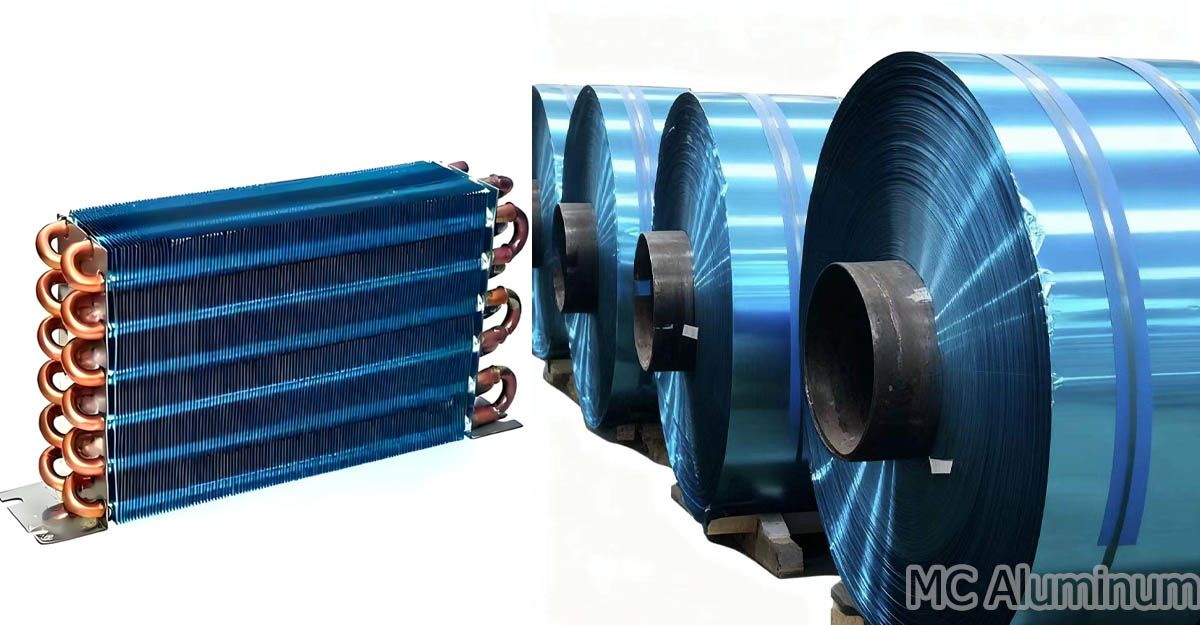
Air conditioner heat exchanger fins are typically made from aluminum foil. Thanks to aluminum's high thermal conductivity, heat can be rapidly transferred to the heat exchange tubes. The expanded fin structure significantly increases the air-side heat exchange area, enhancing convective heat transfer and greatly improving overall heat exchange efficiency.
As an excellent heat-conductive material, 8011 aluminum foil features high thermal conductivity, allowing heat or cold from the air conditioning system to be quickly transferred to the surrounding environment, thereby improving heat exchange efficiency. In addition, 8011 aluminum foil is lightweight and corrosion-resistant, ensuring long-term durability and extending the service life of air conditioning equipment.
8011 aluminum foil is widely used in refrigeration equipment such as air conditioners, refrigeration units, and evaporators. In air conditioning systems, aluminum foil is mainly used to manufacture heat exchanger fins, commonly supplied in H22/H24/H26 tempers, with thickness ranging from 0.08 mm to 0.20 mm.
Chemical Composition of 8011 Aluminum Foil
By carefully controlling the content of alloying elements, it is possible to achieve a balanced combination of strength, thermal conductivity, formability, and corrosion resistance.
| Element | Content Range (%) | Function |
| Si | 0.50 – 0.90 | Improves strength and hardness |
| Fe | 0.60 – 1.00 | Enhances heat resistance and stability |
| Cu | ≤0.10 | Enhances heat resistance and stability |
| Mn | ≤0.20 | Improves microstructure |
| Mg | ≤0.05 | Enhances strength |
| Zn | ≤0.10 | Improves corrosion resistance |
| Ti | ≤0.08 | Refines grain structure |
| Al | remainder | Provides excellent thermal conductivity |
Specifications
| Alloy | 8011 |
| Temper | H22 / H24 / H26 |
| Thickness | 0.08 – 0.20 mm |
| Width | 200 – 1250 mm |
| Length | 100 – 8000 mm |
| Tensile Strength | 110 – 150 MPa |
| Elongation | ≥8% |
| Surface | Bare foil / Hydrophilic aluminum foil |
| Surface Quality | No oil stains, no scratches, no color difference, clean edges |
| Applications | Residential split air conditioners, VRF central air conditioning systems, automotive AC radiators, industrial dehumidifiers, cold storage evaporators |
| MOQ | 1–3 tons |
Four Core Advantages of 8011-H22 Aluminum Foil for AC Heat Exchanger Fins
1. High Thermal Conductivity
Aluminum has an extremely high thermal conductivity coefficient, enabling rapid heat transfer from copper tubes to the surrounding air. This significantly improves the energy efficiency ratio (EER) of air conditioning systems.
2. Excellent Stamping Formability
Air conditioner fins usually contain complex structures such as louver fins and bridge-type holes, which enhance airflow turbulence and heat exchange area.
8011-H22 aluminum foil performs exceptionally well in high-speed continuous stamping, offering excellent cupping value and crack resistance, resulting in a high production yield.
3. Outstanding Surface Wettability and Corrosion Resistance
The foil surface is clean and passes water-brushing tests, making it highly suitable for hydrophilic or anti-corrosion coating treatments. This helps prevent the "water bridge" effect and improves heat transfer efficiency.
4. High Cost Performance
Compared with copper or other expensive metals, aluminum foil has lower density, lighter weight, and lower cost, making it an ideal solution for lightweight design and cost reduction in HVAC systems.
8011 vs 3102 Hydrophilic Aluminum Foil: Which is Better for Your Heat Exchanger?
In air conditioner fin production, 8011 and 3102 are two commonly used alloys with different performance focuses.
| Feature | 8011 Aluminum Foil (Al-Fe-Si Series) | 3102 Aluminum Foil (Al-Mn Series) |
| Main Alloying Elements | Iron (Fe), Silicon (Si) | Manganese (Mn) |
| Thermal Conductivity | Excellent | Excellent |
| Strength | Higher tensile strength | Medium, with better plasticity |
| Corrosion Resistance | Good (standard environments) | Excellent (especially in humid environments) |
| Formability | High stiffness, suitable for high-fin stamping | Excellent ductility, suitable for complex forming |
| Cost Advantage | Highly cost-effective and widely available | Slightly higher cost, used in mid-to-high-end applications |
FAQ
Q: What aluminum alloys are commonly used for air conditioner fins?
A: Common aluminum alloys for AC fins include 8011, 3102, 1100, and 1200 series aluminum. Among them, 8011 aluminum alloy is the most widely used material due to its balanced performance and excellent cost efficiency.
Q: Can 8011 H22 aluminum foil meet anti-corrosion requirements?
A: Yes. The base aluminum foil can be combined with hydrophilic or anti-corrosion surface coatings, meeting corrosion resistance and anti-condensation requirements under humid air-conditioning environments.
Q: Which is better for heat exchangers: 8011 aluminum foil or 3102 aluminum foil?
A: Both alloys have their advantages, and the selection depends on the operating conditions.
8011 aluminum foil: Better balance between strength and plasticity, excellent stamping formability, less prone to cracking, and more cost-effective. It is the preferred choice for standard air conditioner fins.
3102 aluminum foil: Slightly higher strength and better thermal stability, suitable for high-load or high-airflow heat exchanger applications, but with slightly higher cost and forming difficulty.
For most conventional air-conditioning heat exchange applications, 8011 aluminum foil is generally the preferred material.
Q: What thickness of aluminum foil is typically used for air conditioner fins?
A: The typical thickness of aluminum foil used for AC fins ranges from 0.08 mm to 0.15 mm, with 0.09-0.12 mm being the industry mainstream.
Thinner foil reduces thermal resistance and improves heat transfer efficiency, but overly thin foil may deform during stamping. Thicker foil increases structural strength but also raises thermal resistance, so a balance between heat transfer performance and mechanical strength is required.