
Aluminum foil is widely used across many industries. Based on different application requirements, aluminum foil can be classified into more than 20 categories. In the Chinese market, aluminum foil is primarily used as an industrial raw and auxiliary material, while packaging aluminum foil accounts for only about 30% of total domestic demand, serving industries such as food, beverages, dairy products, pharmaceuticals, and electronics.
This raises an important question: why are medicines so commonly packaged in aluminum foil?
As a professional aluminum foil manufacturer, MC Aluminum provides hard packaging suitable for pharmaceutical products such as pills, capsules, and tablets. The aluminum foil typically has a thickness of 25-28 microns. Its bright side is coated with a heat-sealing layer, while the matte side is treated with a printing coating. All coatings comply with food-safety and environmental requirements and meet the standards of the U.S. Department of Agriculture (USDA) and the U.S. Food and Drug Administration (FDA) for direct contact with food or pharmaceuticals.
Pharmaceutical packaging is in fact a complex multilayer structure. On the side that comes into direct contact with the drug (the inner side), a layer of adhesive is applied. During packaging, through high-temperature heat sealing, this adhesive firmly bonds the aluminum foil to the plastic forming film (such as PVC) that holds the medicine, creating a completely sealed blister. On the outer side of the foil, key information such as the drug name, specifications, and expiration date is printed, and a protective layer is applied on top to prevent ink abrasion and to prevent chemical components in the ink from migrating and contaminating the drug.
At present, the commonly used 8011 aluminum foil, through the addition of elements such as silicon, manganese, and iron, also features high strength and corrosion resistance, meeting the requirements of high-speed automated packaging equipment.
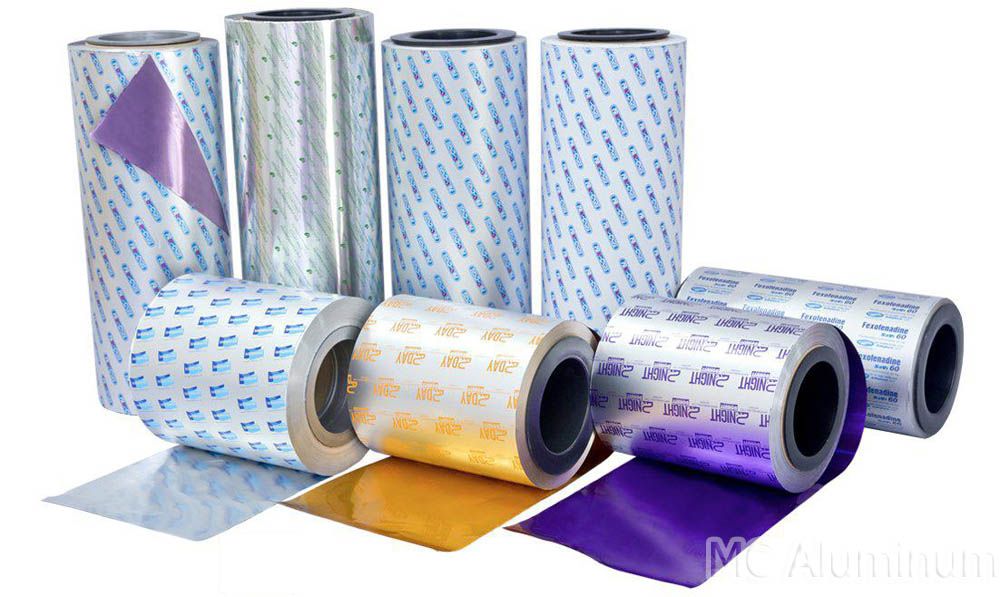
Standard dimensions of aluminum foil
| Alu Foil Thickess (mm) | 0.025 - 0.028 | 0.02 - 0.023 |
| Tolerance (mm) | +/- 8% of AL foil | |
| Density (GSM/CC) | 2.71 | 2.71 |
| Alu Foil Wt (GSM) | 68 | 54 - 67 |
| Alu Foil Surface | Matt / Bright | |
| Temper | Hard Temper | |
| Primer (GSM) Max | 1 – 1.5 | |
| Heat Seal Lacquer | 3-5 GSM (Standard) | |
| 6-8 GSM (Special) | ||
Advantages of Aluminum Foil in Pharmaceutical Packaging
1. Protecting Drug Stability
The primary function of aluminum foil packaging is to isolate medicines from external environmental factors and ensure stability throughout their shelf life.
Moisture barrier: The dense molecular structure of aluminum foil effectively blocks water vapor, preventing moisture absorption and degradation.
Oxygen barrier: Aluminum foil prevents oxygen penetration, reducing oxidation reactions and preserving drug efficacy.
Light protection: Many active pharmaceutical ingredients are light-sensitive. Aluminum foil's excellent opacity protects medicines from photodegradation.
2. Convenience and Safety
In addition to protection, aluminum foil packaging is designed for user safety and ease of use.
Accurate dosing: Combined with plastic blister bases, aluminum foil forms blister packs where each dose is individually sealed, making single-dose dispensing easy and precise.
Child resistance: Blister packaging is relatively rigid and difficult for children to open, reducing the risk of accidental ingestion.
Privacy and anti-counterfeiting: Opaque aluminum foil provides discretion for users and offers inherent anti-tampering and anti-counterfeiting features.
3. Additional Advantages of Aluminum Foil
Safe and heat-resistant: Aluminum foil is non-toxic, chemically stable, and unlikely to react with medicines. It also withstands high temperatures, making it suitable for sterilization processes.
Lightweight and environmentally friendly: Compared with glass bottles, aluminum foil packaging is lighter, saving transportation and storage costs. Aluminum foil is also recyclable, supporting sustainability goals.
Adaptable to production needs: Aluminum foil can be laminated with plastics to form flexible, high-barrier materials suitable for automated production, cold forming, or heat sealing in various package shapes.
Reliable sealing: Aluminum foil supports both heat-seal and cold-seal technologies, ensuring airtight packaging that protects medicines from contamination and oxidation.
Conclusion
As an excellent packaging material, aluminum foil plays a critical role in protecting the quality and safety of pharmaceutical products. By minimizing exposure to moisture, oxygen, light, and contaminants, aluminum foil helps extend shelf life and maintain drug efficacy.
Moreover, aluminum foil can be combined with other materials to create multilayer composite structures, further enhancing the performance and functionality of pharmaceutical packaging systems.