
With the continuous advancement of pharmaceutical packaging technology, flexible aluminum foil has become an indispensable material in the medical packaging industry. Thanks to its outstanding barrier properties, excellent formability, and high safety reliability, it is widely used in the packaging of tablets, capsules, powders, granules, and other pharmaceutical products.
What Is Flexible Aluminum Foil?
Flexible aluminum foil is a thin, soft, and highly ductile aluminum material, typically produced from aluminum alloys through annealing treatment. It provides exceptional barrier protection against moisture, light, gases, and contaminants, along with good corrosion resistance and toughness.
In pharmaceutical packaging, flexible aluminum foil is usually laminated with PVC, PVDC, PE, PP, or cold-forming films to create multi-layer packaging structures that ensure optimal drug protection.
Common types of flexible aluminum foil used in the pharmaceutical industry include:
PTP Aluminum Foil (Blister Foil)
Cold Forming Aluminum Foil (Alu-Alu)
Laminated Aluminum Foil Films (for strip packs and sachets)
All of these products are made from high-purity aluminum and processed through precision rolling and surface coating technologies to deliver reliable protection for medicines.
Common Aluminum Alloy Grades for Pharmaceutical Foil
Currently, the most widely used aluminum alloys for pharmaceutical packaging are 8011, 8021, and 8079.
8011 Aluminum Foil (PTP Foil)
This is the most commonly used pharmaceutical aluminum foil, with thicknesses typically ranging from 0.016 to 0.04 mm. Due to the presence of silicon and iron elements, 8011 aluminum foil offers good strength and corrosion resistance. The printed and sealing layers on the back of blister packs are usually based on 8011 aluminum foil.
8021 Aluminum Foil (Blister / Cold Forming Foil)
Compared with 8011, 8021 aluminum foil is thicker, generally 0.04–0.065 mm, and provides superior barrier performance. It is ideal for moisture-sensitive and light-sensitive drugs that require high tensile strength and enhanced corrosion resistance.
8079 Aluminum Foil
8079 aluminum foil delivers outstanding performance but comes at a higher cost. It is typically used for high-end pharmaceutical packaging with extremely strict requirements for formability and pinhole control.
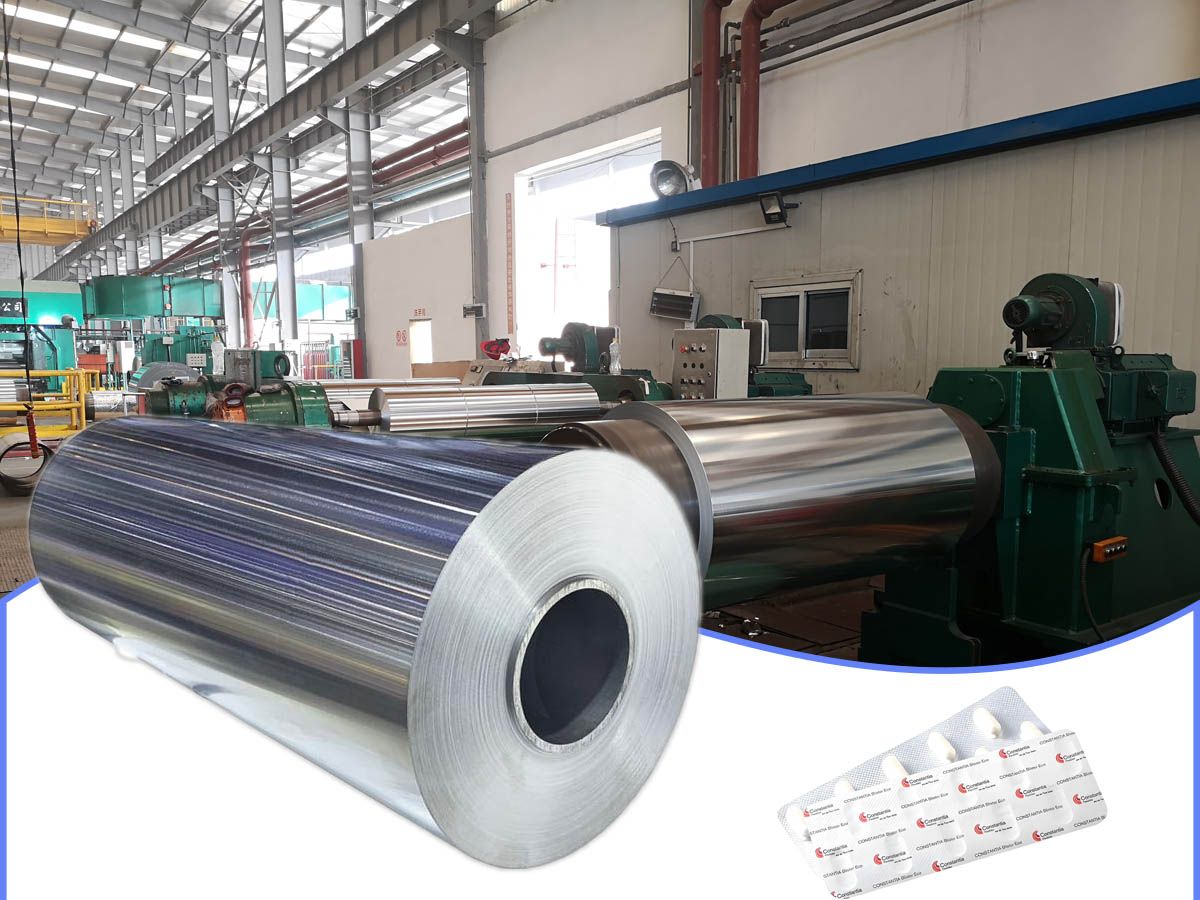
Specifications and Technical Parameters
| Alloy | 8011 / 8021 / 8079, etc. |
| Temper | O (Annealed) |
| Thickness | PTP Aluminum Foil: 20 μm, 23 μm, 25 μm (mainstream) Cold Forming Aluminum Foil: 45 μm, 50 μm, 60 μm Aluminum Foil for Laminated Pouches: 7 μm, 9 μm, 12 μm (double-zero foil) |
| Width | 200 - 1100 mm (customizable) |
| Length | 1000 - 16000 mm |
| Tensile Strength | ≥ 60 MPa |
| Elongation | ≥ 20% |
| Pinhole Density | ≤ 1 pinhole / m² (≤ 0.020 mm) |
| Applications | Tablets, capsules, pills, granules, etc. |
| MOQ | 1-3 tons |
Core Advantages of Flexible Aluminum Foil in Pharmaceutical Packaging
1. Ultimate Barrier Protection
Completely blocks light, oxygen, moisture vapor, and odors, preventing drug degradation, oxidation, and moisture absorption. This significantly extends shelf life and improves drug stability.
2. Safe and Non-Toxic
Manufactured from pharmaceutical-grade high-purity aluminum, with no heavy metal migration and no odor transfer. Coatings and adhesives comply with Chinese Pharmacopoeia, FDA, and European Union standards, fully meeting GMP requirements.
3. Excellent Processability
Annealed structure with high elongation and toughness allows compatibility with blister forming, cold forming, laminating, pouch making, and tube forming processes. Stable forming with low risk of cracking.
4. Reliable Heat-Sealing Performance
Special heat-seal coatings provide balanced sealing strength, excellent airtightness, smooth seals without leakage, and good peelability for easy patient access.
5. Printing and Identification Compatibility
Uniform surface treatment ensures strong ink adhesion and abrasion resistance. Suitable for gravure and flexographic printing, enabling clear printing of drug names, specifications, batch numbers, expiration dates, traceability codes, and anti-counterfeiting information.
Applications of Flexible Aluminum Foil in Different Pharmaceutical Packaging Forms
1. Blister Packaging (PTP Aluminum Foil – Most Common)
Structure: 20–25 μm aluminum foil → inner heat-seal coating (compatible with PVC / PP / PVDC) → outer protective lacquer / printed layer
Applications: Single-dose packaging for tablets, capsules, and pills, offering hygiene protection and convenient dispensing
2. Cold Forming Aluminum Foil (Alu-Alu – High Barrier)
Structure: Outer OPA (nylon, 25 μm) → aluminum foil (45–60 μm) → inner PVC / PE heat-seal layer
Applications: Highly sensitive drugs, biological products, and long-acting formulations requiring superior barrier performance
3. Aluminum Foil Laminated Pouches (Multi-Dose / Powder Packaging)
Structure: PET / PA / Aluminum Foil / PE multilayer laminates (e.g., PET + AL + PE)
Applications: Granules, powders, APIs, and bulk packaging for tablets or capsules
Quality Requirements for Pharmaceutical Aluminum Foil
Base Material Purity: Aluminum purity ≥ 99.7%, free from impurities, low pinhole rate (< 3 pinholes / m²)
Coating Performance: Stable heat-seal strength, peel strength, abrasion resistance, solvent resistance, and no migration
Hygienic Standards: Controlled heavy metals (lead, arsenic, mercury), low solvent residue (< 0.1 mg/m²), compliant microbial limits
Impact Resistance: Burst strength typically > 200 kPa, ensuring resistance to accidental damage during packaging and transport