
8011 aluminum foil is one of the most widely used products among 8-series aluminum alloys. Thanks to its excellent barrier properties, formability, corrosion resistance, and processing adaptability, it is extensively applied in food packaging, pharmaceutical packaging, food containers, bottle cap materials, cable foil, insulation materials, household aluminum foil, and other industries.
As an experienced aluminum foil manufacturer, MC Aluminum provides 8011 aluminum foil in various tempers, including O temper, H18 temper, H22 temper, and H24 temper. These tempers form a complete performance range from "extremely soft" to "fully hard."
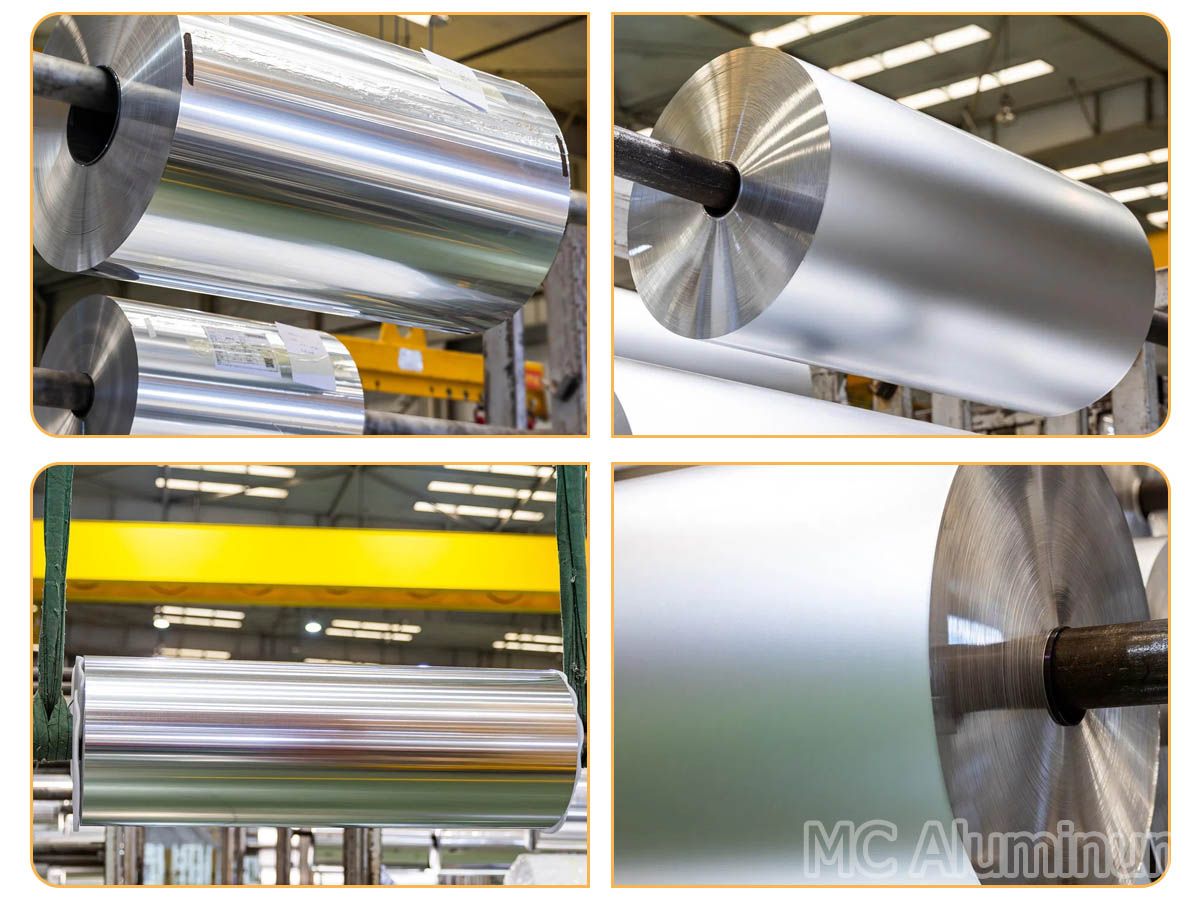
8011 O Temper Aluminum Foil
O temper refers to the fully annealed condition, meaning the aluminum foil has been completely softened through annealing treatment. In this state, internal stress is fully released, and the foil shows the lowest hardness and the highest ductility.
Key characteristics: Extremely soft; easily bent by hand with no significant spring-back; elongation exceeds 25%; clean surface free of residual oil.
Typical applications: Yogurt lidding film, cheese packaging, pharmaceutical aluminum foil blister packaging (for capsules and tablets), and easy-peel lidding film. O-temper pharmaceutical foil offers excellent flexibility and is commonly used for capsule and tablet packaging.
Precautions: Low hardness and poor scratch resistance; care must be taken to avoid scratching during transport and processing.
In terms of performance data, the tensile strength of O-temper aluminum foil typically ranges from 50 to 110 MPa (depending on thickness); elongation is approximately 0.5% for thicknesses of 0.006–0.009 mm but increases significantly as thickness rises.
8011 H18 Temper Aluminum Foil
H18 temper is a fully hard condition without annealing, obtained directly through high-reduction cold rolling. In this state, the crystal lattice inside the aluminum foil is highly compressed, and the strength reaches its peak.
Key Characteristics: Extremely high hardness; difficult to bend by hand, resulting in distinct creases; tensile strength ≥160 MPa; excellent rigidity, resistant to deformation or collapse; however, elongation is very low (approx. 3%), making it virtually non-stretchable.
Typical Applications: PTP pharmaceutical aluminum foil (rigid lidding for blister packs), air conditioner radiator fins, electronic shielding materials, and tape substrates (hard-temper foil used directly without annealing).
Precautions: Poor ductility; avoid forced stretching or bending during processing, as the material is prone to cracking.
8011 H22/H24 Temper Aluminum Foil
Both H22 and H24 belong to partially annealed tempers, positioned between hard temper and soft temper. They are produced by controlling the annealing temperature and time after cold rolling, achieving a specific balance between hardness and ductility.
H22 Temper: Moderate hardness (Vickers hardness approx. 40–50) and elongation ≥10%, offering a balance of rigidity and formability. Commonly used for toothpaste tubes, cosmetic tube liners, construction tape substrates, and food container stock. The tensile strength of H22-temper aluminum foil typically ranges from 90 to 150 MPa.
H24 Temper: Moderately high hardness (Vickers hardness approx. 55–65) and higher strength than H22, with an elongation of approximately 8%. Suitable for container foil (can bodies or non-stretched sections of can bottoms), automotive heat-shielding foil, and industrial wrap substrates. The tensile strength of H24-temper foil typically ranges from 120 to 170 MPa.
The choice between H22 and H24 tempers essentially involves balancing the need for sufficient softness for forming against the need for sufficient strength to resist deformation.
Mechanical Properties
| Temper | Hardness Feeling | Tensile Strength (MPa) | Elongation (%) | Typical Applications |
| 8011-O | Extremely soft | 70–100 | ≥20% | Pharmaceutical foil, household food foil, yogurt lid foil |
| 8011-H22 | Relatively soft | 100-140 | ≥10% | Shallow-drawn food containers, honeycomb aluminum core |
| 8011-H24 | Half-hard | 120-160 | ≥5% | Cable foil, bottle cap liners |
| 8011-H18 | Fully hard | 150-200 | ≤2% | Anti-theft wine bottle caps, cosmetic cap materials |
How to Choose the Right 8011 Aluminum Foil?
When purchasing 8011 aluminum foil, it is recommended to focus on the following aspects:
1. Define the Application Clearly
Different applications require different tempers. For example:
Household aluminum foil: O temper
Pharmaceutical PTP foil: H18 temper
Container foil: H24 temper
Flexible packaging: O temper or H22 temper
Choosing the correct temper according to the actual application helps improve processing efficiency and product performance.
2. Pay Attention to Thickness Range
Common thickness ranges include:
0.006–0.009 mm: Household aluminum foil
0.009–0.020 mm: Food packaging
0.020–0.050 mm: Container foil
0.060–0.200 mm: Industrial aluminum foil
The appropriate thickness should be selected according to product structure and processing requirements.
3. Check Surface Quality
High-quality 8011 aluminum foil should have the following characteristics:
Clean surface
No oil stains
No pinholes
No scratches
Uniform color
Neat winding
A high-quality surface helps improve printing, lamination, coating, and subsequent processing performance.
4. Choose a Reliable Supplier
A reliable aluminum foil supplier can usually provide:
Stable chemical composition control
Precise thickness tolerance
Complete quality inspection reports
Customized width, coil weight, and temper
Fast delivery and professional after-sales service
For food packaging and pharmaceutical packaging applications, it is also important to confirm whether the product complies with relevant standards such as FDA and EU food contact material regulations.
FAQ
Q: What is the biggest difference between 8011 O temper and H18 temper?
A: O temper is fully annealed, soft, and highly ductile, making it suitable for deep drawing and bending. H18 is a fully hard temper with high strength and hardness but lower ductility. It is suitable for products requiring higher rigidity, such as pharmaceutical foil and bottle cap materials.
Q: How should I choose between 8011 H22 and H24?
A: H22 has better flexibility and formability, making it suitable for general packaging applications. H24 has higher strength and is suitable for aluminum foil containers, container foil, and industrial packaging where higher rigidity is required.
Q: Does the temper of 8011 aluminum foil affect the price?
A: Yes, it may have some impact. Different tempers of 8011 aluminum foil involve differences in production process, annealing treatment, and performance control, so prices may vary.
However, the price of 8011 aluminum foil is also affected by factors such as thickness, width, order quantity, surface quality, packaging method, aluminum ingot price, and processing requirements.
When purchasing, it is not recommended to compare price alone. The correct temper should be selected according to the actual application.
Q: Can 8011 aluminum foil be customized in thickness and width?
A: Yes. Most manufacturers can customize thickness, width, coil weight, inner diameter, and different tempers such as O, H22, H24, and H18 according to customer requirements. This allows the foil to meet various needs in food packaging, pharmaceutical packaging, and industrial applications.
Q: How can I determine whether the quality of 8011 aluminum foil is qualified?
A: Key factors to check include thickness tolerance, surface quality, pinhole quantity, mechanical properties, chemical composition, and packaging integrity. It is also recommended to request material certificates and quality inspection reports from the supplier.
Q: Is 8011 aluminum foil suitable for food and pharmaceutical packaging?
A: Yes. 8011 aluminum foil that meets relevant food contact material standards is widely used in food packaging, pharmaceutical blister packaging, aluminum foil containers, bottle caps, and laminated packaging materials. It offers excellent barrier performance, safety, and processing properties.