
In the modern aluminum processing industry, 3003 aluminum foil is widely used in food packaging, container manufacturing, electronic materials, and industrial applications due to its excellent corrosion resistance, good formability, and moderate strength. However, during secondary processing such as stamping, drawing, and bending, friction and wear often affect product quality and production efficiency. Therefore, pre-lubrication technology has gradually become an important value-added process in 3003 aluminum foil processing.
What Is 3003 Pre-Lubricated Aluminum Foil?
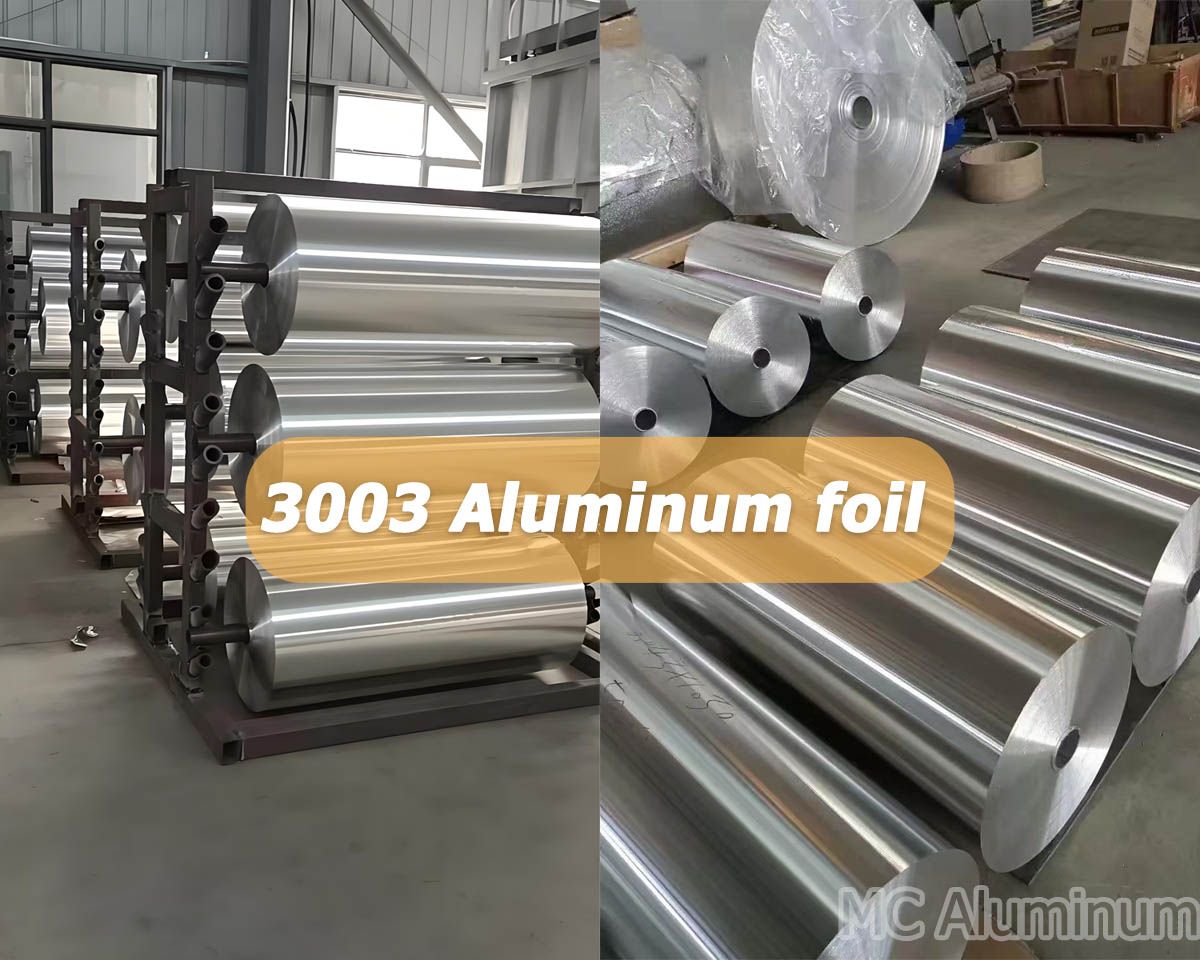
3003 aluminum foil is a typical Al-Mn alloy with good rust resistance, moderate strength, excellent elongation, and high processing plasticity. It is an ideal base material for manufacturing food trays and aluminum foil containers.
In practical applications, 3003 aluminum foil is usually supplied in H22 or H24 temper. Among them, H24 temper offers moderate hardness and excellent ductility. Through proper work-hardening treatment, it ensures that the material is not easy to crack during stamping while providing sufficient structural strength. This balance of properties is the key reason why 3003-H24 aluminum foil has become a preferred material for container manufacturing.
Pre-lubricated aluminum foil refers to aluminum foil that has been uniformly coated with an extremely thin layer of high-performance lubricant on the clean foil surface after rolling and annealing by the aluminum foil manufacturer. The lubricant is usually food-grade lubricating oil or a special water-based/oil-based resin film.
After lubrication, the aluminum foil is directly wound into coils for further processing. When downstream aluminum container manufacturers receive the material, they can put it directly onto the stamping machine without secondary oil spraying.
Performance Advantages of 3003 Aluminum Alloy Foil
1.Excellent Rust and Corrosion Resistance
The addition of manganese significantly improves the alloy's resistance to atmospheric and chemical corrosion. Especially in humid, weakly acidic, and weakly alkaline environments, its rust resistance is much better than that of pure aluminum foil, making it suitable for food, chemical, and other applications that require high material stability.
2.Outstanding Formability and Processability
3003 aluminum alloy combines good strength and ductility. Its tensile strength is approximately 110–145 MPa, and its elongation can reach 10%–20%. It is suitable for high-speed stamping, deep drawing, rolling, bending, and other complex forming processes, with low risk of cracking, wrinkling, and other defects.
3.Stable Thermal and Electrical Conductivity
The thermal conductivity of 3003 aluminum foil is approximately 160–190 W/(m·K), and its electrical conductivity is about 80% of pure aluminum. It can meet the heat conduction requirements of heat exchange equipment and is also suitable for basic applications such as electronic shielding and heat dissipation components.
4.Excellent Balance Between Cost and Performance
Compared with higher-strength alloys such as 3004 and 5052, 3003 aluminum alloy has greater advantages in cost control while still offering good rust resistance and processability. It provides excellent cost performance and is suitable for large-scale industrial applications.
Technical Parameters of 3003 Pre-Lubricated Aluminum Foil
| Item | Technical Parameter |
| Alloy Grade | 3003 |
| Temper | O / H14 / H16 / H18 / H24 |
| Thickness Range | 0.02 mm – 0.20 mm |
| Width Range | 50 mm – 1600 mm |
| Coil Weight | 100 kg – 2000 kg |
| Inner Diameter | 76 mm / 152 mm |
| Outer Diameter | ≤ 800 mm |
| Lubrication Type | Oil-based / Dry film / Water-based |
| Coating Weight | 0.5 – 3.0 g/m² |
| Coefficient of Friction, COF | 0.05 – 0.15 |
| Lubricant Layer Adhesion | ≥ Grade 0, no peeling |
| Surface Finish | One side bright / Double side bright / Matte |
| Tensile Strength | 95 – 160 MPa |
| Elongation | ≥ 5% – 25% |
| Electrical Conductivity | ≥ 40% IACS |
| Surface Cleanliness | Meets food-grade or industrial-grade standards |
| Lubricant Type | Food grade / Industrial grade |
| Applications | Food containers, pharmaceutical packaging, electronic materials, industrial stamped parts |
| MOQ | 1-3 tons |
Pre-Oiling Methods for Aluminum Foil
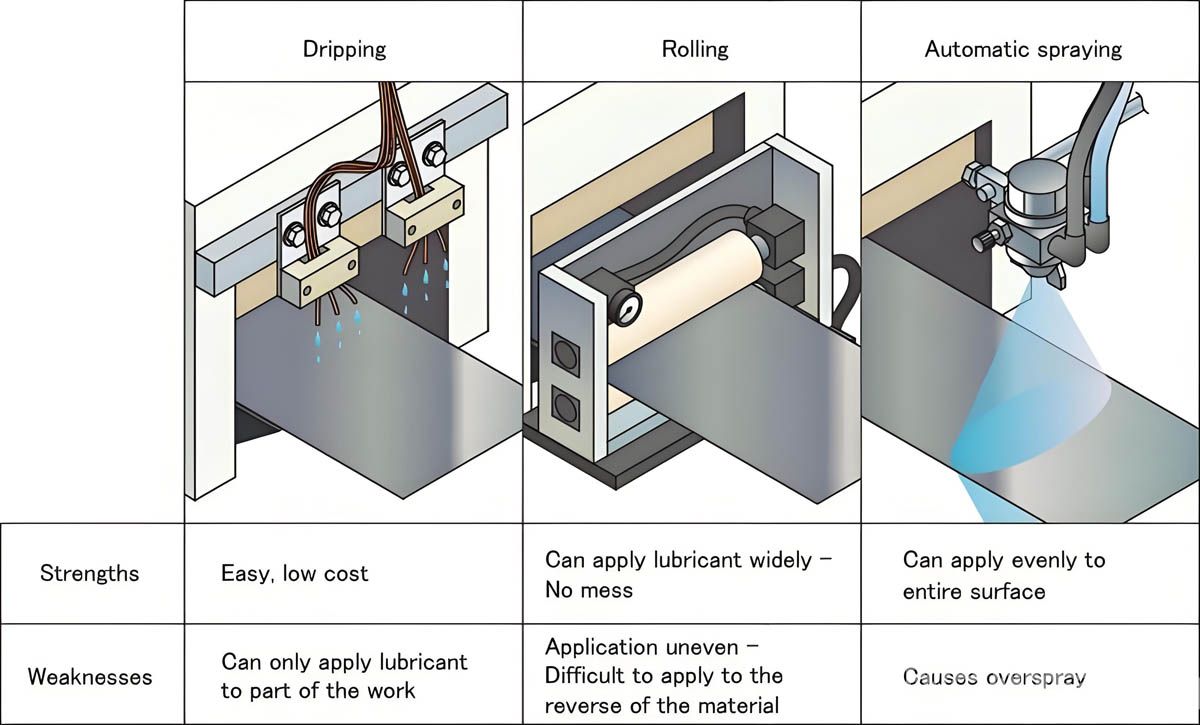
The traditional oiling method is mainly roller coating. Roller coating is the most basic oiling method. However, when roller coating is used for aluminum foil surface oiling, it often causes uneven oil distribution on the foil surface, which may lead to unstable production during stamping.
If the oil amount is too low, the lubrication effect is not obvious, and the aluminum foil may be scratched or abraded. If the oil amount is too high, the aluminum foil may stick to the stamped parts, causing various production problems.
Inspired by the anti-rust surface treatment methods used in the steel strip industry, electrostatic spraying has been introduced for aluminum foil surface treatment. This method provides excellent coating uniformity. The oil film thickness is controllable and highly consistent across the entire width of the foil. It also saves oil consumption and has received positive feedback from many customers.
Process Flow of 3003 Pre-Lubricated Aluminum Foil
1. Base Material Preparation and Cleaning
After fine rolling, 3003 aluminum foil must undergo thorough annealing and degreasing treatment to ensure that the surface is free of residual oil and aluminum powder. This helps ensure good adhesion of the lubricating coating.
2. Precision Coating
High-precision coating equipment is used to evenly apply a controlled amount of food-grade lubricant to one side or both sides of the aluminum foil.
3. Curing and Cooling
The lubricating film is stabilized and cured through a drying tunnel, followed by rapid cooling to prevent blocking or sticking during winding.
4. Online Inspection
The coating thickness and uniformity are monitored in real time by online thickness gauges to ensure stable product quality for every batch.
Applications of 3003 Pre-Oiled Aluminum Foil
Food Packaging Industry:Aluminum food containers, baking aluminum foil, food retort pouches, yogurt lid foil
HVAC and Heat Exchange Industry:Air conditioner fins, heat exchanger aluminum foil, heat dissipation fins
Electronics Industry:Electronic shielding covers, heat dissipation aluminum foil, base material for aluminum-plastic film used in lithium battery soft packs
Building Insulation Industry:Thermal insulation aluminum foil rolls, air duct insulation aluminum foil, roof reflective insulation aluminum foil
General Industry:Stamped parts, hardware accessories, chemical anti-corrosion liners
MC Aluminum Foil is a professional aluminum foil manufacturer. We supply pre-oiled aluminum foil for stamping various containers, with commonly used alloys including 8011, 3003, 3004, 1145, etc. The thickness range is 0.02-0.08 mm, and the oil coating thickness is 150-400 mg/m².
In fact, whether you should purchase lubricated aluminum foil or non-lubricated aluminum foil depends on your production requirements. If your machine is equipped with its own lubrication function, you only need to purchase non-lubricated aluminum foil. If your machine does not have a lubrication function, then lubricated aluminum foil is required for aluminum foil production.