
MC Aluminum produces 14 micron battery-grade aluminum foil, a thin-gauge aluminum foil specifically designed for lithium-ion battery cathode current collectors. It is typically manufactured from aluminum materials that meet battery application requirements through melting and casting, rolling, precision thickness control, slitting, and other processes. The foil features low thickness, light weight, good electrical conductivity, and suitability for continuous electrode coating operations.
14 micron battery-grade aluminum foil, also known as 0.014 mm high-purity aluminum foil, is specifically used as the current collector for lithium-ion battery cathodes. It carries and supports cathode active material slurries, including lithium iron phosphate (LFP), ternary NCM materials, and lithium cobalt oxide (LCO), while collecting and conducting the electrical current generated at the cathode.
In a typical lithium-ion battery structure, cathode active materials are coated onto an aluminum foil substrate. As the cathode current collector, the aluminum foil collects electrons generated by the active material and conducts the current to the tabs and external circuit.
Battery aluminum foil is commonly made from high-purity aluminum alloys such as 1060, 1070, 1100, and 1235. Its main component is aluminum, generally with an aluminum content above 99.5%, along with small amounts of silicon, iron, copper, and other trace elements. Due to its simple composition and stable properties, it is widely used as a cathode current collector in lithium-ion batteries.
Other Thickness Options for Battery-Grade Aluminum Foil
16–20 μm: Traditional thicker aluminum foil with higher tensile strength and a lower coating scrap rate. However, its higher proportion of inactive metal reduces overall battery energy density.
14 μm: A widely used balance between lightweight design and mechanical strength. It reduces weight and supports higher energy density while retaining sufficient strength for high-speed coating, calendering, slitting, and winding processes. It is suitable for stable mass production.
12 μm and below: Provides further weight reduction and higher energy density, but places much stricter requirements on production equipment, cleanliness, foil mechanical properties, and process control. Manufacturing costs and scrap risks also increase significantly.
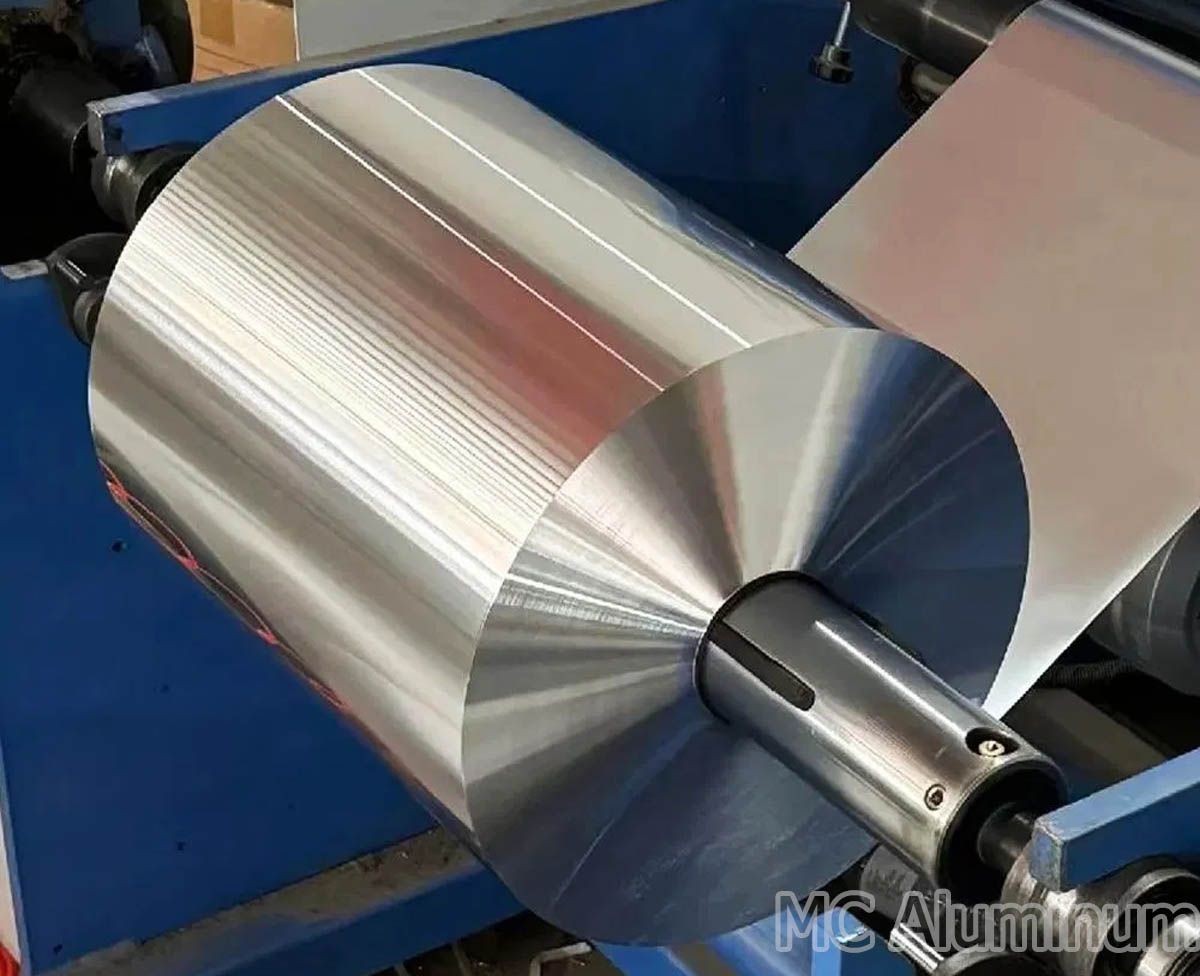
Main Features of 14 μm Aluminum Foil
Lightweight: Reduces the mass of the current collector per unit area, creating more room for battery energy density optimization.
Good electrical conductivity: Provides a conductive substrate for electron transport at the cathode.
Good processing adaptability: Suitable for continuous coating, calendering, slitting, and other electrode manufacturing processes.
High thickness-control requirements: Helps maintain stable electrode structure and coating performance.
Suitable for large-scale production: With stable quality control, it can meet the requirements of continuous battery manufacturing lines.
Why Do Lithium-Ion Battery Cathodes Use Aluminum Foil Current Collectors?
1. Electrical Conductivity
As a high-purity aluminum material, 14 micron battery-grade aluminum foil has good electrical conductivity. Its resistivity is approximately 0.0282 Ω·mm²/m, second only to copper among commonly used conductive metals. This makes it an ideal cathode current collector material, helping reduce electrical energy loss and improve battery efficiency.
2. Lightweight Properties
Aluminum has a density of approximately 2.7 g/cm³, which is significantly lower than that of copper and many other metals. Its lightweight nature is important for improving the gravimetric energy density of batteries.
3. Chemical Stability
Under high-voltage charge and discharge cycling conditions, aluminum foil demonstrates good electrochemical corrosion resistance when used as a cathode current collector in suitable battery systems.
4. Coating Adhesion
Stable surface wettability helps lithium iron phosphate, ternary cathode materials, lithium cobalt oxide, and other cathode slurries coat evenly onto the foil surface.
5. Mechanical Properties
The foil provides appropriate tensile strength and elongation, helping prevent strip breakage during slitting, coating, calendering, and winding operations.
6. Edge Quality
Smooth slit edges with minimal burrs help improve electrode processing efficiency and reduce the risk of internal short circuits.
7. Suitable for High-Volume Battery Production
Different widths, coil diameters, coil weights, and core inner diameters can be supplied to meet the requirements of automated battery production lines.
8. High Surface Cleanliness
The surface should be free from visible oil stains, dents, oxidation spots, pinholes, and foreign particles, helping ensure uniform adhesion of cathode slurry.
9. Cost Efficiency
Compared with materials such as copper foil, 14 micron battery-grade aluminum foil generally has a lower material cost, offering a significant economic advantage in battery manufacturing.
Technical Specifications of Lithium Battery-Grade Aluminum Foil
| Item | Data |
| Alloy | 1050, 1060, 1100, 1235, etc. |
| Temper | H18, H19 |
| Width | 300 mm |
| Thickness | 14 ± 1 μm |
| Length | 16,000 mm |
| Inner Diameter | 76 mm, 152 mm, 300 mm |
| Areal Density | 30–34 g/m² |
| Transverse Surface Density Uniformity | ≤ 0.003 g / 40 × 40 mm |
| Longitudinal Surface Density Uniformity | ≤ 0.03 g / 400 × 40 mm |
| High-Temperature Oxidation Resistance, 200°C × 30 min | No oxidation |
| Splice Quantity | < 2 |
| Chemical Composition, Al | > 99.45% |
| Expandability | Less than 0.5% |
| Tensile Strength at Room Temperature | > 141 kgf/mm² |
| Tensile Strength After 1 Hour of Baking at 1200°C | > 122 kgf/mm² |
| Tensile Strength | ≥ 190 MPa |
| Elongation After Fracture | ≥ 2.5% |
Applications of 14 Micron Battery-Grade Aluminum Foil in Lithium-Ion Batteries
1. Electric Vehicle Batteries
In EV batteries, cathode current collectors must withstand relatively high current loads and elevated operating temperatures. With good electrical conductivity and controlled thickness, 14 micron battery-grade aluminum foil can help reduce resistance and heat generation, supporting battery performance and safety.
2. Mobile Phone and Laptop Batteries
For mobile phones and laptop batteries, cathode current collectors need to support lightweight and high-energy-density designs. Due to its thin gauge and good conductivity, 14 micron aluminum foil can help reduce battery volume and weight while maintaining efficient current collection.
3. Renewable Energy Storage Batteries
In renewable energy storage systems, cathode current collectors require good heat dissipation and long-term durability. With favorable thermal conductivity and corrosion resistance, 14 micron battery-grade aluminum foil can help improve battery heat management and service life.
4. Industrial Batteries
In industrial battery applications, cathode current collectors require reliable mechanical strength and durability. The mechanical properties and corrosion resistance of 14 micron battery-grade aluminum foil can contribute to improved battery reliability and operating life.
Battery-Grade Aluminum Foil vs. Ordinary Packaging Aluminum Foil
Battery-grade aluminum foil for lithium-ion batteries is not the same product as ordinary food packaging aluminum foil. The two products differ significantly in terms of production environment, quality-control objectives, and performance requirements. They should not be used interchangeably.
1. Production Environment
Battery aluminum foil is rolled and slit in a controlled clean production environment, with strict limits on dust and particle contamination. Ordinary aluminum foil generally does not have the same cleanliness requirements. Surface particles may create micro-short-circuit risks inside battery cells.
2. Pinhole Control
Battery-grade aluminum foil has strict limits on the number and size of pinholes per square meter. Even very small pinholes may create potential battery safety risks. Packaging foil may allow a limited number of pinholes depending on its application.
3. Impurity Control
Battery-grade foil is made from high-purity aluminum with tightly controlled impurity levels. Ordinary aluminum foil may have less stringent impurity requirements, which can increase the risk of electrochemical side reactions in battery applications.
4. Flatness and Mechanical Consistency
Battery aluminum foil requires excellent flatness and uniform elongation to support continuous high-speed coating over long production lengths. Ordinary packaging foil may be more prone to wrinkling and unstable elongation, increasing the risk of strip breakage during electrode production.
5. Surface Dyne Level and Wettability
Battery aluminum foil is cleaned and surface-activated to ensure proper wetting and adhesion of NMP-based cathode slurry. Ordinary aluminum foil may contain oil residues or release agents, which can lead to slurry delamination and active material shedding.
FAQ
Q1: What is 14 μm battery-grade aluminum foil mainly used for?
It is mainly used as a cathode current collector in lithium-ion batteries, where it collects and conducts electrons. It can be used for lithium iron phosphate, ternary lithium, and other battery chemistries, provided that it meets the specific battery design and manufacturing requirements.
Q2: Is thinner 14 μm aluminum foil always better?
Not necessarily. Reducing foil thickness helps lower current collector weight, but it can also reduce mechanical strength and increase process-control difficulty during coating, calendering, slitting, and winding. Energy density, conductivity, coating process requirements, and production yield should all be considered.
Q3: Which alloys are commonly used for battery-grade aluminum foil?
Common alloy options include 1060, 1070, and 1235. The specific alloy should be selected according to material standards, performance requirements, and supplier production capability. Different alloys should not be considered directly interchangeable based only on aluminum content or alloy name.
Q4: Which quality indicators should be tested for 14 μm aluminum foil?
Key inspection items include thickness and thickness uniformity, width tolerance, pinhole quantity, surface defects, tensile strength, elongation, edge burrs, coil winding quality, surface cleanliness, and flatness. Specific test methods and acceptance limits should be clearly defined in the purchasing technical agreement.