
As an important component of lithium-ion batteries, the cathode current collector does not directly participate in the main electrochemical reactions. However, it has a significant impact on electron transport, active material adhesion, electrode processing performance, and the overall performance of the battery. Carbon-coated aluminum foil has been developed as a functional battery aluminum foil to address these requirements.
What Is Carbon-Coated Aluminum Foil?
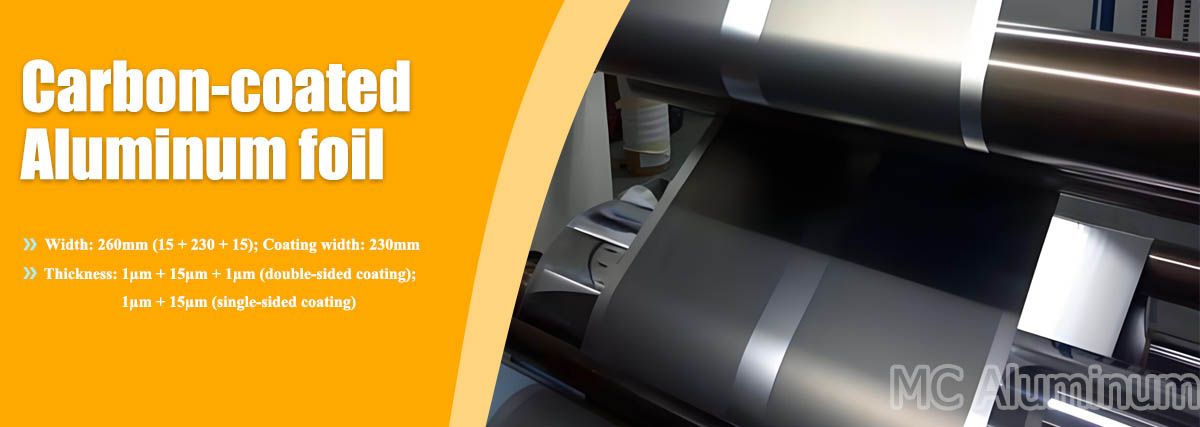
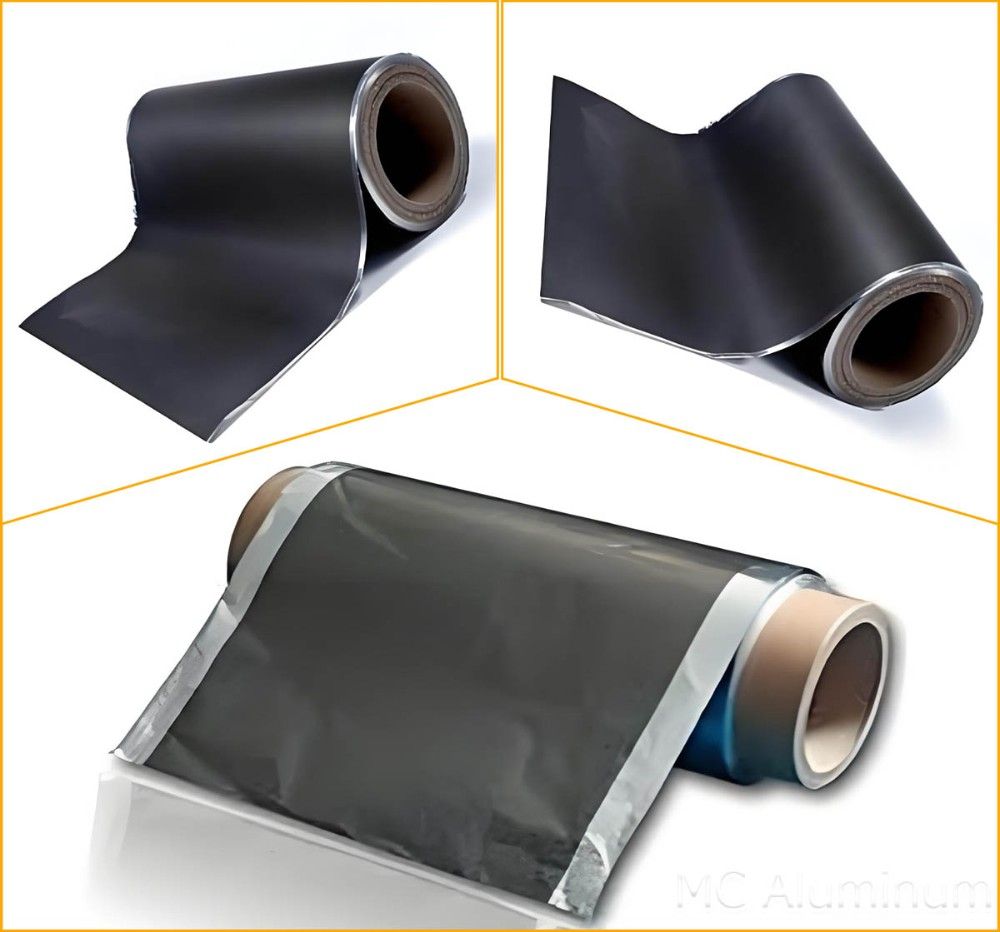
Carbon-coated aluminum foil, also known as carbon coating aluminum foil, conductive carbon aluminum foil, or carbon-coated current collector foil, is a composite material made by applying a layer of nanoscale conductive carbon material onto the surface of conventional aluminum foil.
It is typically produced by combining nano-conductive graphite with aluminum foil through a roll-to-roll coating process. This process forms conductive carbon layers on both sides of the aluminum foil, usually with a coating thickness of approximately 2 μm per side.
Traditional lithium-ion battery cathode current collectors generally use aluminum foil. Cathode active materials, such as lithium iron phosphate (LFP), nickel cobalt manganese (NCM/NCA) materials, and lithium cobalt oxide (LCO), are mixed with binders and conductive additives to form a slurry, which is then coated onto the surface of the aluminum foil.
However, conventional bare aluminum foil may exhibit relatively weak adhesion to cathode active materials. Its corrosion resistance in electrolyte may also be limited, and aluminum oxide films can form on its surface. These factors may affect battery performance and service life. Carbon-coated aluminum foil was developed to address these issues.
According to the coating chemistry, carbon-coated aluminum foil can generally be divided into water-based coating products and solvent-based coating products. Based on the number of coated surfaces, it can also be classified as single-sided or double-sided carbon-coated aluminum foil. At present, double-sided carbon-coated aluminum foil is the mainstream product on the market and is widely used as a cathode current collector in LFP power batteries and lithium-sulfur batteries.
Key Performance Advantages of Carbon-Coated Aluminum Foil
1. Improved Interfacial Conductivity
The carbon coating has good electrical conductivity. It can fill microscopic irregularities on the aluminum foil surface and increase the effective contact area between the active material and the current collector.
During cathode operation, electrons can be transported through a more continuous conductive network, thereby reducing interfacial contact resistance.
This advantage is particularly important for batteries requiring high rate capability and high power performance.
2. Enhanced Adhesion of Cathode Materials
The carbon coating can improve interfacial compatibility between the aluminum foil and the cathode slurry.
Compared with directly coating cathode materials onto bare aluminum foil, a carbon coating provides a more suitable surface structure for active material adhesion. This helps enhance the bonding strength between the electrode coating and the current collector.
This is especially important for subsequent manufacturing processes, including calendering, slitting, winding, and stacking.
3. Reduced Interfacial Contact Resistance
Battery internal resistance consists of several components, and the interface between the current collector and the active material is one of the important factors.
High-quality carbon-coated aluminum foil can optimize interfacial contact and reduce contact resistance, helping improve the overall internal resistance performance of the battery.
4. Improved Cycling Stability
During repeated charge and discharge cycles, cathode materials undergo a certain degree of volume change and structural evolution.
If the active material is not firmly bonded to the current collector, localized delamination and deteriorated electrical contact may occur after long-term cycling.
The carbon coating can strengthen interfacial bonding and maintain stable electron transport pathways, thereby helping improve electrode stability during long-term cycling.
5. Better Electrode Processing Performance
For lithium-ion battery manufacturers, current collectors must not only meet electrochemical performance requirements but also be suitable for continuous coating, drying, calendering, slitting, and winding processes.
High-quality carbon-coated aluminum foil typically has a uniform surface condition and stable coating adhesion, helping reduce the risk of coating detachment, powder shedding, and related processing defects.
6. Suitable for High-Rate Charge and Discharge
Under high-rate charging and discharging conditions, the transport efficiency of electrons and lithium ions directly affects battery power performance.
By optimizing the electron transport path between the cathode material and the current collector, the carbon coating can help reduce polarization and improve electron conductivity. It is therefore suitable for battery systems that require high rate performance.
Typical Structure of Carbon-Coated Aluminum Foil
A typical carbon-coated aluminum foil consists of three main components:
1. Aluminum Foil Substrate
Aluminum foil is the base material of the composite and primarily functions as the current collector.
Aluminum foil used as a cathode current collector in lithium-ion batteries generally requires high purity, good electrical conductivity, stable mechanical properties, and excellent surface quality.
Common substrate alloys are mainly high-purity 1xxx series aluminum alloys, such as 1050, 1060, 1070, and 1235. The specific alloy grade and temper should be selected according to the battery manufacturer’s processing requirements.
2. Conductive Carbon Coating
The conductive carbon coating is the key feature that distinguishes carbon-coated aluminum foil from standard battery aluminum foil.
Depending on product design, the coating may use different conductive carbon materials, including conductive carbon black, graphite, and carbon nanomaterials.
Different carbon materials vary in conductivity, specific surface area, dispersibility, and cost. Therefore, the coating formulation should be designed according to the cathode material system and battery performance requirements.
3. Functional Binder System
A suitable binder system is required to firmly attach the carbon materials to the aluminum foil surface.
The binder system must ensure good adhesion between the coating and the aluminum foil while also providing electrochemical stability, coating flexibility, and compatibility with downstream electrode manufacturing processes.
Carbon-Coated Aluminum Foil Specifications
| Item | Reference Specification |
| Product Name | Carbon-Coated Aluminum Foil for Battery Cathodes |
| Common Aluminum Alloys | 1050, 1060, etc. |
| Aluminum Foil Temper | O, H18, etc. |
| Aluminum Foil Thickness | 8-30 μm |
| Common Thicknesses | 10 μm, 12 μm, 15 μm, 16 μm, 20 μm |
| Product Width | 100-1500 mm, customizable |
| Carbon Coating | Single-sided or double-sided |
| Carbon Coating Thickness | Typically about 0.5–3 μm per side; customizable upon request |
| Surface Condition | Flat, clean, and free from obvious scratches, particles, wrinkles, and other defects |
| Coating Uniformity | High uniformity, suitable for continuous electrode coating |
| Coil Form | Jumbo roll / coil |
| Coating Type | Single-sided carbon coating or double-sided carbon coating |
| Typical Applications | Cathodes for LFP, NCM, NCA, LCO, and other lithium-ion batteries |
| Packaging | Moisture-proof and contamination-resistant packaging designed for battery materials |
| Customization Service | Foil thickness, width, coating thickness, coating formulation, and other specifications can be customized |
Which Cathode Materials Are Suitable for Carbon-Coated Aluminum Foil?
Carbon-coated aluminum foil can be used in a wide range of lithium-ion battery cathode systems.
1. Lithium Iron Phosphate (LFP)
Lithium iron phosphate offers high safety, long cycle life, and clear cost advantages. It is an important cathode material for power batteries and energy storage batteries.
Since LFP has relatively low intrinsic electronic conductivity, improving the electron transport network is especially important.
Carbon-coated aluminum foil can optimize interfacial contact between the LFP cathode material and the current collector, making it highly valuable in LFP battery applications.
2. Ternary Cathode Materials
Ternary materials such as NCM and NCA offer high energy density and are widely used in electric vehicle power batteries.
For high-nickel ternary cathode systems, electrode interfacial stability, electrode processing performance, and long-term cycling performance are all important considerations.
Carbon-coated aluminum foil can serve as one of the materials used to optimize the cathode current collector interface.
3. Lithium Cobalt Oxide (LCO)
Lithium cobalt oxide has long been used in consumer electronics such as smartphones, tablets, and laptop computers.
For high-energy-density and high-rate applications, stable electron transport pathways and strong electrode adhesion are essential.
Therefore, carbon-coated aluminum foil can also be used in certain LCO cathode systems.
What Is the Difference Between Carbon-Coated Aluminum Foil and Standard Battery Aluminum Foil?
| Comparison Item | Standard Battery Aluminum Foil | Carbon-Coated Aluminum Foil |
| Basic Structure | Aluminum foil | Aluminum foil + conductive carbon coating |
| Surface Structure | Metallic aluminum surface | Functionalized conductive surface |
| Interfacial Contact | Depends on the aluminum foil and slurry system | Generally provides improved interfacial contact |
| Active Material Adhesion | Conventional | Generally stronger |
| Interfacial Resistance | Conventional | Helps reduce interfacial resistance |
| Cycling Stability | Depends on the overall electrode system | Helps improve interfacial stability |
| Cost | Relatively lower | Relatively higher |
| Suitable Applications | Conventional lithium-ion batteries | Battery systems with higher performance requirements |