
Aluminum foil combines aluminum's excellent electrical conductivity with strong formability. It can be stably rolled into ultra-thin foil with a thickness of 0.0045 mm and above, and is widely used in the capacitor industry.
Capacitor aluminum foil is mainly used in high-voltage capacitors, electric heating capacitors, electronic capacitors, and transformer capacitors. The capacitor aluminum foil supplied by us offers uniform thickness tolerance of ±3%, strict width tolerance of ±0.5 mm, and flat coil edges with an end-face tolerance of ±0.1 mm. These indicators are designed to meet demanding capacitor manufacturing requirements.
Our advanced packaging methods provide cleanliness, moisture resistance, and convenient handling, earning positive feedback from capacitor manufacturers in domestic and international markets.
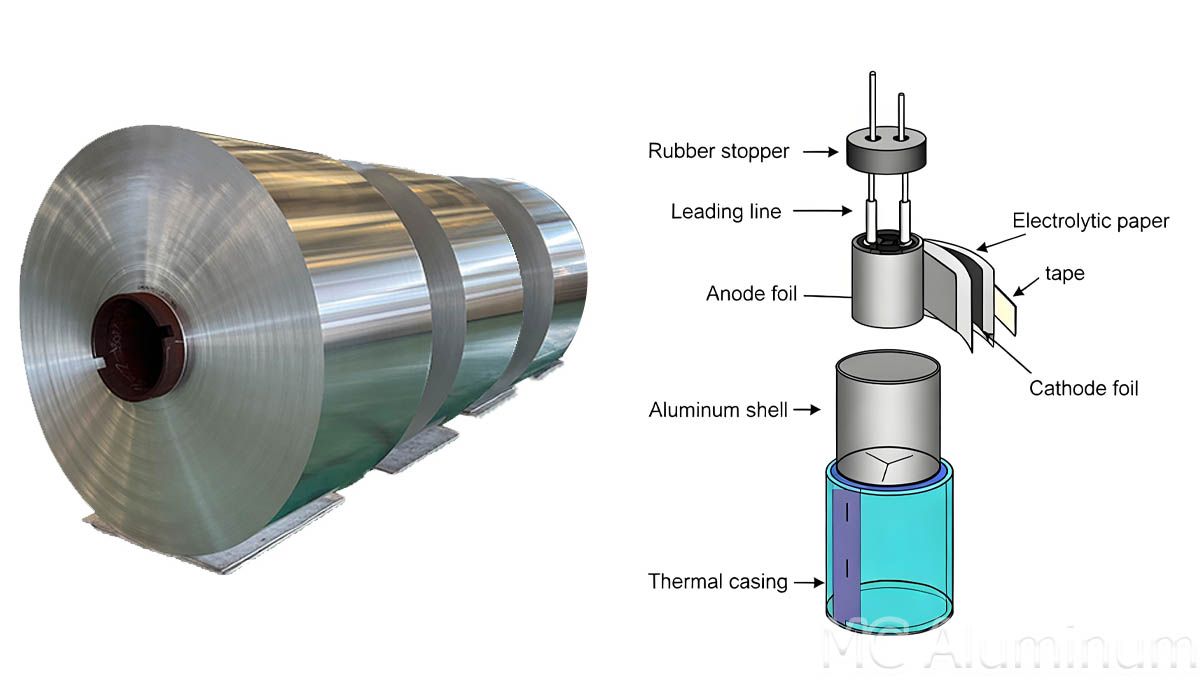
What Is 1235 O Temper Aluminum Foil?
1235 O temper aluminum foil is a soft aluminum foil product made primarily from high-purity aluminum through precision rolling and annealing processes. With good electrical and thermal conductivity, stable chemical composition, excellent ductility, and reliable processing performance, 1235 O aluminum foil is widely used in electronic capacitor foil, composite materials, electronic shielding, and other precision processing applications.
In electronic capacitor manufacturing, it is one of the commonly used and important base materials.
1235 aluminum belongs to the industrial pure aluminum series. Its aluminum content is generally no less than 99.35%, providing high purity and relatively low impurity content. Compared with aluminum alloys containing more alloying elements, 1235 aluminum offers better electrical conductivity, ductility, softness, and corrosion resistance.
"O" refers to the fully annealed soft temper. After complete annealing, the internal structure of the foil becomes more stable, while hardness is reduced and flexibility is improved. This makes the material suitable for slitting, rewinding, stamping, embossing, etching, formation, and other downstream processing operations.
For electronic capacitor applications, 1235-O aluminum foil is typically supplied in thicknesses from 0.0045 mm to 0.09 mm, covering a wide range of specifications from miniature electronic components to power electronic capacitors.
For electronic capacitor manufacturers, the main benefit of selecting 1235 O temper aluminum foil is its ability to provide a stable substrate for subsequent electrochemical etching and oxide film formation processes. This contributes to improved product consistency and processing efficiency.
Performance Advantages of 1235 Capacitor Aluminum Foil
High Purity and Good Electrical and Thermal Conductivity
Produced from high-purity aluminum with low impurity content, 1235 aluminum foil offers good electrical and thermal conductivity. Its stable composition helps reduce batch-to-batch variation and supports stable etching and formation processes, contributing to improved production yield.
O Temper Softness and Excellent Ductility
After annealing, the foil is soft, flexible, and easy to process. It is suitable for slitting, rewinding, stamping, embossing, and other deep-processing operations.
Its good ductility helps reduce the risk of cracking, strip breakage, and wrinkling, while enabling compatibility with high-speed processing equipment.
Good Etching Consistency and Stable Specific Capacitance
With a uniform grain structure, 1235 O aluminum foil can provide more consistent etching point distribution and orderly etching tunnel formation. This helps avoid localized over-etching or under-etching.
As a result, the specific capacitance can be controlled more consistently, capacity variation among capacitors from the same batch can be reduced, and finished product yield can be improved.
Uniform Thickness for Precision Processing
Good control of thickness tolerance, width accuracy, and coil flatness helps maintain consistency during etching and formation processes. It also improves the operating efficiency of automated processing equipment.
Stable Surface Quality
The foil surface is flat and clean. Surface defects such as oil contamination, scratches, dents, pinholes, and black lines can be controlled according to customer requirements.
Stable surface quality supports subsequent etching, formation, and composite processing, reducing material loss caused by surface defects.
Good Corrosion Resistance and Broad Processing Adaptability
Industrial pure aluminum naturally forms a dense oxide film on its surface, providing good corrosion resistance. After further treatment, 1235 O aluminum foil can adapt to different processing environments and application requirements.
It provides a reliable foundation for capacitor etching and formation processes.
Environmentally Friendly and Recyclable
As an aluminum product, 1235 O aluminum foil is highly recyclable and supports greener manufacturing practices.
Typical Specifications of 1235 O Aluminum Foil
| Item | Specification |
| Alloy | 1235 |
| Temper | O temper, fully annealed soft condition |
Aluminum Content | Al ≥ 99.35% |
| Thickness | 0.005 mm–0.12 mm; common capacitor foil thicknesses include 6μm, 7μm, 8μm, 9μm, and 10μm |
| Width | 3 mm–1600 mm, precision slitting available |
| Length | 1000 mm–16000 mm |
| Surface | Double-sided bright finish; one-side bright finish available upon request |
| Standards | GB/T 3198, ASTM B479 |
| Elongation | ≥18%, subject to slight variation depending on thickness |
| Electrical Conductivity | Available according to customer technical requirements |
| Surface Roughness | Ra ≤ 0.5μm |
| Tensile Strength | Available according to thickness and temper requirements |
| Bending Radius | ≥3 times the material thickness |
| Operating Temperature Range | -55°C to +125°C |
| Packaging | Moisture-proof, oxidation-resistant, and damage-resistant packaging |
| MOQ | 1–3 tons |
Main Applications
1.Aluminum Electrolytic Capacitors
Used in power filtering, voltage stabilization, and other functions in electronic circuits.
2.Consumer Electronics
Widely used in televisions, computers, power adapters, smartphones, chargers, and other consumer electronic products.
3.Industrial Equipment
Suitable for inverters, frequency converters, UPS power systems, industrial control systems, and related electrical equipment.
4.New Energy Applications
Used in electric vehicles, photovoltaic inverters, wind power systems, energy storage equipment, and charging infrastructure.
Telecommunications
Applied in base-station power supplies, communication equipment modules, network power systems, and related electronic devices.
Quality Control of 1235 O Aluminum Foil
Capacitors are electronic components with high requirements for material consistency. Therefore, strict quality control is essential throughout the production of 1235 O aluminum foil.
To ensure that 1235 O aluminum foil meets downstream processing requirements, the following aspects should be carefully controlled:
1.Raw Material Control
The chemical composition of the aluminum raw material is strictly controlled to ensure that the alloy meets the requirements of the 1235 standard.
2.Rolling Precision
Multi-pass precision rolling is used to control foil thickness and transverse thickness distribution.
3.Annealing Process
Annealing temperature and holding time are carefully controlled to ensure uniform O temper softness and stable mechanical properties.
4.Surface Inspection
The foil surface is inspected for oil stains, scratches, pinholes, dents, black lines, and other defects that may affect performance.
5.Slitting Quality
Coil width, edge burrs, coil end-face flatness, winding tightness, and edge quality are controlled to meet customer processing requirements.
6.Packaging Protection
Appropriate moisture-proof and dust-proof packaging is used to prevent damage, oxidation, or contamination during transportation and storage.
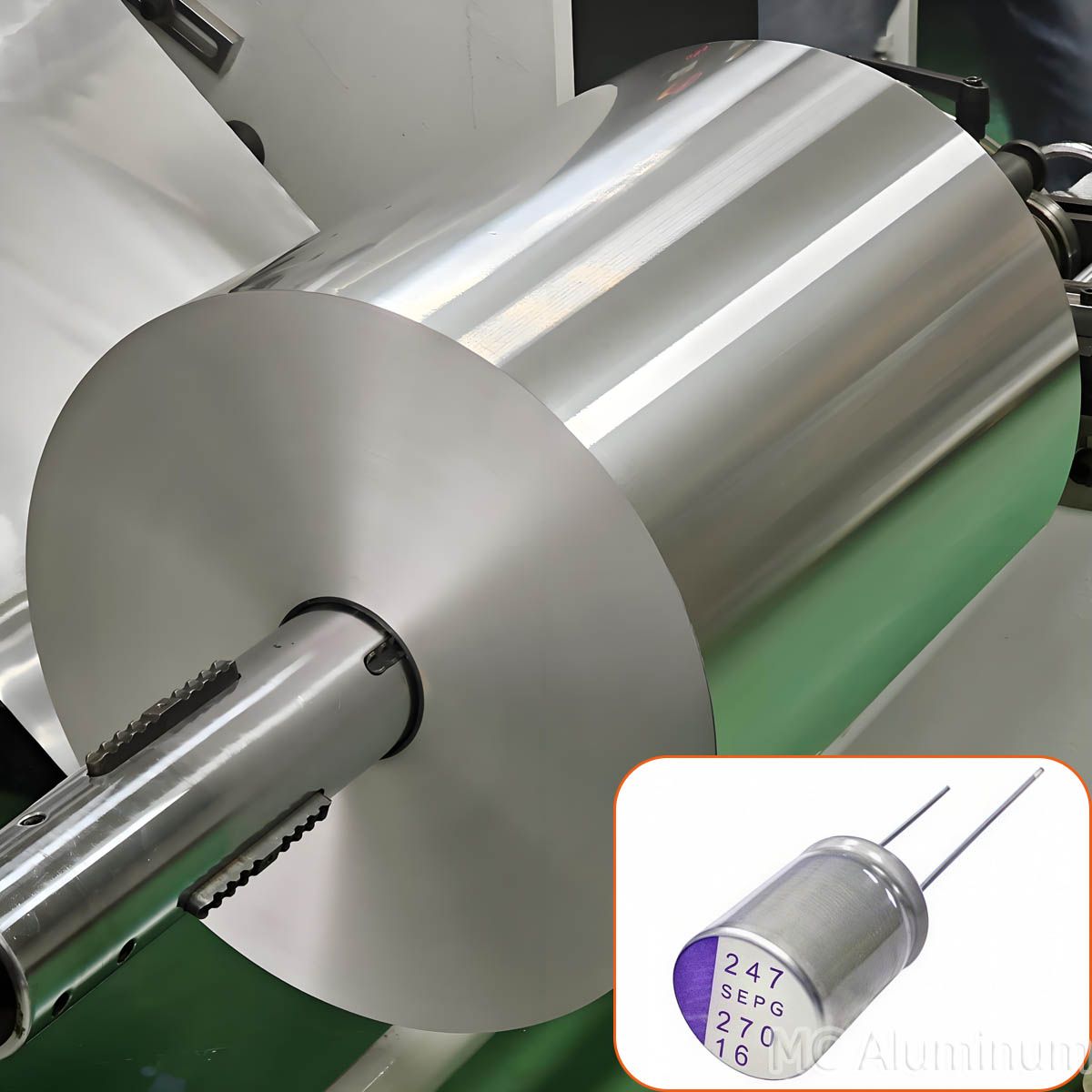
Why Choose MC Aluminum 1235 O Aluminum Foil?
MC Aluminum is committed to the production and supply of aluminum foil and aluminum processing products, serving customers worldwide with various alloy grades, thicknesses, and customized specifications.
For the electronic capacitor manufacturing industry, we can provide suitable 1235 O aluminum foil solutions according to customers' equipment conditions, product requirements, and processing methods.
Our supply and service capabilities include:
1. Customized Specifications
Aluminum foil thickness, width, coil weight, inner diameter, and other specifications can be customized according to customer requirements.
2. Stable Product Quality
We place importance on chemical composition, thickness tolerance, annealing condition, coil flatness, and surface quality control.
3. Professional Slitting Service
Aluminum foil coils can be slit to the required widths according to customer processing equipment and production requirements.
4. Export Packaging
We use packaging methods suitable for aluminum foil transportation, helping reduce the risk of moisture, oxidation, deformation, and mechanical damage during shipment.
5. Technical Support
Based on the customer's application scenario and processing requirements, our team can assist in selecting suitable aluminum foil grades, thicknesses, tempers, and coil specifications.
FAQ
Q1: Why is 1235 O aluminum foil suitable for electronic capacitor manufacturing?
1235 aluminum foil has relatively high aluminum purity, good electrical conductivity, and reliable processing adaptability. The fully annealed O temper provides excellent softness and flexibility, making it suitable for slitting, winding, rewinding, and other processing operations.
Q2: What is the difference between 1235 O aluminum foil and 8011 O aluminum foil in electronic applications?
A: 1235 aluminum has higher aluminum purity, generally above 99.35%, with fewer impurities. It performs well in electronic capacitor and precision shielding applications requiring stable electrochemical performance and corrosion resistance.
8011 aluminum contains controlled amounts of iron and silicon. It generally offers relatively higher tensile strength and better high-temperature performance, and is commonly used for household foil, packaging foil, and composite foil applications where higher strength is required.
Q3: Can 1235 O aluminum foil be used for aluminum electrolytic capacitors?
Yes. It can be used as a base material for aluminum foil components in electrolytic capacitor production. However, whether it is suitable for a specific electrode foil application should be verified based on etching performance, formation process, surface quality, capacitor design, and electrical performance requirements.
Q4: What thicknesses and widths are available? What is the minimum order quantity?
A: Standard thicknesses range from 6μm to 0.12 mm, while the minimum slit width can be as narrow as 3 mm. MOQ is negotiable. Sample orders, small trial batches, and bulk orders can be supported depending on the specification.
Q5: What information is needed when purchasing 1235 O capacitor aluminum foil?
A:It is recommended to provide alloy grade, status, thickness, width, coil inner diameter, single coil weight, surface requirements and purchase quantity. If there are special electrical conductivity or mechanical performance requirements, corresponding technical standards can also be provided.