
As a professional aluminum honeycomb manufacturer, MC Aluminum provides commercial-grade honeycomb core materials, including 3003, 3005, 3104, and 3105, as well as aerospace-grade core materials such as 5052 and 5056, for industrial, architectural, marine, and aerospace applications.
What Is Aluminum Honeycomb Core Material?
Aluminum Honeycomb Core is a lightweight, high-strength material made from aluminum through a special processing technique to form a hexagonal honeycomb structure. Its structure is similar to a natural honeycomb, offering excellent mechanical performance and significant weight advantages.
Aluminum honeycomb cores are widely used in aerospace, rail transportation, architectural curtain walls, shipbuilding, electronic equipment, and many other fields.
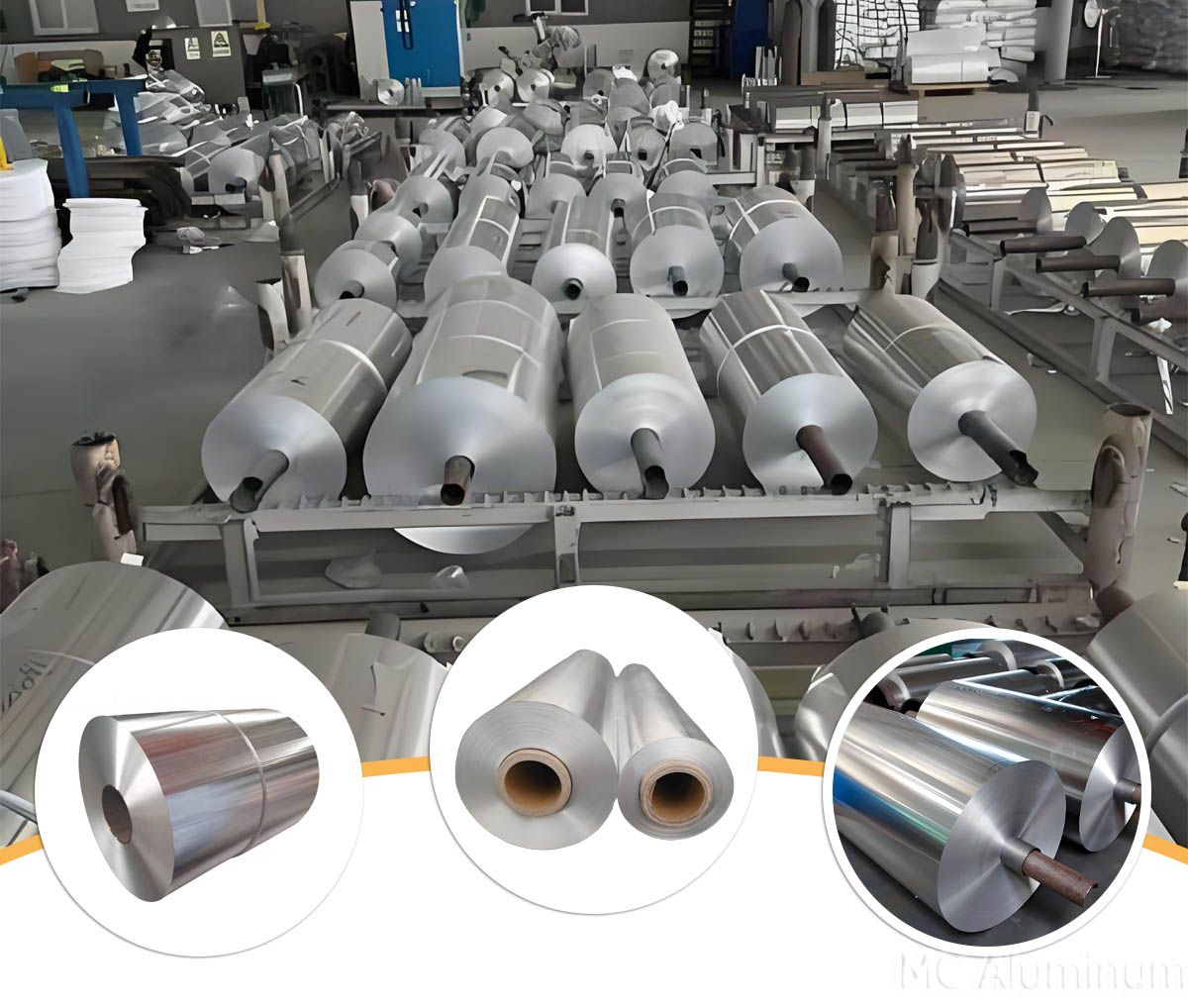
Main Raw Materials of Aluminum Honeycomb Core
1. Aluminum Alloy Types
3003 Aluminum Honeycomb Core Material
3003 is the most widely used commercial alloy for aluminum honeycomb cores. It offers moderate strength, good corrosion resistance, and excellent processing performance. It is widely used in architectural curtain walls, general interior decoration, advertising panels, and interior components of conventional transportation vehicles.
3005 Aluminum Honeycomb Core
3005 aluminum honeycomb core has higher strength than 3003 and is suitable for architectural and transportation projects that require better mechanical performance.
3103 Aluminum Honeycomb Core
3103 aluminum honeycomb core combines good corrosion resistance and formability. It is commonly used in decorative and industrial panels.
3104 Aluminum Honeycomb Core
3104 aluminum honeycomb core features excellent welding and forming properties. It is suitable for honeycomb structures that require bending or stamping.
5052 Aluminum Honeycomb Core
5052 aluminum honeycomb core offers excellent corrosion resistance, balanced strength, and good ductility, although its cost is relatively higher. Therefore, it is widely used in ships, railways, truck flooring, and other applications requiring higher durability.
5056 Aluminum Honeycomb Core
5056 aluminum honeycomb core is a high-strength aerospace alloy with strength far exceeding that of 5052 alloy. It provides excellent long-term durability and corrosion resistance and is widely used in satellite solar wing substrates, military radar structures, and other high-performance applications.
2. Temper of Aluminum Foil
The thickness of aluminum foil used for aluminum honeycomb cores is usually between 0.03 mm and 0.08 mm. Hard temper aluminum foil, typically in H18 or H19 temper, is commonly used to ensure that the honeycomb cells remain uniform and do not deform during expansion and forming.
The foil surface must be clean and free from oil contamination. It is usually treated by anodizing or chromating to form a dense conversion coating. This coating not only serves as a corrosion-resistant barrier but also acts as a "bridge" for subsequent bonding.
3. Adhesive
During the formation of the honeycomb structure, adhesives are used to bond adjacent aluminum sheets together. Epoxy resin-based adhesives are commonly used and are one of the most critical raw materials in the process.
The adhesive must have extremely high bonding strength and be able to firmly adhere to the metal surface, ensuring the structural integrity and durability of the aluminum honeycomb core.
Technical Specifications
| Item | Specification |
| Material | Aluminum Foil |
| Alloy | 3003, 3004, 3104, 3105, 5052, 5056 |
| Temper | H18, H19 |
| Thickness | 0.02 – 0.08 mm |
| Width | 100 – 1600 mm |
| Length | 1000 – 16000 mm |
| Cell Size | 3 / 4 / 6 / 8 / 10 / 12 mm |
| Core Height | 5 – 100 mm |
| Density | 30 – 120 kg/m³ |
| Applications | Architectural curtain walls, rail transportation, aerospace, marine, etc. |
| Delivery Form | Jumbo roll |
| Standards | ASTM C365, ASTM C273, EN 14509, GB/T 1453 |
| MOQ | 1–3 tons |
Physical Properties
| Property | Value |
| Working Temperature | -40℃ to 180℃, depending on adhesive |
Thermal Conductivity | 0.04 – 0.06 W/(m·K) |
Sound Absorption Coefficient | 0.3 – 0.8 |
| Thermal Expansion Coefficient | 23 × 10⁻⁶ /℃ |
Main Performance Features of Aluminum Honeycomb Core
1. Lightweight Performance
The density of aluminum honeycomb core is usually only 1/5 to 1/20 of that of solid aluminum plate, giving it significant advantages in weight reduction.
2. High Strength and High Rigidity
Thanks to its unique honeycomb structure, aluminum honeycomb core provides high compressive strength and bending stiffness while maintaining a lightweight structure.
3. Excellent Energy Absorption Performance
When subjected to impact or vibration, aluminum honeycomb core can effectively absorb and disperse energy, making it suitable for cushioning, protection, and impact-resistant applications.
4. Good Thermal Performance
Aluminum honeycomb core has good thermal conductivity and thermal stability, allowing it to dissipate heat effectively. It is suitable for applications where heat dissipation is required.
5. Excellent Processing Performance
Aluminum honeycomb core is easy to cut, drill, and form. It can be further processed and customized according to specific application requirements.
6. Corrosion Resistance
With proper anti-corrosion treatment, aluminum honeycomb core offers good corrosion resistance and can be used for long periods in various environments.
Key Technical Parameters of Aluminum Honeycomb Core
In practical applications, the performance of aluminum honeycomb core is mainly determined by the following parameters:
1. Cell Size
Common specifications: 3 mm / 6 mm / 10 mm / 12 mm
The smaller the cell size, the higher the strength, but the cost is also higher.
2. Density
Typical range: 30 kg/m³ – 120 kg/m³
The higher the density, the stronger the load-bearing capacity.
3. Foil Thickness
Foil thickness determines the wall thickness of the honeycomb structure and directly affects its compressive and shear performance.
4. Core Height
Common range: 5 mm – 100 mm
The greater the core height, the higher the bending stiffness.
Manufacturing Process of Aluminum Honeycomb Core
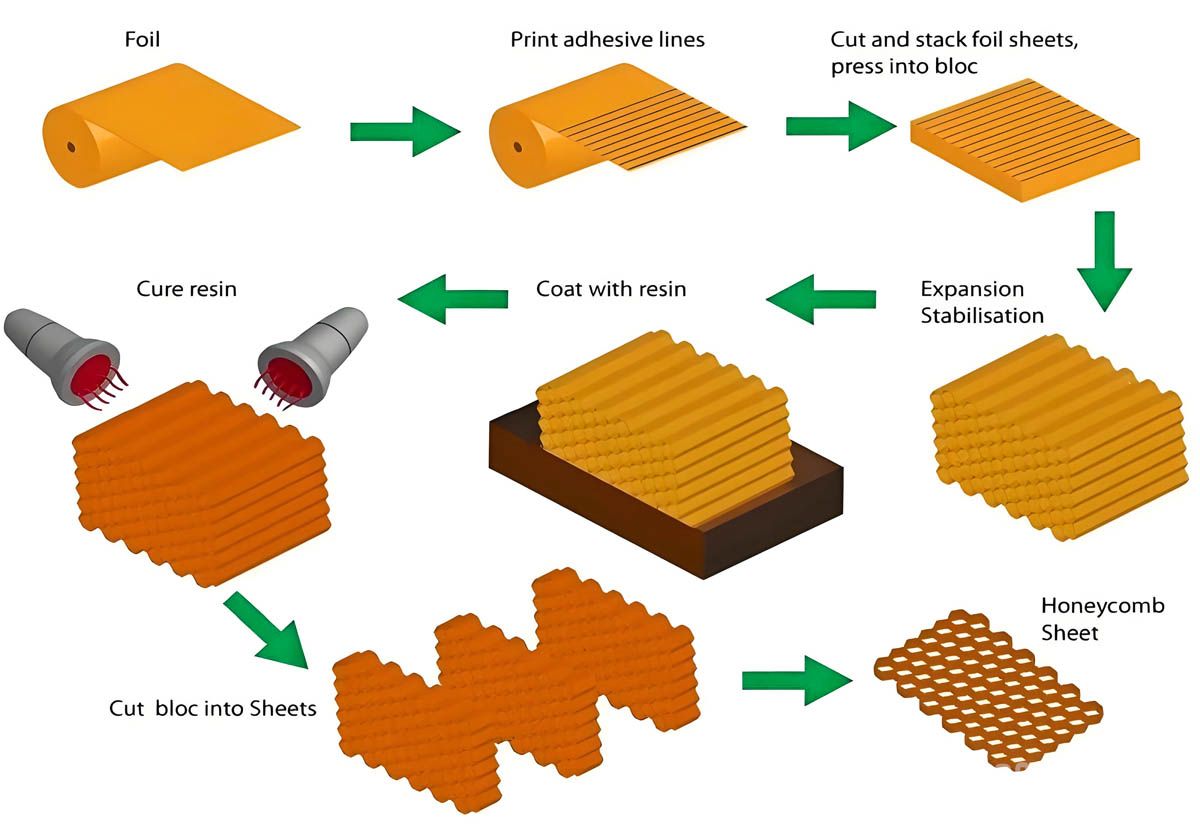
The production of aluminum honeycomb core is a precise and controllable process designed to ensure high strength, stability, and durability.
1. Foil Preparation
High-quality aluminum foil is cut, degreased, etched, and surface-treated to prepare it for bonding.
2. Adhesive Application
Industrial adhesive is applied in a precise pattern, which determines the cell size and bonding strength of the honeycomb core.
3. Stacking and Pressing
Layers of aluminum foil are stacked and pressed into a solid block with uniform bonding strength.
4. Expansion
The bonded block is expanded into a hexagonal honeycomb structure.
5. Cutting and Forming
CNC cutting, waterjet cutting, or laser cutting is used to ensure accurate dimensions. Additional forming can also be carried out according to customer requirements.
6. Surface Treatment
Final anodizing, coating, or laminating can be applied to enhance durability and overall performance.
FAQ
1. Which aluminum alloy is commonly used for aluminum honeycomb cores?
The most commonly used material is 3003 aluminum foil, because it offers good formability, corrosion resistance, and high cost-effectiveness. For higher strength requirements, 3004 can be selected. For marine or highly corrosive environments, 5052 aluminum alloy is recommended.
2. Is aluminum honeycomb core fire-resistant?
Aluminum itself is non-combustible, but the overall fire resistance depends on the adhesive used:
Phenolic adhesive: excellent fire resistance, recommended for fire-rated applications
Epoxy adhesive: good high-temperature resistance, but general fire rating performance
If a specific fire rating is required, such as A2 grade, please specify it in advance.
3. What is the usual delivery time?
The delivery time for standard orders is generally 7-20 days, depending on specifications, quantity, and whether customization is required. Large-volume orders or special specifications should be confirmed in advance.
4. Do you provide samples?
Yes. Free or paid samples can be provided depending on the size and specification. Customers usually only need to cover the shipping cost.