
In modern HVAC (Heating, Ventilation, and Air Conditioning) systems, heat transfer efficiency, corrosion resistance, and long-term operational stability are critical factors in equipment design. As a key material used for evaporator and condenser fins in air conditioning systems, Hydrophilic Lacquered Aluminum Foil has become one of the core materials in high-efficiency heat exchange systems due to its excellent hydrophilic performance and corrosion resistance.
Compared with ordinary aluminum foil, hydrophilic lacquered aluminum foil is coated with a special hydrophilic layer on the surface. This coating allows condensed water to spread quickly and flow away, significantly improving heat exchange efficiency while reducing energy consumption during operation.
What Is Hydrophilic Aluminum Foil?
(1) Historical Background
The development of hydrophilic aluminum foil is the result of advances in materials engineering. Initially, aluminum foil was widely used in packaging because it is lightweight and easy to form. However, to achieve higher heat transfer efficiency, researchers developed hydrophilic coating technology.
This technological breakthrough in the late 20th century solved the problem of condensed water blockage, enabling aluminum foil to become a key heat exchange material in HVAC systems and various humidity-control equipment.
| Timeline | Milestone |
| 1960s | Development of industrial aluminum alloys |
| 1980s | Introduction of surface treatment technologies |
| 2000s | Rapid adoption of hydrophilic coatings in HVAC applications |
| Today | Widely used across industries with continuous performance improvements |
(2) Product Description
Hydrophilic lacquered aluminum foil is a functional aluminum material coated with a hydrophilic layer on the surface.
Ordinary aluminum foil has a hydrophobic surface, where water droplets form bead-like shapes similar to dew on a lotus leaf. Hydrophilic coatings change the surface wettability of aluminum foil, allowing water droplets to spread quickly and form a thin water film. This film enables condensed water to drain rapidly from the surface.
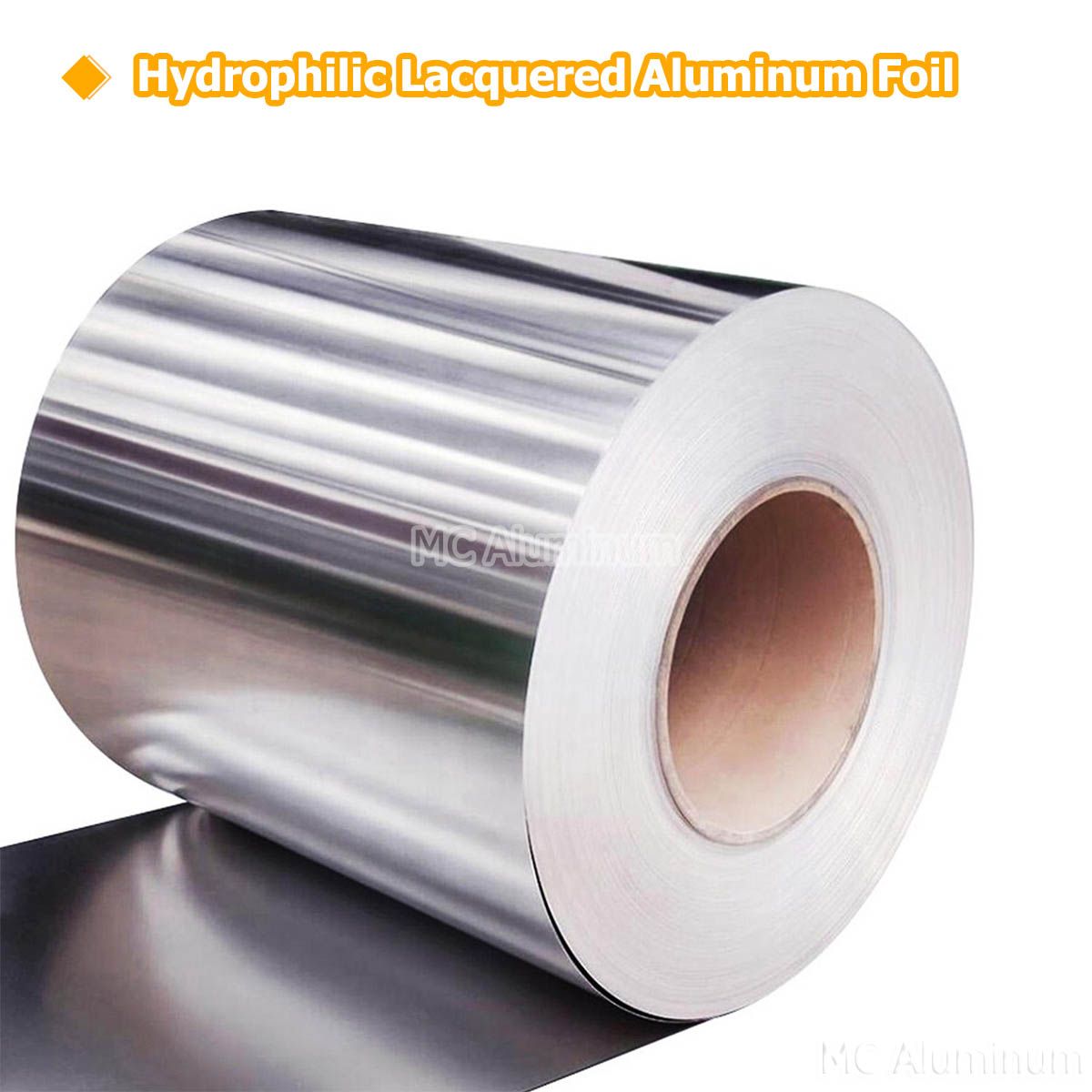
(3) Structure of Hydrophilic Lacquered Aluminum Foil
Hydrophilic aluminum foil generally consists of the following components:
Base Aluminum Foil
The core material is high-quality aluminum foil, typically made from pure aluminum or aluminum alloys and rolled into thin sheets.Hydrophilic Coating
A special coating applied to one or both sides of the aluminum foil to provide hydrophilic properties.Surface Treatment
The coating is applied through chemical or electrochemical processes to enhance the surface's affinity for water molecules.Microstructure
Hydrophilic treatment modifies the foil surface and reduces the water contact angle. As a result, water spreads into a thin film instead of forming droplets.
(4) Material Composition
Hydrophilic aluminum foil mainly consists of aluminum, often alloyed with other elements to improve mechanical strength and thermal performance.
| Alloy Series | Typical Grades | Applications |
| 1000 Series | 1050, 1060 | Food packaging, HVAC |
| 3000 Series | 3003, 3102, 3104 | Heat exchangers |
| 8000 Series | 8011, 8021 | High-strength coated foil |
Coating Materials
Inorganic Coatings
Silicon dioxide (SiO₂)
Titanium dioxide (TiO₂)
Organic Coatings
Acrylic resins
Epoxy polymers
(5)Production Process of Hydrophilic Aluminum Foil
High-quality hydrophilic aluminum foil is typically produced through several precision processes:
1. Raw Material Rolling
High-purity aluminum alloys (commonly 3104, 8011, and 1100) are cold-rolled to achieve uniform thickness and high surface quality.
2. Surface Cleaning and Chemical Treatment
Degreasing, cleaning, and chemical conversion treatments are performed to form a stable adhesion layer on the aluminum foil surface.
3. Hydrophilic Coating Application
Precision coating equipment is used to apply hydrophilic paint evenly to the aluminum foil surface, followed by high-temperature curing to form a stable coating.
4. Coiling and Quality Inspection
After curing, the foil is rewound and subjected to thickness testing, contact angle testing, and corrosion resistance testing to ensure product stability.
Hydrophilic Aluminum Foil Specifications
| Item | Specification |
| Alloy | 1100, 1200, 1030, 3003, 3102, 3104, 8006, 8011, 8021 |
| Temper | O, H22, H24, H26 |
| Width | 60 mm – 1440 mm |
| Thickness | 0.006 – 0.3 mm |
| Coil Inner Diameter | 76 mm, 152 mm |
| Coil Outer Diameter | Customized according to customer requirements |
| Color | Natural, Blue, Gold, Black, White |
| Standards | ASTM B479, ASTM B117, JIS H4160, DIN1784; Hydrophilic foil for air conditioners complies with YS/T95.2-2001 |
Mechanical Properties of Hydrophilic Aluminum Foil
| Alloy-Temper | Thickness Range (mm) | Tensile Strength (MPa) | Elongation (%) | Cupping Test Value (mm) |
| 1030B H26, 3102 H26 | 0.085-0.09 | 130-140 | ≥13 | ≥5.2 |
| 1030B H26, 3102 H26 | 0.091-0.12 | 130-140 | ≥15 | ≥5.5 |
| 8011-O | 0.10-0.15 | 110-122 | ≥23 | ≥6.0 |
| 0.151-0.25 | 110-122 | ≥25 | ≥6.5 | |
| 8011 H22 | 0.08-0.09 | 115-125 | ≥20 | ≥6.5 |
| 0.091-0.15 | 115-125 | ≥22 | ≥6.0 | |
| 0.151-0.2 | 115-125 | ≥25 | ≥6.5 | |
| 8011 H24 | 0.09-0.2 | 120-135 | ≥22 | ≥6.0 |
Physical and Chemical Properties of Hydrophilic Coating
| Property | Value |
| Coating Thickness (Single Side) | 1.0 – 3.0 μm |
| Hydrophilic Contact Angle | ≤ 10° |
| Coating Adhesion | Grade 0 (no peeling) |
| Corrosion Resistance | ≥ 720 hours salt spray test |
| Solvent Resistance | ≥ 20 rubbing cycles |
| Alkali Resistance | No blistering after immersion in 20% NaOH solution at 20°C for 3 minutes |
| Anti-mildew Performance | Grade 0 |
| Heat Resistance | No significant discoloration at 200°C |
Types of Hydrophilic Aluminum Foil
Transparent Hydrophilic Aluminum Foil (Silver)
Features
Maintains the natural metallic appearance of aluminum foil with a transparent hydrophilic coating.Applications
Standard air conditioning systems where appearance requirements are minimal.Advantages
Cost-effective and ideal for large-scale production.
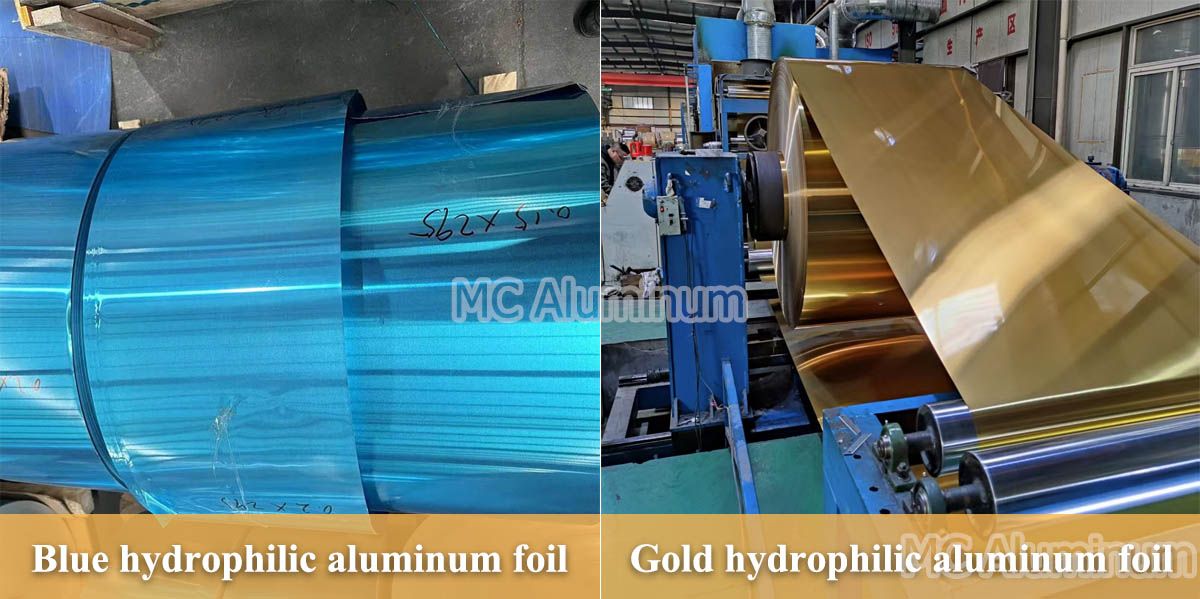
Blue Hydrophilic Aluminum Foil
Features
The coating mainly consists of hydrophilic organic resins that prevent water bridging and provide basic corrosion protection.Applications
Heat exchangers used in residential buildings and office environments.Advantages
The blue coating enhances corrosion resistance and provides an attractive appearance.
Gold Hydrophilic Aluminum Foil
Features
Excellent salt spray corrosion resistance, typically 500-1000 hours or more.Applications
Coastal areas with high salt content, chemical plants, and high-durability outdoor air conditioner units.Advantages
Premium golden appearance with superior durability and corrosion resistance.
Main Applications of Hydrophilic Aluminum Foil
Hydrophilic aluminum foil is widely used in:
Household air conditioner heat exchangers
Commercial air conditioning evaporators
Condenser fins
Refrigerator evaporators
Automotive air conditioning systems
Industrial heat exchange equipment
Hydrophilic Aluminum Foil vs Ordinary Aluminum Foil
(1) Thermal Conductivity
Hydrophilic aluminum foil improves heat transfer by enhancing surface wettability. The continuous water film formed on the surface increases the effective heat transfer coefficient.
Ordinary aluminum foil relies mainly on conduction, and its efficiency may decrease in humid environments.
(2) Performance Comparison
| Comparison Item | Hydrophilic Aluminum Foil | Bare Aluminum Foil |
| Surface Condition | Hydrophilic coating | Bare aluminum surface |
| Water Behavior | Water spreads into a thin film | Water forms droplets |
| Condensate Drainage | Rapid drainage | Water retention |
| Heat Exchange Efficiency | Higher | Moderate |
| Airflow Resistance | Lower | Higher |
| Corrosion Resistance | Excellent | Moderate |
| Frost Formation | Less likely | More likely |
| Equipment Noise | Lower | Higher |
| Service Life | Longer | Relatively shorter |
(3) Economic Analysis
Although hydrophilic aluminum foil may have a higher initial cost due to the coating process, its long-term benefits-such as energy savings and reduced maintenance costs-make it a highly cost-effective solution.
FAQ
Q: Which aluminum alloys are commonly used for HVAC fins?
A: Common alloys include 3104, 8011, and 1100 aluminum foil. Among them, 3104 aluminum foil is the most widely used due to its excellent strength and formability.
Q: What is the main advantage of hydrophilic aluminum foil compared to ordinary aluminum foil?
A: Its improved wettability enhances heat transfer efficiency, providing better moisture management and energy savings.
Q: What is the typical thickness of hydrophilic aluminum foil?
A: The common thickness range is 0.08 mm - 0.20 mm, depending on the heat exchanger design requirements.
Q: How long does the hydrophilic effect last?
A: Under normal HVAC operating conditions, a properly cured coating can maintain a contact angle below 10° for at least five years.
Q: In which industries is hydrophilic aluminum foil used?
A: It is commonly used in HVAC systems, food packaging, electronics, and medical industries.