
In the manufacturing of air-conditioning and refrigeration equipment, aluminum fin foil is a key material for heat exchangers. Among them, 3104 Hydrophilic Aluminum Foil is widely used in AC evaporators, condensers, and various heat-exchange devices thanks to its excellent thermal conductivity, corrosion resistance, and strong hydrophilic properties.
3104 hydrophilic aluminum foil is a functional material made from 3000-series Al–Mn alloy (AA 3104) foil stock, followed by a professional hydrophilic surface treatment (roller coating of a hydrophilic coating and curing). Compared with common alloys such as 1100 or 8011, 3104 offers higher tensile strength and better compressive resistance. With moderate elongation, it is well-suited for complex processing such as deep drawing and thinning, giving it natural advantages in producing thinner and more compact heat-transfer fins.
Hydrophilic Coating Process
"Hydrophilic" means that a special inorganic or organic coating is applied to the foil surface. Standard bare aluminum foil is relatively hydrophobic; condensate tends to form spherical droplets, which obstruct airflow and create "water bridging," reducing heat-transfer efficiency. Hydrophilic aluminum foil allows condensate to spread quickly into a thin water film and drain along the fins.
Chemical Composition of 3104 Aluminum Alloy (%)
| Element | Content |
| Al | remainder |
| Mn | 0.8 – 1.4 |
| Mg | 0.8 – 1.3 |
| Fe | ≤0.7 |
| Si | ≤0.6 |
| Cu | ≤0.25 |
Specifications
| Alloy | 3104 |
| Temper | H14 / H16 / H18 |
| Thickness | 0.08 – 0.20 mm |
| Width | 200 - 1250 mm |
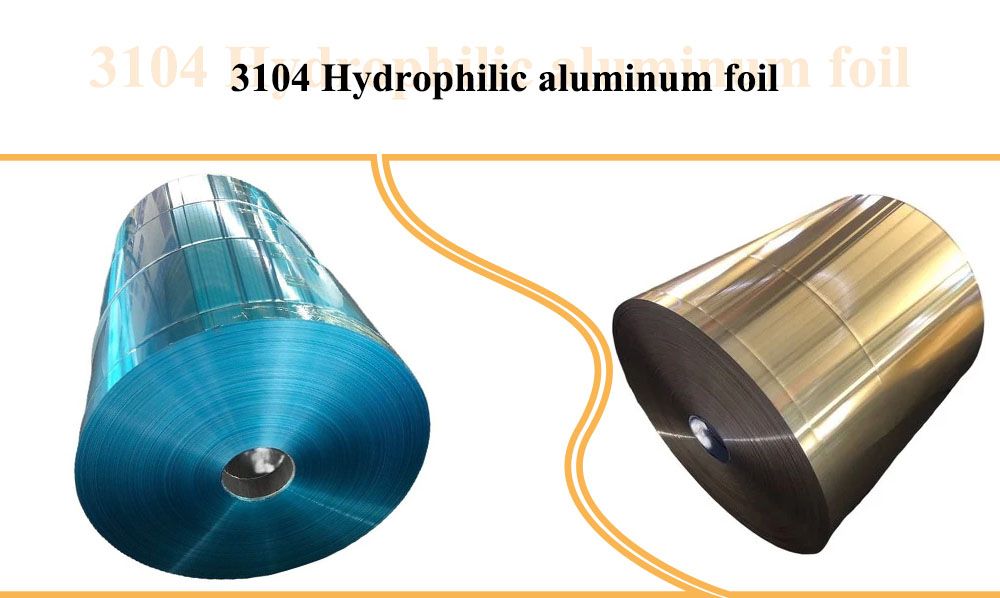
| Coating Type | Hydrophilic coating / Blue hydrophilic coating |
| Surface | Single-side or double-side coating |
| Application | Air conditioner fins, heat exchangers |
Performance Advantages of 3104 Hydrophilic Aluminum Foil
1. Excellent Heat Exchange Efficiency
Because the surface of 3104 hydrophilic aluminum foil has very high wettability (contact angle typically below 10°), condensed water does not accumulate between fins.
This eliminates the common "water bridge" phenomenon in air conditioners and keeps the airflow channel clear, improving heat transfer efficiency by 10-15% compared with ordinary aluminum foil.
2. Strong Corrosion Resistance and Long Service Life
In humid environments with frequent temperature fluctuations, aluminum foil can easily oxidize and produce white corrosion powder.
The 3104 alloy itself has excellent corrosion resistance, and the hydrophilic coating usually contains anti-corrosion components. This combination effectively resists salt spray, acid rain, and atmospheric pollutants, significantly extending the service life of outdoor air conditioning units.
3. Excellent Formability
3104 aluminum foil has relatively high yield strength. During high-speed fin stamping, the collaring and forming processes remain stable, reducing the risk of cracking.
For manufacturers pursuing lightweight and thinner fin structures, 3104 alloy can maintain structural strength even at reduced thickness.
4. Odor Control and Improved Air Quality
High-quality hydrophilic coatings are non-toxic and can effectively inhibit mold growth on heat exchanger fins. This helps prevent unpleasant odors generated during air conditioner operation and provides a healthier indoor air environment.
5. Higher Strength
Compared with pure aluminum alloys such as 1060 and 1100, 3104 aluminum alloy offers higher strength, ensuring that fins maintain structural stability even at very thin gauges.
Application of 3104 Aluminum Foil
Although traditional hydrophilic fin stock is often made from alloys such as 3102 or 8011, 3104 hydrophilic foil, thanks to its higher strength and better corrosion resistance, is more commonly used in air conditioners and heat pump heat exchangers for high-humidity or coastal environments, as well as in automotive A/C condensers and evaporators. It is also suitable for specialized cooling components that require both deep-draw formability and corrosion resistance. In addition, it is used in some food cold-chain equipment where high corrosion resistance is required.
Production Process of 3104 Hydrophilic Aluminum Foil
The manufacturing process typically includes the following steps:
1. Raw Material Casting
3104 aluminum alloy ingots are produced through continuous casting and rolling or semi-continuous casting.
2. Hot Rolling
The ingots are heated and hot rolled into intermediate slabs.
3. Cold Rolling
Multiple cold rolling passes reduce the material to the required thickness, typically:
0.08 mm – 0.20 mm
4. Annealing
Annealing improves the plasticity and forming performance of the aluminum foil.
5. Surface Treatment
Surface treatment is the key step in producing hydrophilic aluminum foil and includes:
Degreasing and cleaning
Chemical conversion coating
Hydrophilic coating application
Drying and curing
This process forms a stable hydrophilic coating layer on the aluminum foil surface.
FAQ
1. What equipment is 3104 hydrophilic aluminum foil mainly used for?
It is mainly used for air conditioner evaporators, condensers, refrigerator heat exchangers, and automotive air conditioning systems.
2. What is the difference between hydrophilic aluminum foil and ordinary aluminum foil?
Ordinary aluminum foil does not have a hydrophilic coating, so condensed water forms droplets that adhere to the surface. Hydrophilic aluminum foil allows water to spread into a thin film and drain quickly, improving heat exchange efficiency.
3. What are the common tempers of 3104 hydrophilic aluminum foil?
Common tempers include:
H14
H16
H18
These tempers are suitable for different fin stamping processes.
4. Why is hydrophilic aluminum foil often blue?
Many high-end products use a blue hydrophilic coating. This coating not only provides hydrophilic properties but also improves corrosion resistance and antibacterial performance. Therefore, it is commonly called blue fin aluminum foil.
About MC Aluminum
As a professional aluminum foil manufacturer, MC Aluminum not only produces 3104 hydrophilic aluminum foil for heat exchangers, but also supplies 1100 aluminum foil, 3102 aluminum foil, and 8011 aluminum foil.
Available tempers include O, H18, H22, H24, and H26, with thickness ranging from 0.09 mm to 0.20 mm to meet different customer requirements.
Our products feature stable quality, global exports, sample testing support, and factory-direct supply with competitive prices.