
In the air conditioning and heat exchanger industry, hydrophilic aluminum foil serves as the core fin material and directly affects equipment energy efficiency and service life. Among the many aluminum alloy grades available, 3102 and 8011 are the two most widely used.
Hydrophilic aluminum foil is a specially surface-treated material that allows condensate to spread rapidly into a continuous water film rather than forming droplets. This increases the effective heat transfer area and accelerates cooling and heating performance. At the same time, it prevents noise caused by droplet accumulation blocking airflow channels and avoids oxidation powder being blown into indoor spaces, thereby improving air quality.
8011 Aluminum Foil
Belonging to the 8000 series aluminum alloys (Al-Fe-Si), 8011 is a general-purpose alloy widely used in packaging and heat dissipation applications. It is well known for its excellent tensile strength and elongation. Common tempers include H22, H24, and H26.
3102 Aluminum Foil
Part of the 3000 series Al-Mn alloys, 3102 benefits from the addition of manganese, which significantly improves strength and corrosion resistance. It is considered a "workhorse" material for mid- to high-end heat exchanger applications. Typical tempers are H24 or H26, with the degree of work hardening affecting ductility and strength.
MC Aluminum offers thicknesses from 0.08 mm to 0.15 mm, with coating colors including blue, gold, black, and green, and customized colors available according to customer application requirements.
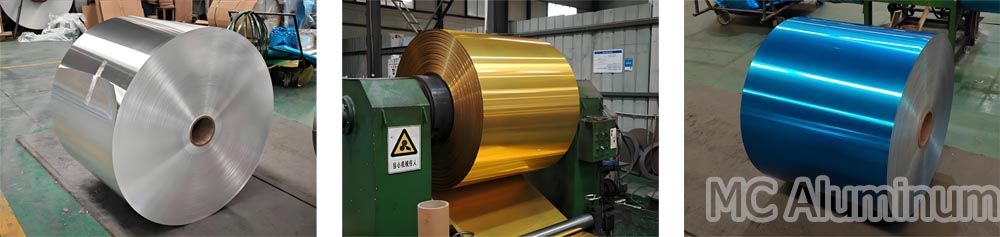
Hydrophilic Aluminum Foil: 3102 vs. 8011
1. Chemical Composition
8011 belongs to the 8xxx series, with aluminum content above 97.5%, containing 0.50-0.90% silicon and 0.60-1.0% iron, forming an Al-Fe-Si ternary alloy.
3102 belongs to the 3xxx series, with aluminum as the base and 0.05-0.20% manganese as the primary alloying element.
Although their compositions are similar, 8011 generally contains slightly higher levels of copper and iron, leading to differences in mechanical properties and corrosion resistance.
2. Mechanical Properties
8011 aluminum foil (H14): tensile strength 125-165 MPa, yield strength ≈110 MPa, elongation 2-5%, about 30% stronger than pure aluminum foil.
3102 aluminum foil: tensile strength 120-160 MPa, yield strength ≈100 MPa, elongation 3-8%, offering similar strength with slightly better ductility.
3. Corrosion Resistance and Coating Performance
8011 relies mainly on alloy characteristics for corrosion resistance; acid and alkali resistance are enhanced by coatings. Heat resistance shows no change after baking at 200°C for 5 minutes, with slight yellowing at 300°C.
3102, due to manganese addition, has better inherent corrosion resistance. Coating requirements include no black spots or blistering under acid and alkali exposure, with similar heat resistance standards.
4. Strength and Ductility
| Parameter | 3102 Aluminum Foil | 8011 Aluminum Foil |
| Tensile Strength | 120-150 MPa | 150-180 MPa |
| Yield Strength | 80-100 MPa | 100-130 MPa |
| Elongation | 12-18% | 8-12% |
3102 offers superior elongation and is suitable for applications requiring plastic deformation.
8011 provides higher strength and is preferred where greater mechanical strength is required.
5. Hydrophilicity Indicators
| Parameter | 3102 Aluminum Foil | 8011 Aluminum Foil |
| Contact Angle | <5° | <3° |
| Surface Energy | 72-75 mN/m | 75-78 mN/m |
8011 exhibits slightly better hydrophilicity, making it especially suitable for applications requiring higher surface energy, such as capacitors and advanced coating processes.
6. Typical Applications
8011 hydrophilic aluminum foil is widely used for household air conditioners, automotive radiators, and other cooling equipment, as well as pharmaceutical packaging requiring high barrier properties.
3102 hydrophilic aluminum foil is more commonly applied in air conditioner heat exchangers (evaporators and condensers), where its base material strength and corrosion resistance are better suited for long-term operation.
7. Cost
8011 involves a more complex production process and higher cost but delivers higher value in specific applications.
3102 benefits from a mature production process, resulting in lower cost and more stable supply.
Performance Advantages of 8011 & 3102 Hydrophilic Aluminum Foil for Air Conditioning
1. Excellent Hydrophilicity
The hydrophilic coating significantly reduces the water contact angle (typically θ ≤ 10°), allowing condensate to spread into a thin film and drain smoothly by gravity. This reduces airflow resistance and prevents water splashing.
2. Improved Heat Exchange Efficiency
By eliminating water-bridge resistance between fins, airflow becomes smoother. Test data show that heat exchangers using hydrophilic aluminum foil achieve 10-15% higher heat transfer efficiency compared with ordinary aluminum foil.
3. Enhanced Corrosion Resistance
High-quality hydrophilic coatings (such as blue or gold organic coatings) effectively isolate the aluminum substrate from acid rain, salt spray, and atmospheric oxidants, significantly extending the service life of condensers and evaporators-especially in harsh industrial or coastal environments.
4. Antibacterial and Anti-Mildew Performance
Efficient drainage reduces water retention. Many premium hydrophilic coatings also incorporate antibacterial agents, effectively inhibiting mold and algae growth, ensuring cleaner airflow and compliance with environmental and health standards.
5. Reduced Operating Noise
Smooth drainage and unobstructed airflow reduce fan load, significantly lowering operating noise and providing a quieter indoor environment.
Appearance Quality of Hydrophilic Aluminum Foil
Surface color shall be agreed upon by both parties and must be free from obvious color differences, coating omission, corrosion, pinholes, or other defects affecting coating performance and usability. Minor color spots or marks that do not affect use are acceptable.
The foil shall be tightly wound with clean, even edges. There shall be no dents or contamination; slight burrs are permitted.
MC Aluminum, as a professional aluminum foil manufacturer, supplies 3102 and 8011 hydrophilic aluminum foil in thicknesses from 0.09 mm to 0.15 mm. We can customize coil diameter and coating color (blue / gold / clear) according to your stamping equipment requirements. Our products feature stable quality, factory-direct pricing, global export capability, and reliable after-sales service.