
As an aluminum foil manufacturer, we produce giant aluminum foil rolls for capacitor insulation layer protection, winding support, and related electrical component applications. Capacitor production requires consistent material behavior across long converting runs. For this reason, the aluminum foil used near insulation systems must have controlled thickness, stable mechanical properties, clean surfaces, reliable flatness, and carefully managed coil quality.
Our aluminum foil jumbo rolls are supplied for capacitor manufacturers, slitting centers, and electrical material converters that require large coil weights and dependable processing efficiency. We manufacture foil to customer-defined specifications, including alloy, temper, thickness, width, inner diameter, outer diameter, surface condition, and packaging configuration.
It is important to distinguish the role of aluminum foil in a capacitor insulation structure. Aluminum foil is electrically conductive and is not itself a dielectric insulation material. In practical capacitor designs, it may be used as an electrode foil, shielding foil, protective interlayer, wrapping layer, or structural layer adjacent to dielectric paper, polymer film, or other insulation materials. Its function depends on the final capacitor design and assembly process.
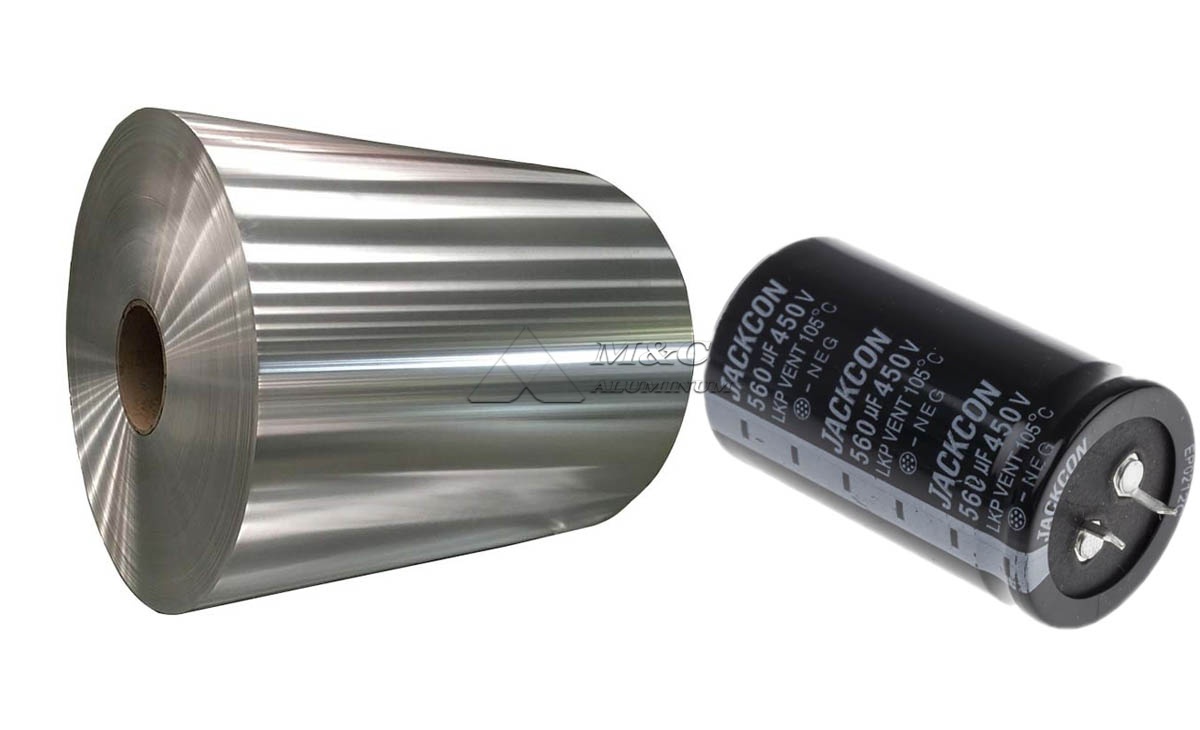
Why Giant Aluminum Foil Rolls Are Used in Capacitor Production
Capacitor manufacturing commonly involves high-speed slitting, winding, laminating, and assembly operations. Giant aluminum foil rolls, also called aluminum foil jumbo rolls or master coils, help reduce the number of coil changes during these processes. A larger parent roll can improve line continuity, reduce material handling frequency, and support stable production planning.
For capacitor insulation layer protection, foil quality must remain uniform throughout the roll length. Thickness variation, edge damage, surface contamination, or poor winding tension may affect downstream slitting and winding. Our production process is designed to maintain consistent coil build, controlled strip profile, and reliable surface cleanliness for industrial conversion.
The main manufacturing advantages of giant aluminum foil rolls include:
Longer continuous processing lengths for slitting and winding lines.
Reduced downtime caused by roll replacement.
Stable mechanical performance across large coil weights.
Controlled thickness and width tolerances.
Clean surfaces suitable for contact with insulation paper or film systems.
Customized packaging for export transportation and warehouse storage.
Recommended Aluminum Alloys for Capacitor Foil Applications
The appropriate alloy depends on the capacitor type, foil thickness, final forming process, electrical design, and required mechanical strength. For non-etched protective, wrapping, and interlayer applications, commercially pure aluminum foil grades are widely selected due to their formability, conductivity, and stable processing performance.
We regularly manufacture 1100 Aluminum Foil for applications requiring high aluminum purity, good ductility, and stable surface quality. This alloy is suitable for many electrical and industrial foil conversion processes.
1235 Aluminum Foil is another commonly specified material for aluminum foil jumbo rolls. It offers good workability and is frequently considered where thin-gauge foil, large coil supply, and cost-controlled conversion are required.
Depending on the design requirements, other aluminum grades may also be evaluated. Our technical team reviews the required foil function before confirming alloy and temper recommendations. This approach helps ensure that the material matches the customer's winding equipment, insulation system, and end-use requirements.
Technical Parameters for Giant Aluminum Foil Rolls
The following table shows typical production ranges for capacitor aluminum foil and protective foil applications. Final specifications are confirmed according to the customer's drawings, samples, and applicable standards.
| Parameter | Typical Range or Option | Notes |
|---|---|---|
| Alloy | 1100, 1235, 1050, 1060 | Other alloys available upon technical review |
| Temper | O, H14, H16, H18 | Selected according to forming and winding requirements |
| Thickness | 0.006 mm to 0.080 mm | Thin gauges are available for specialized applications |
| Width | 100 mm to 1,650 mm | Slit coils can be supplied as required |
| Coil weight | 200 kg to 2,500 kg | Depends on thickness, width, and handling capacity |
| Inner diameter | 152 mm, 300 mm, 505 mm, 508 mm | Custom core sizes available |
| Outer diameter | Up to approximately 1,800 mm | Controlled according to transport and equipment limits |
| Surface finish | Mill finish, one-side bright, both-side bright | Subject to alloy and rolling process |
| Surface cleanliness | Controlled rolling oil residue | Confirmed according to conversion requirements |
| Edge condition | Trimmed edge, slit edge | Burr level controlled for winding performance |
| Packaging | Export seaworthy packaging | Includes moisture and impact protection |
Key Quality Requirements for Capacitor Insulation Layer Protection
In capacitor-related applications, material selection should not be based on thickness alone. The foil must perform consistently during slitting and winding, especially when it is combined with capacitor paper, polypropylene film, polyester film, or other dielectric materials.
Thickness Consistency
Uniform thickness is essential for stable roll tension and accurate winding geometry. Excessive gauge variation can create uneven layers, localized stress points, and inconsistent finished-component dimensions. We control thickness through rolling process management and final inspection procedures.
Surface Quality and Cleanliness
The surface of capacitor aluminum foil should be free from scratches, pinholes beyond the agreed quality level, oil spots, oxidation marks, embedded particles, and other defects that may interfere with conversion. Where foil is used beside insulation layers, surface cleanliness supports reliable assembly and reduces the risk of foreign-material transfer.
Our inspection process includes visual surface review, dimensional checks, and coil condition verification. For applications with specific cleanliness limits or surface appearance standards, these requirements can be included in the technical agreement before production.
Edge Quality
Clean, consistent edges are especially important for narrow-width slitting and high-speed winding. Heavy burrs, edge waves, or telescoping can affect web tracking and may damage adjacent insulating film or paper. We control edge condition through suitable slitting methods, tension settings, and packing protection.
Flatness and Coil Build
A properly wound jumbo roll supports stable unwinding on customer equipment. Our coil build is managed to reduce telescoping, loose wraps, crushed edges, and uneven tension distribution. For customers operating automated or high-speed lines, we can discuss preferred coil hardness and winding direction before order confirmation.
Manufacturing Process at Our Aluminum Foil Factory
Our giant aluminum foil rolls are manufactured through an integrated rolling and finishing process. Starting from qualified aluminum stock, we control key stages including rolling, intermediate annealing where required, final rolling, slitting, inspection, winding, and export packing.
The production route is adjusted according to the specified alloy, final temper, thickness, and surface requirements. Soft temper foil may require annealing to achieve the ductility needed for winding and forming. Harder tempers can be selected where greater tensile strength or handling rigidity is needed.
During production, we focus on the following control points:
Chemical composition verification for the specified alloy.
Gauge control during rolling and finishing.
Surface monitoring to identify rolling marks and contamination.
Width and edge inspection after slitting.
Coil winding control to maintain a stable roll profile.
Final packaging inspection before shipment.
This manufacturing control is particularly important for aluminum foil for capacitors because downstream operations may involve thin insulation materials and precise winding tolerances.
Matching Foil Specifications to the Capacitor Design
Before manufacturing begins, we recommend that buyers provide the intended application details. The most useful information includes foil function, capacitor type, required thickness, width tolerance, temper, coil weight, core size, winding direction, and any surface cleanliness requirements.
For example, a foil used as a protective wrapping layer may require a different temper from a foil used in a tightly wound internal structure. A high-speed slitting operation may prioritize coil build and edge condition, while a laminated construction may require controlled surface characteristics. By reviewing these conditions in advance, we can produce giant aluminum foil rolls that are better aligned with the customer's converting process.
For projects requiring trial material, we can arrange sample coils or smaller trial rolls before large-volume production. This allows customers to evaluate slitting behavior, winding performance, and compatibility with their insulation materials under actual operating conditions.
Packaging and Export Protection
Giant aluminum foil rolls require secure packaging because large coils are sensitive to edge impact, moisture exposure, and handling damage. We use export-oriented packing methods designed for sea freight, container loading, and warehouse storage.
Typical packaging includes protective wrapping, moisture-resistant materials, reinforced outer protection, wooden pallets or cradles, and clear product identification. Coil labels can include alloy, temper, thickness, width, net weight, gross weight, coil number, and production batch information as required.
For customers with containerized shipments, we also consider coil dimensions, loading orientation, weight distribution, and unloading requirements. Proper packaging helps preserve foil quality from our factory to the customer's slitting or capacitor production facility.
Conclusion
Giant aluminum foil rolls provide an efficient material format for capacitor insulation layer protection systems, protective wraps, electrode-related structures, and other electrical foil applications. The reliability of the finished capacitor assembly depends not only on the dielectric material but also on the consistency of adjacent aluminum foil layers.
As a manufacturer, we supply capacitor aluminum foil with controlled alloy composition, thickness, temper, surface condition, edge quality, and coil construction. By matching the jumbo roll specification to the customer's winding and insulation process, we help support stable conversion, efficient production, and dependable material performance.