
In modern air conditioning systems, heat exchangers—including evaporators and condensers—serve as the heart of the system. The fins within these heat exchangers are critical materials that directly affect cooling efficiency, coefficient of performance (COP), and service life.
Driven by the dual requirements of lightweight design and high thermal conductivity, 3003 aluminum foil has become the mainstream and preferred material for manufacturing air conditioner fins.
So, why is 3003 aluminum foil widely used for air conditioner fins? This article provides a detailed answer.
What Is 3003 Aluminum Foil?
3003 aluminum foil is an Al-Mn (aluminum-manganese) alloy belonging to the 3000 series of rust-resistant aluminum alloys. Compared with pure aluminum, such as the 1100 series, 3003 alloy contains approximately 1.0%–1.5% manganese.
This manganese addition enables the material to maintain excellent thermal conductivity while providing higher strength, better corrosion resistance, and more stable processing performance. As a result, it is widely used for air conditioner heat exchanger fins.
Temper Conditions
Common temper conditions for 3003 air conditioner aluminum foil include O, H22, H24, and H26. Since this alloy cannot be strengthened by heat treatment, its strength and ductility are primarily controlled through cold working to meet the stamping and forming requirements of air conditioner heat exchanger fins.
O Temper (Annealed Soft Temper): Offers the best ductility and is suitable for components requiring complex deep drawing or flanging. However, its strength is relatively low.
H22 / H24 / H26 Tempers (Strain-Hardened Tempers): These are semi-hard tempers with different degrees of work hardening. H22 and H24 are the most commonly used tempers for air conditioner heat dissipation fins. They provide excellent formability along with higher yield strength, helping prevent fin collapse and deformation during high-speed stamping or tube expansion.
Surface Types
Bare aluminum foil
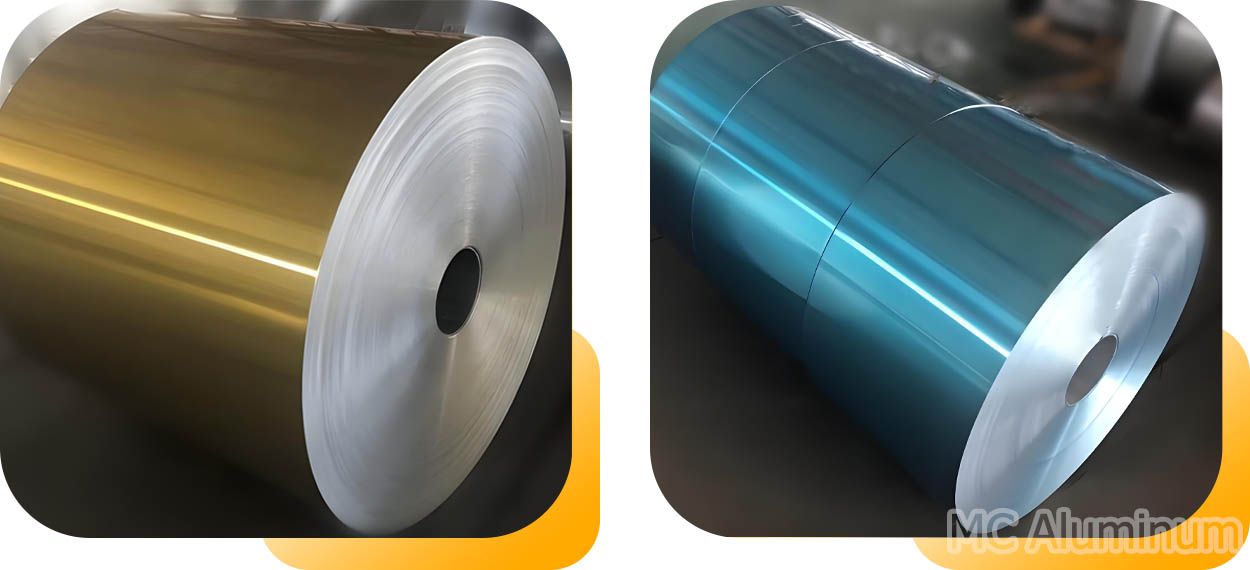
Blue hydrophilic aluminum foil
Golden hydrophilic aluminum foil
Corrosion-resistant hydrophilic aluminum foil
Super-hydrophilic aluminum foil
Key Advantages of 3003 Aluminum Foil for Air Conditioner Fins
1. Moderate Strength
3003 aluminum foil generally has higher strength than industrial pure aluminum foil. The addition of manganese improves tensile strength and yield strength, allowing the formed fins to provide better structural support.
2. Excellent Formability
3003 aluminum foil has good plasticity and ductility. In an appropriate temper condition, it can meet a variety of forming requirements for air conditioner fins.
It is less prone to cracking than certain high-strength alloys and, unlike excessively soft materials, can maintain a stable formed profile.
3. High Thermal Conductivity
3003 aluminum alloy offers relatively high thermal conductivity, enabling heat to be transferred efficiently between refrigerant and air. This improves the heat exchange efficiency of evaporators and condensers.
At the same time, it offers advantages in both weight and cost, making it a mainstream material for HVAC heat exchangers.
4. Outstanding Corrosion Resistance
3003 aluminum foil can form a dense oxide film, providing good resistance to air, moisture, and most mildly corrosive media.
When combined with hydrophilic, corrosion-resistant, or other functional coatings, its service life can be further improved in high-humidity and high-salt-spray environments.
5. Excellent Adhesion for Hydrophilic Coatings
The smooth and uniform surface of 3003 aluminum foil provides excellent coating adhesion. It can be evenly coated with hydrophilic, corrosion-resistant, antibacterial, and other functional layers.
6. Lightweight Properties
Aluminum has a low density—approximately one-third that of steel. Using 3003 aluminum foil as the base material for air conditioner fins helps reduce the weight of heat exchangers while maintaining heat transfer performance and structural stability.
7. Significant Cost Advantages
Compared with copper, 3003 aluminum foil offers lower raw material costs, lighter weight, easier processing, better recyclability, and lower overall manufacturing costs.
For this reason, the vast majority of air conditioner manufacturers worldwide use aluminum fin structures.
Typical Technical Specifications of 3003 Air Conditioner Aluminum Foil
| Item | Specification |
| Alloy | 3003 |
| Temper | H14, H16, H18, H22, H24 |
| Thickness | 0.08–0.20 mm, customizable |
| Width | 100–1250 mm |
| Length | 1000–16000 mm |
| Surface | Bare, hydrophilic, corrosion-resistant, blue, golden |
| Inner Diameter | 76 mm / 152 mm |
| Applications | Evaporators, condensers, radiator fins |
| MOQ | 3 Ton |
Types of Surface Coatings for Air Conditioner Aluminum Foil
Air conditioner aluminum foil is typically not used directly as bare foil. Depending on performance requirements, it can be supplied as:
Uncoated aluminum foil
Coated aluminum foil
Corrosion-resistant aluminum foil
Hydrophilic aluminum foil
Hydrophobic aluminum foil
Self-lubricating aluminum foil
Anti-mildew aluminum foil
Among these, hydrophilic coated aluminum foil is one of the most common types.
3003 aluminum foil performs particularly well in coating compatibility. After surface pretreatment, it can form a strong bond with hydrophilic and corrosion-resistant coatings.
The purpose of a hydrophilic coating is to allow condensate water to spread quickly across the fin surface and flow downward smoothly, rather than forming droplets that block the gaps between fins.
This can improve heat exchange efficiency by approximately 5%, while reducing airflow resistance and noise caused by water bridging. It can also help prevent mold growth and unpleasant odors.
The typical manufacturing process for hydrophilic coated aluminum foil includes:
Cleaning and degreasing the base material
Multi-stage deionized water rinsing
Chemical conversion coating treatment
Roller coating or curtain coating with hydrophilic paint
High-temperature baking and curing
Slitting
During this process, 3003 aluminum foil demonstrates excellent process adaptability, high coating adhesion, and uniform coating coverage.
In terms of thickness:
0.08–0.10 mm: Commonly used for household air conditioner evaporators
0.10–0.15 mm: Commonly used for general HVAC systems
0.15–0.20 mm: Suitable for condensers or applications requiring higher durability
Applications of 3003 Air Conditioner Aluminum Foil
3003 aluminum foil is widely used in various heat exchange equipment, including:
Residential split air conditioners
Central air conditioning systems
VRF/VRV multi-split systems
Automotive air conditioners
Heat pump units
Industrial cooling equipment
Condensers
Evaporators
Air-source heat pumps
HVAC heat exchangers
It is also widely used in refrigerators, fre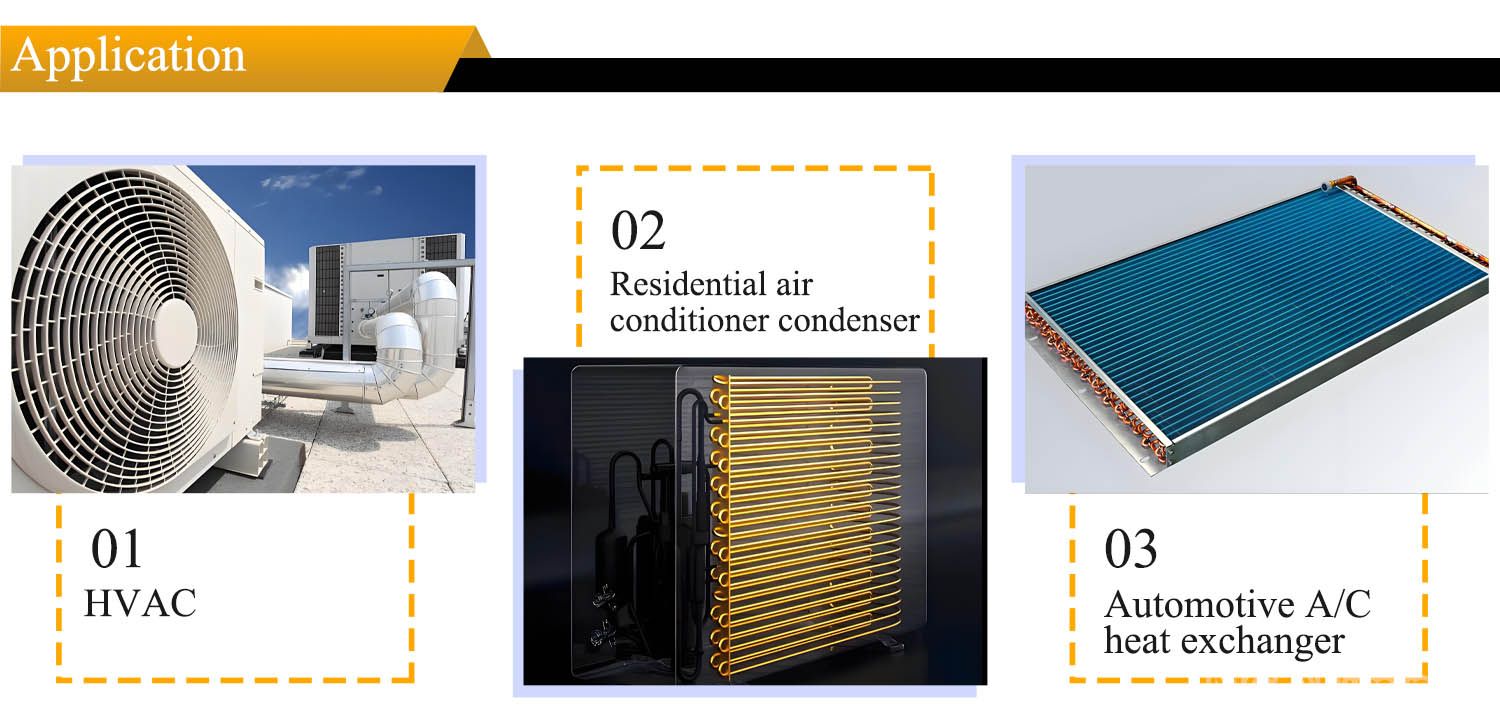 ezers, dehumidifiers, fresh air systems, and industrial radiators.
How Much Does 3003 Aluminum Foil Cost Per Ton?
The price of 3003 aluminum foil is a major concern for many buyers. Since each customer may require different thicknesses, widths, temper conditions, surface treatments, and coating types, quotations can vary accordingly.
Based on current aluminum ingot prices and industry processing fees, the tax-inclusive market price of conventional 3003 air conditioner aluminum foil, including bare foil or hydrophilic coated foil—is generally around:
USD 3,900-4,800 per metric ton.
For an accurate 3003 aluminum foil price, please contact us online. Our sales team can recommend suitable specifications based on your application requirements and provide a competitive detailed quotation.