
As the global energy transition accelerates, electric vehicles (EVs), energy storage systems (ESS), and the photovoltaic industry are experiencing rapid growth. Behind this green transformation, aluminum foil has become an indispensable material in the new energy supply chain due to its high performance, lightweight properties, and excellent electrical conductivity.
From cathode current collectors in lithium-ion batteries to aluminum-plastic laminate packaging for pouch cells, as well as photovoltaic backsheet structures and supercapacitors, aluminum foil plays an important role in improving the energy density, safety, and service life of new energy products.
Why Is Aluminum Foil an Important Material in the New Energy Industry?
Aluminum offers low density, good electrical and thermal conductivity, excellent ductility, corrosion resistance, and high recyclability. Through rolling processes, aluminum foil can be produced at micron-level thicknesses while maintaining good strength, flatness, and processing stability.
In new energy applications, aluminum foil provides the following key advantages.
1. Significant Lightweight Benefits
Aluminum has a density of approximately 2.7 g/cm³, much lower than steel and many conventional metallic materials. For electric vehicles and energy storage batteries, high-performance aluminum foil helps reduce battery material weight, improve vehicle driving range, and enhance overall system energy efficiency.
2. Good Electrical Conductivity
Battery aluminum foil can serve as the cathode current collector in lithium-ion batteries, providing a stable electron transfer path for cathode active materials. Its excellent conductivity helps reduce internal battery resistance and improves charging efficiency, discharging efficiency, and rate performance.
3. Excellent Processing Performance
Aluminum foil has good ductility and formability. It can be slit, laminated, carbon-coated, coated with electrode slurry, stamped, rolled, and surface-treated. These characteristics allow it to meet the requirements of high-speed, automated battery manufacturing lines.
4. Good Corrosion and Oxidation Resistance
Aluminum naturally forms a dense oxide film on its surface, providing good corrosion resistance in suitable environments. Through optimized alloy composition, surface cleanliness, and coating technology, battery aluminum foil can meet the long-term stability requirements of new energy battery systems.
5. Environmentally Friendly and Highly Recyclable
Aluminum is a highly recyclable metal material. Compared with primary aluminum production, recycled aluminum can significantly reduce energy consumption and carbon emissions. Therefore, aluminum foil supports the green manufacturing and sustainable development objectives of the new energy industry.
Core Applications of Aluminum Foil in the New Energy Industry
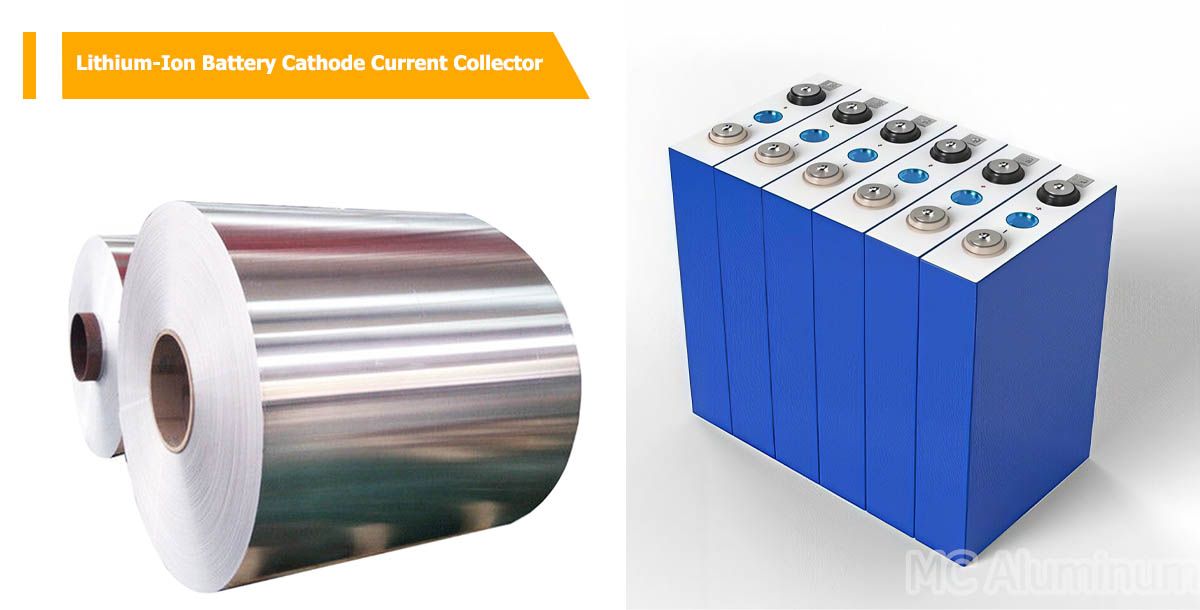
1. Lithium-Ion Battery Cathode Current Collector: The Critical Bridge for Charge Transfer
In a lithium-ion battery, the cathode current collector is responsible for collecting the electrical current generated by the active material and transmitting it to the external circuit.
Due to its high conductivity, good processing ductility, and electrochemical stability at cathode potentials, aluminum foil is widely used as the preferred cathode current collector material.
Specifications for battery-grade aluminum foil: Pure aluminum foils-typically in 1060, 1235, 1100, and 1070 alloys, as well as high-strength 1235-H18 and 1060-H18 tempers are commonly used, with thicknesses generally ranging from 9 μm to 15 μm.
Carbon-Coated Aluminum Foil Technology
Carbon-coated aluminum foil is produced by applying a uniform nano-scale conductive carbon coating to the surface of plain aluminum foil.
This technology can significantly reduce the contact resistance between the current collector and cathode active material. It can also improve active-material adhesion, extend battery cycle life, and enhance high-rate charging and discharging performance.
It should be noted that, in conventional lithium-ion batteries, aluminum foil is generally used as the cathode current collector, while copper foil is generally used as the anode current collector. Therefore, aluminum foil is an essential material in lithium-ion battery cathode manufacturing.
2. Energy Storage Systems and Supercapacitors: Supporting Efficient Energy Storage
Formed aluminum foil serves as an electrode support and conductive medium in energy storage batteries and supercapacitors:
High Power Output: Etched aluminum foil used in supercapacitors features an exceptionally high specific surface area, enabling rapid high-current charging and discharging within milliseconds.
Corrosion Resistance and High Reliability: Designed to withstand complex outdoor environments, specially surface-treated aluminum foil effectively resists chemical corrosion from electrolytes, supporting a cycle life of over 10 years for energy storage systems.
The U.S. Department of Energy notes that battery energy storage can be utilized for grid-scale storage, balancing electricity supply and demand, and managing energy within renewable energy systems.
For energy storage batteries, aluminum foil must be suitable for long-term cyclic operation and large-scale manufacturing. Consequently, the stability, processing consistency, and batch-to-batch control of the foil are critically important.
3. Photovoltaic Modules and Solar Backsheets: Improving Photoelectric Conversion Efficiency
In the photovoltaic industry, aluminum foil is primarily utilized in P-IBC (Interdigitated Back Contact) solar cells and as a barrier layer in photovoltaic backsheets:
Back-contact conductive layer: Grid lines or conductive patterns made from high-purity aluminum foil reduce shading on the front of the cell, thereby boosting the solar cell's photoelectric conversion efficiency to new levels.
Weather-resistant backsheet protection: In the backsheets of double-glass or single-glass PV modules, an aluminum foil composite layer achieves zero water vapor transmission rate (WVTR), effectively blocking environmental moisture from corroding the internal silicon wafers.
Aluminum foil's excellent thermal conductivity accelerates heat dissipation for electronic components inside inverters, preventing overheating and aging and extending the service life of the PV system; simultaneously, its barrier properties serve as a moisture-proof layer for PV module backsheets, preventing component failure caused by water vapor penetration.
Common Specifications of Battery Aluminum Foil
| Item | Typical Range or Requirement |
| Alloy Grade | 1235, 1050, 1060, 1070, and others |
| Temper | O temper, H temper, or customized according to customer process requirements |
| Thickness | Typically 10 μm–20 μm; thinner or thicker gauges can be customized |
| Width | 100–1600 mm |
| Length | 1000–16000 mm |
| Surface Type | Plain foil, one-side treated foil, double-side treated foil, carbon-coated aluminum foil |
| Applications | Power batteries, energy storage batteries, consumer electronics batteries, supercapacitors, and more |
| MOQ | 3 tons |
Ultra-Thin Aluminum Foil: An Important Direction for New Energy Materials
To increase the proportion of active materials in batteries, battery manufacturers continue to optimize the thickness of inactive components, including current collectors and separators.
As a result, ultra-thin battery aluminum foil has become an important development direction in the new energy aluminum foil market.
Provided that strength, surface quality, and processing performance are maintained, reducing aluminum foil thickness can lower the weight and volume occupied by the current collector. This creates more space for battery structure optimization and helps improve energy density.
However, thinner is not always better. As foil thickness decreases, the difficulty of processing during high-speed coating, calendering, slitting, and winding increases.
Therefore, new energy aluminum foil must achieve a balanced performance among thin gauge, mechanical properties, electrical conductivity, surface quality, and production stability.
Why Choose High-Quality Battery Aluminum Foil?
For battery manufacturers, choosing the right aluminum foil supplier requires attention not only to product specifications, but also to quality stability and batch-to-batch consistency.
HAOMEI supplies aluminum foil products for new energy battery applications, including 1050, 1060, 1070, and 1235 aluminum foil. We can provide customized solutions in different thicknesses, widths, tempers, and surface conditions according to customer requirements.
For power battery and energy storage battery applications, suitable aluminum foil specifications can be recommended based on the customer’s cathode material system, coating equipment, and manufacturing process.
Contact HAOMEI for battery-grade aluminum foil technical data, customized specifications, samples, and quotations.