
As an aluminum foil manufacturer, we produce battery-grade foil materials for lithium-ion batteries, energy storage systems, electric vehicles, consumer electronics, and related electrochemical applications. Selecting the correct aluminum foil alloy is essential because foil composition, temper, thickness consistency, surface condition, and mechanical performance directly influence electrode coating quality, current collection efficiency, and downstream processing stability.
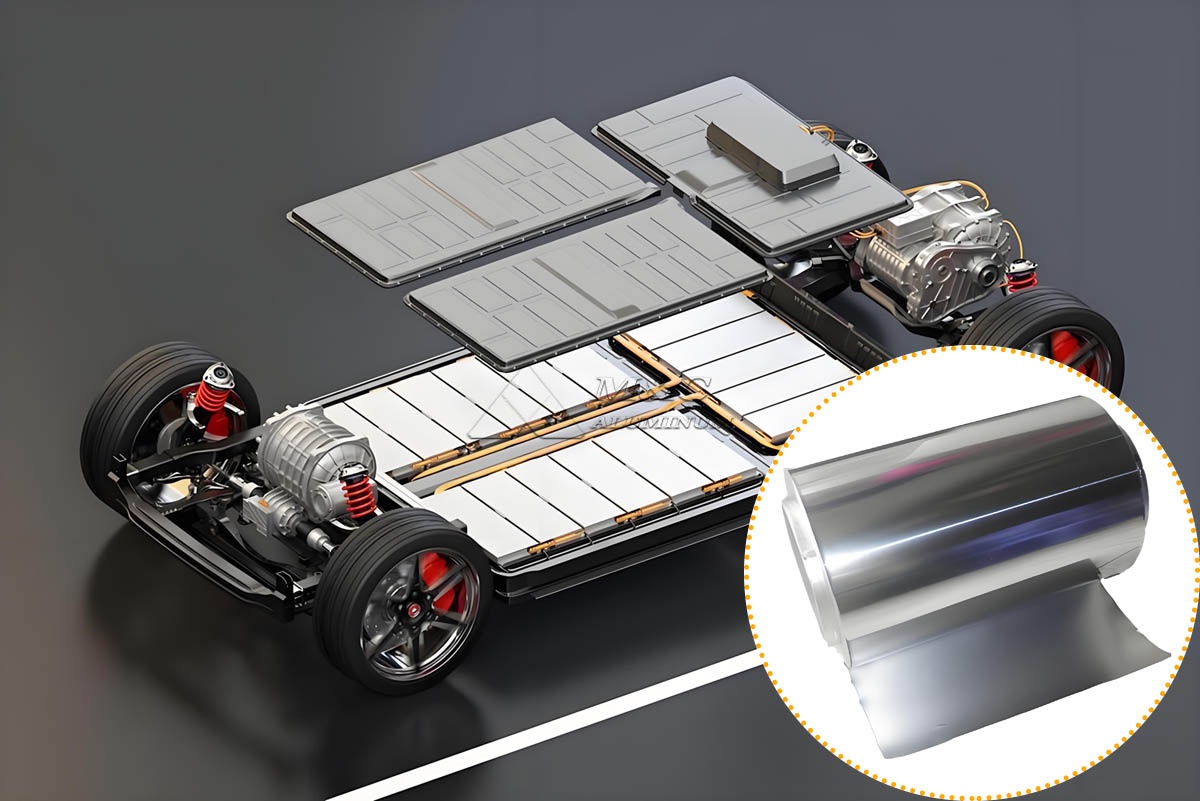
In battery manufacturing, aluminum foil is primarily used as the cathode current collector. It may also be used in battery pouch structures, laminated packaging materials, battery cases, tabs, insulation assemblies, and thermal management components. Different battery applications require different aluminum foil alloy types, and the alloy selection should always be based on the functional role of the foil rather than thickness alone.
Why Aluminum Foil Is Used in Battery Applications
Aluminum foil is widely used in rechargeable battery systems because it combines low density, good electrical conductivity, corrosion resistance within the normal cathode potential range, and excellent processability. Compared with heavier metallic materials, aluminum helps reduce cell weight while maintaining stable current collection performance.
For lithium-ion battery cathodes, aluminum foil serves as the conductive substrate supporting the active-material coating. The foil must maintain reliable adhesion with materials such as lithium iron phosphate, nickel manganese cobalt oxide, lithium cobalt oxide, and high-nickel cathode formulations. It must also tolerate slurry coating, drying, calendaring, slitting, winding, stacking, and cell assembly processes.
From our manufacturing perspective, battery aluminum foil must be controlled not only by alloy designation, but also by surface cleanliness, oil residue, pinhole level, tensile strength, elongation, edge quality, and thickness tolerance. These properties are often more critical to battery production yield than nominal alloy chemistry alone.
Main Aluminum Foil Alloy Types for Battery Applications
1xxx Series Aluminum Foil for Cathode Current Collectors
The 1xxx aluminum alloy series is the most common material family for battery cathode current collector foil. These alloys contain a high aluminum content, generally above 99 percent, which supports high electrical conductivity and reliable coating performance.
Common 1xxx battery aluminum foil grades include 1050, 1060, 1070, 1100, 1145, and 1235. Among these, 1060 and 1100 aluminum foil are frequently selected for conventional lithium-ion battery cathode substrates. The final choice depends on the required conductivity, strength, elongation, foil gauge, coating method, and cell design.
Our 1100 Aluminum Foil can be processed for applications that require balanced conductivity, formability, and stable rolling quality. For cathode current collector production, we maintain strict control of flatness, thickness profile, surface tension, and residual rolling oil to support uniform electrode coating.
| Alloy | Typical Aluminum Content | Main Battery Use | Key Characteristics | Common Temper |
|---|---|---|---|---|
| 1050 | 99.5 percent minimum | General cathode collector foil | Good conductivity and ductility | O, H14, H18 |
| 1060 | 99.6 percent minimum | Lithium-ion cathode current collector | High conductivity and stable coating base | O, H14, H18 |
| 1070 | 99.7 percent minimum | High-conductivity electrode foil | Very high purity and electrical performance | O, H14, H18 |
| 1100 | 99.0 percent minimum | Cathode foil and battery components | Good formability and mechanical balance | O, H14, H18 |
| 1235 | 99.35 percent minimum | Thin foil and laminated structures | Good workability and economical processing | O, H14, H18 |
For most cathode foil applications, 1xxx alloys are preferred because alloying additions are limited. This allows the foil to retain high conductivity while remaining suitable for thin-gauge rolling. Depending on the battery design, typical cathode current collector thickness ranges from 10 to 20 microns, with 12, 15, 16, and 20 micron foil being common specifications.
3003 Aluminum Foil for Battery Cases and Structural Components
3003 aluminum foil contains manganese as its primary alloying element. It provides higher strength than 1xxx series aluminum while retaining good corrosion resistance and formability. However, its electrical conductivity is lower than high-purity aluminum grades, so 3003 foil is generally not the first choice for cathode current collector applications.
Instead, 3003 aluminum foil is more suitable for battery housings, laminated pouch layers, protective structures, heat-transfer assemblies, and formed components where mechanical strength is more important than maximum electrical conductivity. It may also be selected for specific battery packaging designs that require deeper drawing performance or improved resistance to deformation.
Our 3003 Aluminum Foil is manufactured with controlled composition and temper options for applications requiring reliable forming behavior. When used in battery-related structural applications, the material should be evaluated for bending radius, forming depth, surface treatment compatibility, and joining requirements.
| Parameter | 1xxx Series Battery Foil | 3003 Aluminum Foil |
|---|---|---|
| Primary function | Cathode current collector | Battery casing, packaging, structural parts |
| Electrical conductivity | High | Moderate |
| Mechanical strength | Low to medium | Medium |
| Formability | Excellent | Good to excellent |
| Typical thickness | 10 to 20 microns for collector foil | Application dependent, often thicker |
| Preferred battery use | Electrode substrate | Protective and formed components |
8xxx Series Aluminum Foil for Packaging and Specialized Battery Structures
The 8xxx series includes aluminum alloys such as 8011, 8021, and 8079. These alloys are commonly used in flexible packaging, laminated foil structures, and applications requiring good barrier performance, flexibility, and puncture resistance. In battery production, 8xxx aluminum foil is more relevant to packaging and pouch-related construction than to active cathode current collectors.
For example, 8021 and 8079 foil can be incorporated into multilayer battery pouch films after lamination with polymer layers. Their role is to provide a moisture and gas barrier, protect the cell from external contamination, and maintain package integrity during forming and service.
The use of 8xxx foil in battery packaging requires careful attention to surface quality. Pinholes, scratches, oil residues, and uneven thickness can reduce barrier performance or affect lamination adhesion. Our factory controls these factors through rolling, annealing, inspection, and slitting procedures tailored to thin-gauge foil production.
Carbon-Coated Aluminum Foil for Advanced Electrodes
Carbon-coated aluminum foil is an upgraded battery current collector material produced by applying a conductive carbon layer to the aluminum foil surface. The aluminum base foil is commonly a 1xxx alloy, while the carbon coating is engineered to improve electrical contact between the foil and the cathode active material.
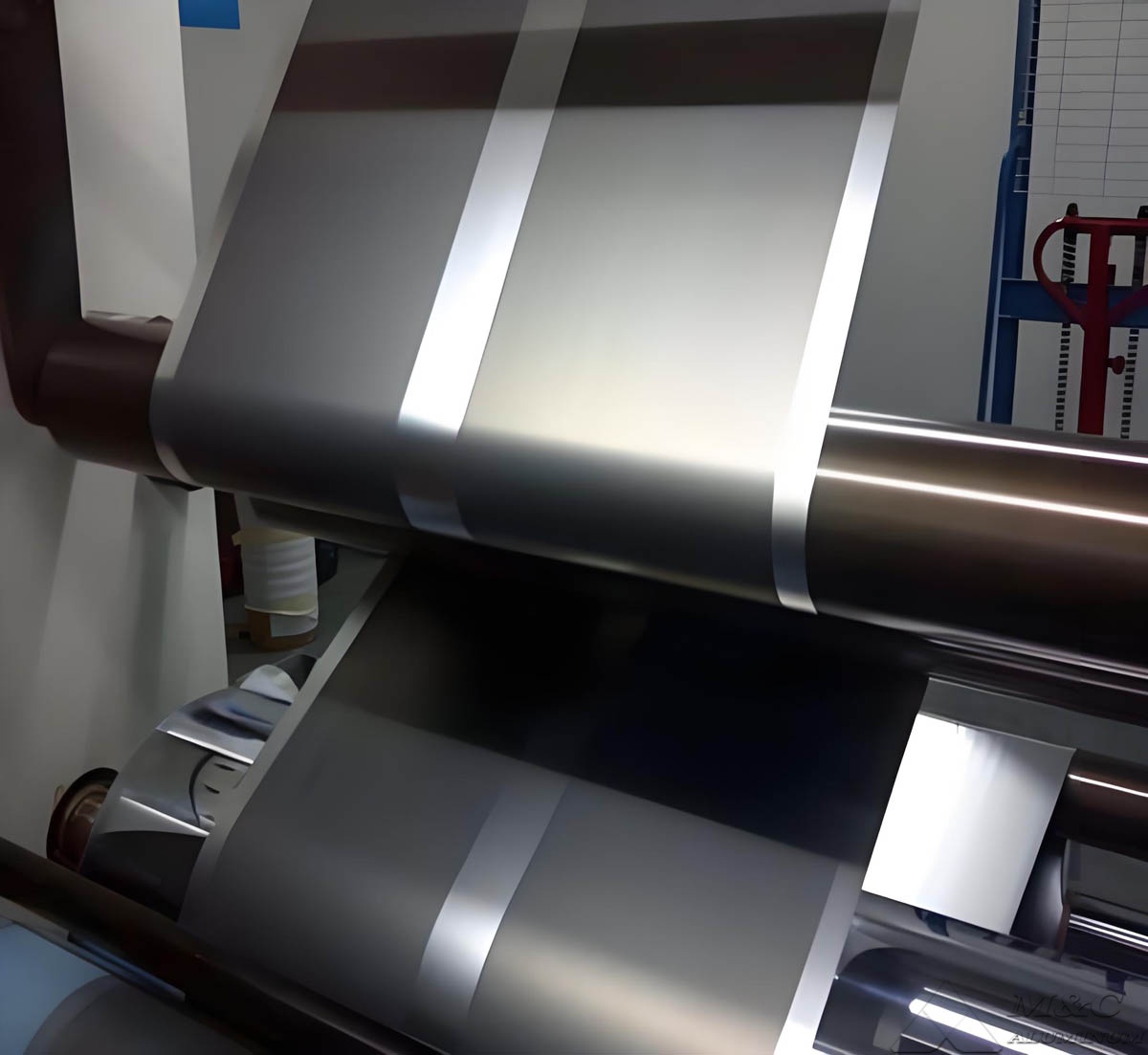
For lithium iron phosphate cathodes and certain high-power battery designs, carbon-coated aluminum foil can help reduce interface resistance, improve coating adhesion, and support more uniform current distribution. It may also improve electrode processing stability during calendaring and cycling, depending on the active material system and coating formulation.
| Technical Item | Typical Carbon-Coated Aluminum Foil Requirement |
|---|---|
| Base alloy | 1050, 1060, 1070, 1100, or equivalent high-purity aluminum |
| Base foil thickness | Commonly 12 to 20 microns |
| Carbon coating side | Single-sided or double-sided |
| Coating thickness | Customized according to electrode design |
| Surface resistance | Controlled according to customer specification |
| Coating adhesion | Suitable for slurry coating and calendaring processes |
| Surface condition | Clean, uniform, free from visible defects |
When selecting carbon-coated aluminum foil, customers should evaluate the coating system together with the cathode chemistry, binder, conductive additive, solvent system, coating weight, and calendaring pressure. A carbon layer that performs well for lithium iron phosphate may require adjustment for nickel-rich cathode materials or high-loading electrodes.
Key Technical Parameters for Battery Aluminum Foil
Battery foil should be specified through a complete technical package. Alloy grade alone is not sufficient for stable electrode production. As a manufacturer, we recommend defining the following parameters before production approval.
| Parameter | Importance in Battery Manufacturing |
|---|---|
| Alloy composition | Determines conductivity, strength, and corrosion behavior |
| Foil thickness | Affects energy density, resistance, and coating capacity |
| Thickness tolerance | Supports uniform slurry loading and stable calendaring |
| Tensile strength | Influences slitting, winding, and handling performance |
| Elongation | Supports deformation without cracking during processing |
| Surface roughness | Influences coating adhesion and electrode uniformity |
| Residual rolling oil | Must be controlled to prevent coating defects |
| Pinhole level | Important for thin foil integrity and packaging applications |
| Edge burr | Affects slitting quality and cell assembly safety |
| Coil flatness | Reduces wrinkles and coating-line instability |
For standard lithium-ion cathode collector foil, customers commonly request clean surface quality, low residual oil, minimal edge defects, stable mechanical properties, and consistent coil-to-coil performance. For ultra-thin foil, tighter process control is required to reduce breakage during high-speed coating and slitting operations.
How We Select the Correct Alloy for Each Battery Project
Our alloy recommendation begins with the battery component function. For cathode current collectors, we usually evaluate 1060, 1070, 1100, or similar high-purity aluminum foil grades. For battery packaging and formed structural components, 3003, 8011, 8021, or 8079 may be considered according to strength, flexibility, and barrier requirements.
We then review the customer's required foil thickness, temper, coil width, coil inner diameter, surface treatment, coating process, and final cell format. Cylindrical, prismatic, pouch, automotive, and stationary energy storage batteries may use different foil specifications even when the cathode chemistry is similar.
Material qualification should include trial coating, adhesion testing, calendaring evaluation, slitting performance, and electrochemical verification where applicable. This approach helps ensure that the selected aluminum foil alloy supports both production efficiency and finished-cell consistency.
Conclusion
Aluminum foil alloy types for battery applications can be divided into several practical categories. High-purity 1xxx series aluminum foil is the principal choice for lithium-ion battery cathode current collectors because of its conductivity and processability. 3003 aluminum foil is better suited to battery casing and structural uses where higher strength is required. 8xxx series foil is commonly applied in flexible battery packaging and laminated barrier structures, while carbon-coated aluminum foil provides an advanced solution for selected electrode systems.
As a battery aluminum foil manufacturer, we supply alloy-based foil solutions with controlled thickness, surface condition, temper, and coil quality. Correct alloy selection, combined with application-specific process control, is essential for reliable battery electrode and packaging performance.