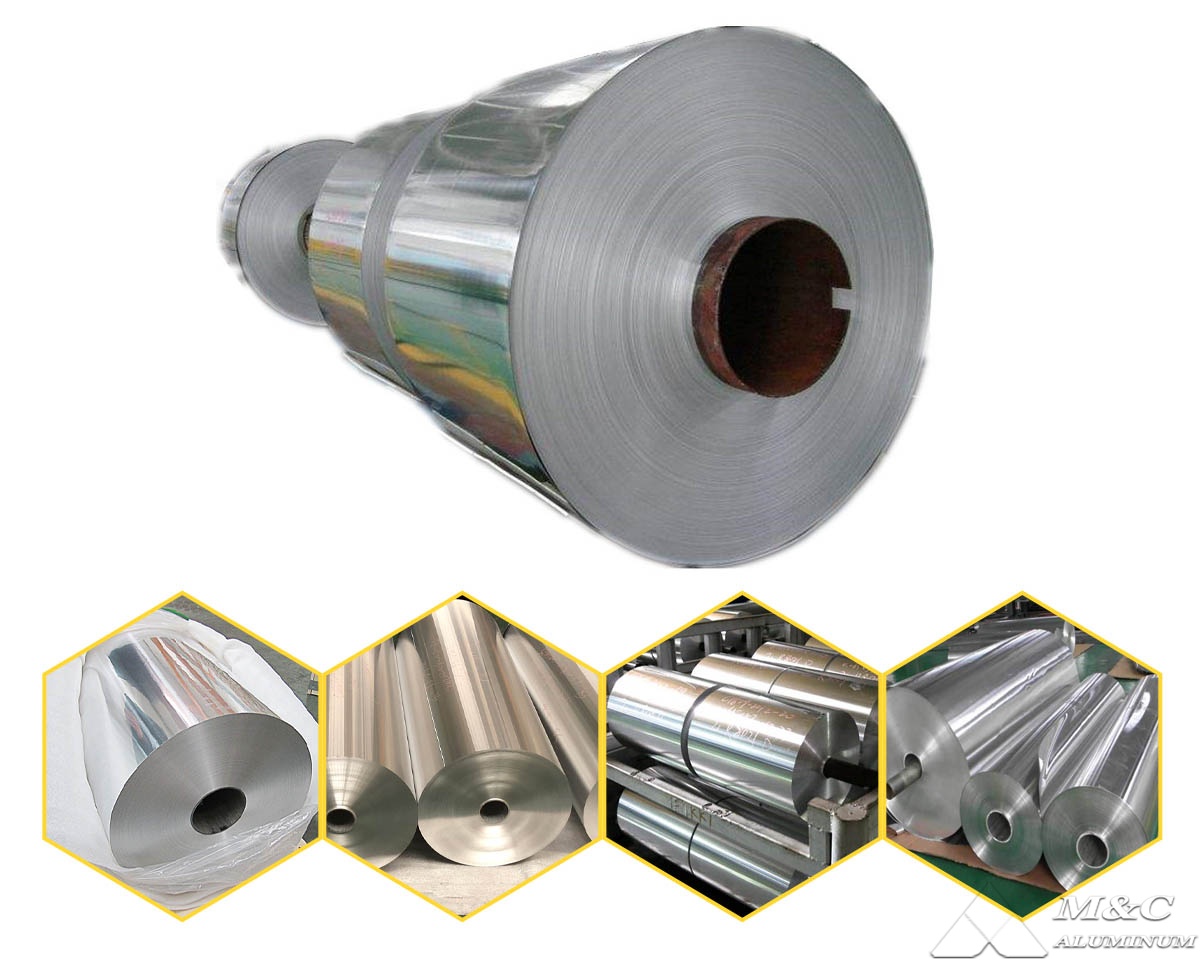
As an aluminum foil manufacturer, we produce 3003 aluminum foil for condenser applications used in residential air conditioners, commercial HVAC systems, refrigeration equipment, automotive heat exchangers, and industrial cooling units. Condenser aluminum foil is not a general packaging material. It is a precision fin stock that must support stable forming, efficient heat transfer, coating compatibility, corrosion resistance, and consistent performance during high-speed fin press operation.
3003 aluminum foil is widely selected for condenser fins because it combines medium strength, good formability, reliable corrosion resistance, and stable thermal conductivity. In our factory production, the alloy is controlled from melting and casting to rolling, annealing, slitting, surface treatment, and final inspection. This integrated manufacturing route allows us to supply aluminum fin stock with consistent thickness, mechanical properties, surface quality, and coil geometry for international condenser and heat exchanger manufacturers.
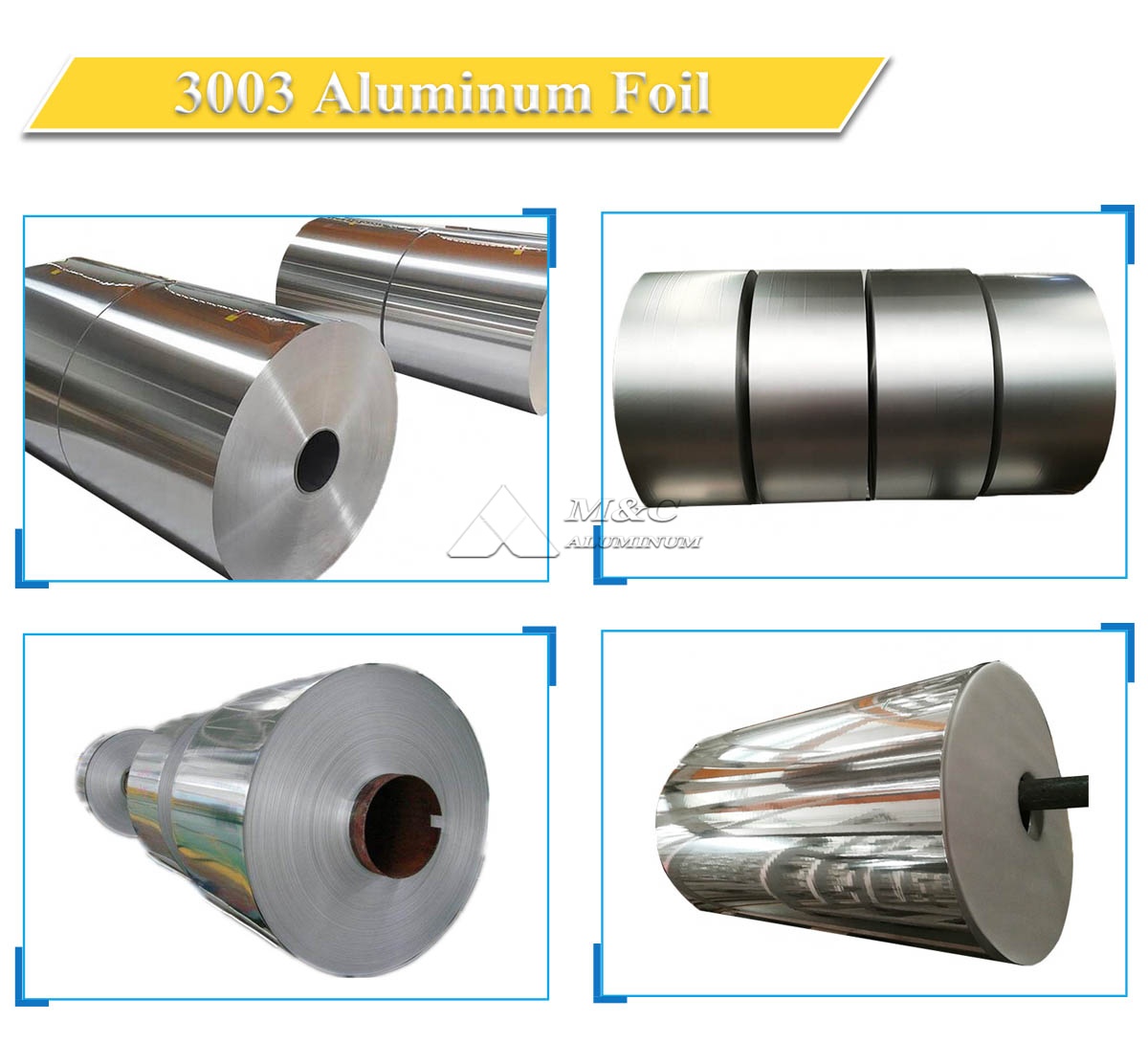
Why 3003 Aluminum Foil Is Used for Condensers
A condenser transfers heat from refrigerant to the surrounding air. The aluminum fin must provide a large heat exchange area while remaining light, thin, and mechanically stable. 3003 aluminum foil for condenser fins is suitable for this function because manganese improves strength compared with pure aluminum grades while maintaining excellent processability.
Compared with 1xxx series aluminum foil, 3003 aluminum foil offers higher tensile strength and better resistance to deformation during fin stamping and assembly. Compared with higher-strength alloys, it remains easier to roll into thin gauges and form into complex fin shapes without excessive cracking or tool wear. This balance makes 3003 aluminum foil a practical choice for louvered fins, corrugated fins, flat fins, and coated hydrophilic condenser fins.
For customers evaluating alloy options, our 3003 Aluminum Foil product line is manufactured for heat exchanger, condenser, evaporator, and related industrial applications where dimensional stability and surface cleanliness are critical.
Main Performance Requirements for Condenser Foil
Condenser aluminum foil is exposed to mechanical forming, coating, assembly, moisture, air pollutants, and thermal cycling. Therefore, production control must focus on more than chemical composition. The following performance requirements are especially important for OEM users.
First, thickness tolerance must be stable across the coil width and length. Uneven foil thickness can affect fin spacing, air flow resistance, heat transfer efficiency, and fin press stability. Second, the surface must be clean and suitable for hydrophilic coating, chromate-free treatment, or customer-specified surface conversion processes. Oil stains, black lines, oxidation marks, and rolling defects can reduce coating adhesion or cause rejection during inspection.
Third, mechanical properties must match the forming design. If the foil is too soft, fin collapse and poor dimensional retention may occur. If it is too hard, cracks can appear at the louver or bending area. Finally, coil winding quality must be controlled to support continuous production. A condenser fin press requires tight coil edges, accurate width, proper inner diameter, and no telescoping or loose winding.
Typical Technical Parameters
The following table shows common specifications for our 3003 aluminum foil for condenser applications. Final values can be customized according to drawing, coating system, fin design, and equipment requirements.
| Item | Typical Specification |
|---|---|
| Alloy | 3003 |
| Temper | O, H22, H24, H26, H18, customized by application |
| Thickness | 0.08 mm to 0.20 mm, common range 0.09 mm to 0.15 mm |
| Width | 60 mm to 1600 mm, slit to customer requirement |
| Inner Diameter | 76 mm, 150 mm, 200 mm, 300 mm, 500 mm, or specified |
| Outer Diameter | According to coil weight and equipment limit |
| Surface | Mill finish, degreased, hydrophilic coated, corrosion-resistant coated |
| Coating Color | Blue, gold, clear, or customer standard |
| Tensile Strength | Typically 120 MPa to 190 MPa depending on temper |
| Elongation | Controlled according to thickness and temper |
| Thickness Tolerance | As agreed by order specification and applicable standards |
| Edge Quality | Slit edge, burr controlled, no serious waves or cracks |
| Application | Condenser fins, evaporator fins, air conditioning fins, heat exchanger fins |
| Packing | Export wooden case, vertical or horizontal packing, moisture protection |
| MOQ | 1-3 tons |
Chemical Composition of 3003 Aluminum Foil
3003 is an Al-Mn series aluminum alloy. The addition of manganese improves strength and corrosion resistance while retaining good workability. In condenser foil production, chemical composition stability is important because small variations can influence rolling behavior, final mechanical properties, and coating performance.
| Element | Typical Range, percent |
|---|---|
| Si | 0.60 max |
| Fe | 0.70 max |
| Cu | 0.05 to 0.20 |
| Mn | 1.00 to 1.50 |
| Zn | 0.10 max |
| Other each | 0.05 max |
| Other total | 0.15 max |
| Al | Balance |
In our melting process, raw material input, alloying addition, degassing, filtration, and casting parameters are recorded and controlled. This helps reduce inclusions, pinholes, segregation, and surface defects during subsequent rolling. For condenser fin stock, stable metallurgy is the foundation of stable coil performance.
Manufacturing Process in Our Factory
Our production of 3003 aluminum foil for condenser begins with aluminum melt preparation and alloy composition control. After casting, the slab or coil stock is homogenized or processed according to the rolling route. Hot rolling and cold rolling reduce the material to the target thickness range, while intermediate annealing may be used to adjust work hardening and grain structure.
Final rolling is carried out under controlled tension, speed, lubrication, and roll surface condition. The purpose is to achieve uniform thickness, smooth surface, and stable flatness. After rolling, annealing is performed according to temper requirements. For O temper, full softness and high elongation are prioritized. For H22, H24, or H26, strength and formability are balanced for fin forming operations.
Slitting is another critical step. Condenser fins are often made from narrow-width foil coils, and edge quality directly affects feeding stability. Our slitting line controls burr height, edge wave, coil tension, and end face alignment. Each coil is marked and traceable to production batch, specification, and inspection records.
Hydrophilic Coated 3003 Aluminum Foil
Many condenser and evaporator systems require hydrophilic aluminum foil to improve condensate drainage and reduce water bridging between fins. A hydrophilic surface allows water to spread as a thin film instead of forming large droplets. This helps reduce air flow resistance, improve heat exchange performance, and limit noise caused by water retention.
Our hydrophilic coated 3003 aluminum foil can be supplied with blue, gold, clear, or customer-defined coating systems. Coating thickness, adhesion, corrosion resistance, and hydrophilic angle are controlled according to the application. In addition, pre-treatment and degreasing are carefully managed because coating performance depends strongly on base foil cleanliness.
For some heat exchanger structures, customers may also compare 3003 with other aluminum foil grades. As a factory with multiple alloy production capability, we can support related requirements such as 8011 Aluminum Foil when different strength, formability, or application standards are needed.
Quality Control for Condenser Aluminum Foil
Quality control is integrated into every stage of production rather than performed only before shipment. During rolling, online and offline measurements are used to monitor thickness and surface condition. After annealing, mechanical properties are tested to confirm that tensile strength and elongation meet the required temper. During slitting, width, burr, winding tension, and coil appearance are inspected.
For condenser aluminum foil, we commonly inspect the following items:
Chemical composition and batch traceability
Thickness, width, and coil dimensions
Tensile strength and elongation
Surface cleanliness and appearance
Pinholes, scratches, roll marks, and oxidation defects
Flatness, edge quality, and winding condition
Coating adhesion, hydrophilic performance, and corrosion resistance when coated foil is ordered
Inspection standards can be aligned with customer specifications, international standards, or mutually agreed technical agreements. Mill test certificates and relevant quality documents are provided with shipment when required.
Surface and Coating Considerations
The surface condition of 3003 aluminum foil for condenser has a direct influence on heat exchanger production. A clean mill finish is required for uncoated fin stock, while coated fin stock requires strong adhesion between the foil and coating layer. Residual rolling oil, uneven oxide film, and surface contamination can affect coating uniformity and long-term corrosion resistance.
Our factory controls rolling oil residue, annealing atmosphere, surface treatment, and packing environment to reduce contamination risk. For hydrophilic coated aluminum foil, we can evaluate coating weight, pencil hardness, adhesion, water contact angle, alkali resistance, salt spray resistance, and heat resistance according to the test method agreed with the customer.
In coastal, humid, or industrial environments, corrosion resistance becomes especially important. Proper alloy selection, surface pre-treatment, and coating system design help extend service life and maintain stable heat exchange performance.
Application Areas
3003 aluminum foil for condenser is used in a wide range of thermal management equipment. Common applications include residential air conditioner condensers, commercial HVAC heat exchangers, refrigeration condensers, cold chain equipment, automotive cooling systems, and industrial air cooling units.
The foil can be processed into louvered fins, slit fins, corrugated fins, and other designs. Different fin geometries require different combinations of temper, thickness, width tolerance, and surface treatment. For example, high-speed fin presses generally require excellent coil flatness and consistent mechanical properties. Hydrophilic coated fins require coating flexibility so that the coating does not crack or peel during forming.
Packing and Export Supply
As an export-oriented aluminum foil manufacturer, we pack condenser foil coils to protect the product during sea transportation, inland trucking, and warehouse storage. Common packing includes moisture-proof film, desiccant, edge protection, steel or plastic strapping, wooden cases, and palletized loading. Packing direction can be vertical or horizontal according to coil size and customer handling method.
Each package is labeled with alloy, temper, thickness, width, coil number, net weight, gross weight, and production batch. This supports traceability after arrival and helps customers manage inventory by specification.
How We Support OEM Condenser Manufacturers
Different condenser manufacturers use different fin dies, fin pitches, coating requirements, and production speeds. Therefore, we do not treat condenser aluminum foil as a single standard commodity. Before mass production, we can review customer drawings, trial specifications, target mechanical properties, surface requirements, and packing preferences.
For new projects, trial coils can be produced for forming evaluation and coating verification. Feedback from fin press trials is then used to adjust temper, thickness tolerance, surface condition, or coil winding parameters. This practical cooperation helps reduce production interruption and supports long-term stable supply.
Conclusion
3003 aluminum foil for condenser is a reliable aluminum fin stock for heat exchanger manufacturing because it offers a balanced combination of strength, formability, corrosion resistance, thermal performance, and coating compatibility. For condenser applications, the value of the material depends not only on alloy grade, but also on precise rolling, annealing, slitting, surface control, coating quality, and export packing.
As a factory manufacturer, we supply 3003 aluminum foil, hydrophilic aluminum foil, and condenser aluminum foil according to customer specifications. Through controlled production and systematic inspection, we provide stable materials for HVAC, refrigeration, automotive, and industrial heat exchanger manufacturers worldwide.