
Aluminum foil materials are widely used in food packaging, pharmaceutical packaging, industrial insulation, electronic shielding and many other fields. Different alloy systems determine their mechanical properties, formability, corrosion resistance and final applications.
Among them, 3003, 8011 and 8021 aluminum foil are three of the most common representative materials on the market. Although they all belong to the aluminum foil category, they differ significantly in alloy composition, performance characteristics and application fields.
Understanding Aluminum Foil Products
3003 Aluminum Foil
3003 aluminum foil belongs to the 3xxx series aluminum-manganese alloy, with manganese as the main alloying element. Compared with pure aluminum foil, 3003 aluminum foil has higher strength while maintaining good ductility, corrosion resistance and processing performance.
3003 aluminum foil cannot be strengthened by heat treatment and is usually strengthened through cold working. It has stable overall performance and is commonly used in applications that require certain strength, formability and corrosion resistance.
Common applications include:
Aluminum foil food containers
Honeycomb aluminum foil
Air-conditioning foil
Container foil
Heat exchanger materials
8011 Aluminum Foil
8011 aluminum foil belongs to the 8xxx series aluminum alloy, with iron and silicon as the main added elements. It is one of the most widely used aluminum foil materials today and has good deep-drawing performance, sealing performance and barrier properties.
8011 aluminum foil features a clean surface, flat shape and good pinhole control, making it suitable for food, pharmaceutical and daily-use product packaging. Its advantages lie in strong processing adaptability, wide application range and relatively reasonable cost.
Common applications include:
Food packaging
Household aluminum foil
Pharmaceutical packaging
Yogurt lid foil / dairy lid foil
Tape foil
8021 Aluminum Foil
8021 aluminum foil also belongs to the 8xxx series aluminum alloy. It has excellent barrier properties, ductility and deep-drawing performance. Compared with 8011 aluminum foil, 8021 aluminum foil performs better in some high-end packaging fields, especially in products that require excellent sealing, moisture resistance, light shielding and formability.
8021 aluminum foil is commonly used in high-end pharmaceutical packaging, battery soft-pack aluminum-plastic film and cold-forming packaging. It has good puncture resistance and deep-drawing performance, making it suitable for complex forming processes.
Common applications include:
Pharmaceutical cold-forming aluminum foil
Blister packaging
Battery soft-pack packaging
Core Performance Comparison
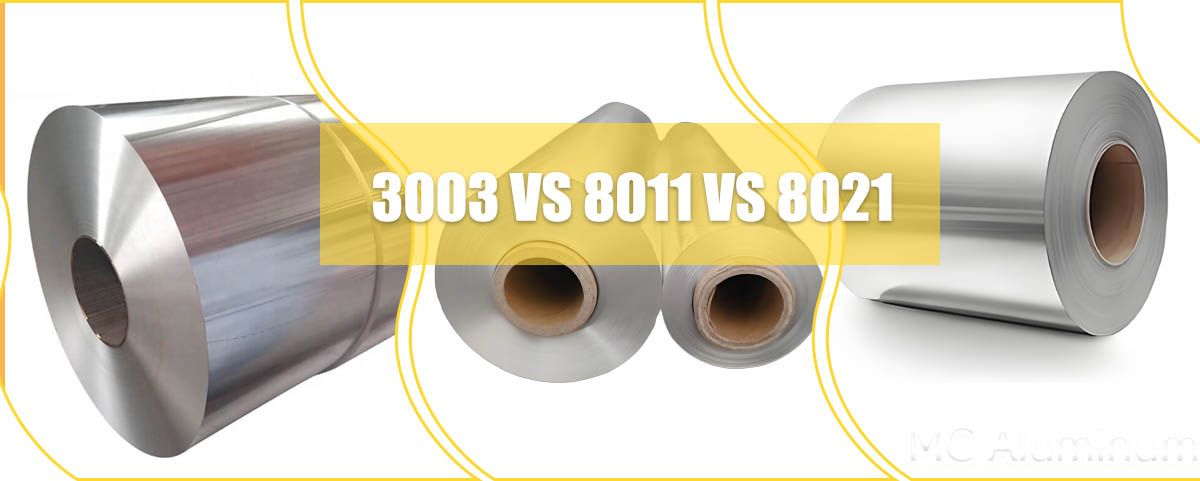
1. Composition and Mechanical Properties
| Property | 3003 Aluminum foil | 8011 Aluminum foil | 8021 Aluminum foil |
| Main Alloying Elements | Manganese, about 1.0% | Iron, silicon, trace elements | Iron, silicon, trace elements |
| Tensile Strength, MPa | 90-140 | 80-110 | 100-140 |
| Elongation, % | 10-15 | 10-15 | 8-12 |
| Thickness Range, mm | 0.006-0.2 | 0.006-0.2 | 0.006-0.2 |
| Formability | Excellent | Excellent | Good |
| Corrosion Resistance | Good | Very Good | Very Good |
2. Barrier Properties
Aluminum foil is widely used in the packaging industry mainly because of its excellent barrier performance. It can effectively block light, oxygen, water vapor and odors.
For 8xxx series aluminum foil, iron and silicon help refine the grain structure. In thin gauges, usually 0.006–0.02 mm, the pinhole rate is extremely low. These foils can provide complete light shielding and excellent resistance to oxygen and moisture penetration.
For high-end pharmaceutical packaging and lithium battery soft-pack applications requiring long-term protection, 8021 aluminum foil is usually preferred. 8011 aluminum foil comes next and is suitable for ordinary snack packaging, daily chemical packaging and general flexible packaging. 3003 aluminum foil may have slightly more pinholes in very thin gauges, so its barrier performance is more suitable for semi-rigid containers and thermal insulation facings. It is less commonly used alone in high-barrier flexible packaging.
Barrier performance ranking: 8021 > 8011 > 3003
3. Processing Performance
Before being used in actual applications, aluminum foil usually needs to go through multiple processes, such as rolling, annealing, slitting, coating, laminating, stamping and embossing. Different grades have different adaptability to these processing methods.
a. 3003 Aluminum Foil: Stable Forming Performance
3003 aluminum foil has good plasticity and stable formability, making it suitable for stamping and forming. Especially in the production of aluminum foil lunch boxes and container foil, 3003 aluminum foil can form good three-dimensional structures, and the finished products have relatively good stiffness.
b. 8011 Aluminum Foil: Strong Processing Adaptability
8011 aluminum foil has strong processing adaptability and is suitable for coating, printing, laminating, embossing and other processes. It can be processed into flexible packaging materials and can also be used for lid materials, sealing materials and other products.
This is one of the main reasons why 8011 aluminum foil is so widely used.
c. 8021 Aluminum Foil: Suitable for Deep Drawing and Lamination
8021 aluminum foil has obvious advantages in deep-drawing forming, especially for pharmaceutical cold-forming packaging. After lamination, it can be combined with nylon, PVC, PP and other materials to form a multilayer composite structure, providing stronger barrier properties and mechanical protection.
4. Corrosion Resistance and Heat Resistance
Corrosion resistance is a key factor in food packaging, refrigeration and outdoor insulation applications. Heat resistance is also important for steaming, cooking and high-temperature sterilization conditions.
3003 Aluminum Foil: Best Rust and Acid-Alkali Resistance Among the Three
The aluminum-manganese alloy forms a dense and stable oxide film. Since it does not contain excessive iron that may cause pitting corrosion, 3003 aluminum foil has good resistance to atmosphere, fresh water, weak acids, oils and fats.
It is suitable for long-term contact with acidic cooked foods and saline foods. Its heat resistance can reach up to about 240°C, allowing it to be directly used for oven food containers and high-temperature steaming trays.
In air-conditioning evaporators, 3003 aluminum foil can withstand long-term hot and cold cycling and is less likely to oxidize or leak. Therefore, it is suitable for humid, hot and mildly corrosive environments.
8011 Aluminum Foil: Qualified Corrosion Resistance at Room Temperature, Weaker at High Temperature
8011 aluminum foil generally has no corrosion risk when used for dry food packaging under normal conditions. However, when it is in long-term contact with acidic sauces or exposed to high-temperature cooking, silicon and iron impurities may cause slight pitting corrosion.
It is more suitable for room-temperature packaging and short-time heating applications. It is not recommended for direct contact with highly acidic or high-salt cooked foods.
8021 Aluminum Foil: Relatively Weaker Corrosion Resistance in Bare Foil Use
Due to its relatively high iron-containing composition, 8021 aluminum foil is more likely to show slight pitting corrosion in humid or acidic environments. Therefore, it is usually used as a base material in composite structures and relies on outer film layers to isolate water vapor, acids and alkalis.
It should not be used as bare foil in direct contact with corrosive contents.
5. Application Fields
| Alloy | Common Applications |
| 3003 Aluminum Foil | Food containers, lunch boxes, honeycomb aluminum foil, air-conditioning foil, heat exchanger fins, etc. |
| 8011 Aluminum Foil | Food packaging, household aluminum foil, sealing materials, pharmaceutical packaging, etc. |
| 8021 Aluminum Foil | Food packaging, household aluminum foil, sealing materials, pharmaceutical packaging, etc. |
Summary Comparison Table
| Comparison Item | 3003 Aluminum Foil | 8011 Aluminum Foil | 8021 Aluminum Foil |
| Alloy Series | 3xxx aluminum-manganese alloy | 8xxx aluminum alloy | 8xxx aluminum alloy |
| Main Elements | Mn | Fe, Si | Fe, Si, etc. |
| Strength | Relatively high | Medium | Medium to high |
| Ductility | Good | Good | Excellent |
| Formability | Good | Good | Very good, suitable for deep drawing |
| Barrier Performance | Good | Good | Excellent |
| Corrosion Resistance | Relatively good | Good | Good |
| Processing Adaptability | Suitable for stamping and container forming | Suitable for coating, lamination and packaging processing | Suitable for deep drawing, lamination and high-end packaging |
| Typical Uses | Lunch boxes, containers, honeycomb foil, heat exchangers | Food packaging, pharmaceutical packaging, household foil, sealing foil | Pharmaceutical cold-forming packaging, battery soft packs, high-barrier packaging |
| Application Positioning | Structural and container aluminum foil | General packaging aluminum foil | High-end barrier packaging aluminum foil |
How to Choose the Right Aluminum Foil
Common Tempers and Thickness Selection
3003, 8011 and 8021 aluminum foil are available in different tempers according to processing requirements, such as O temper, H14, H18, H22 and H24.
1. O Temper Aluminum Foil
O temper refers to the soft annealed state. It has good ductility and is suitable for deep drawing, lamination and flexible packaging processing.
O temper aluminum foil is commonly used in:
Pharmaceutical packaging
Food flexible packaging
Battery soft packs
Cold-forming packaging
2. H Temper Aluminum Foil
H temper refers to the strain-hardened condition. It has higher strength and better stiffness. Aluminum foil lunch boxes, container foil and sealing materials may use different H tempers according to product requirements.
Different tempers directly affect the strength, hardness and formability of aluminum foil. Therefore, even for the same alloy grade, different tempers can lead to different final application results.
Conclusion
Understanding the differences between 3003, 8011 and 8021 aluminum foil is essential for optimizing performance and cost-effectiveness in different applications.
3003 aluminum foil belongs to the aluminum-manganese alloy series. It has relatively high strength, good corrosion resistance and good forming performance. It is suitable for aluminum foil lunch boxes, food containers, honeycomb core materials and heat exchanger materials.
8011 aluminum foil is a widely used 8xxx series aluminum foil with balanced overall performance. It is suitable for general packaging applications such as food packaging, pharmaceutical packaging, household aluminum foil, sealing foil and tape foil.
8021 aluminum foil has better ductility, deep-drawing performance and barrier properties. It is suitable for pharmaceutical cold-forming packaging, battery soft-pack aluminum foil and high-end barrier packaging materials.