
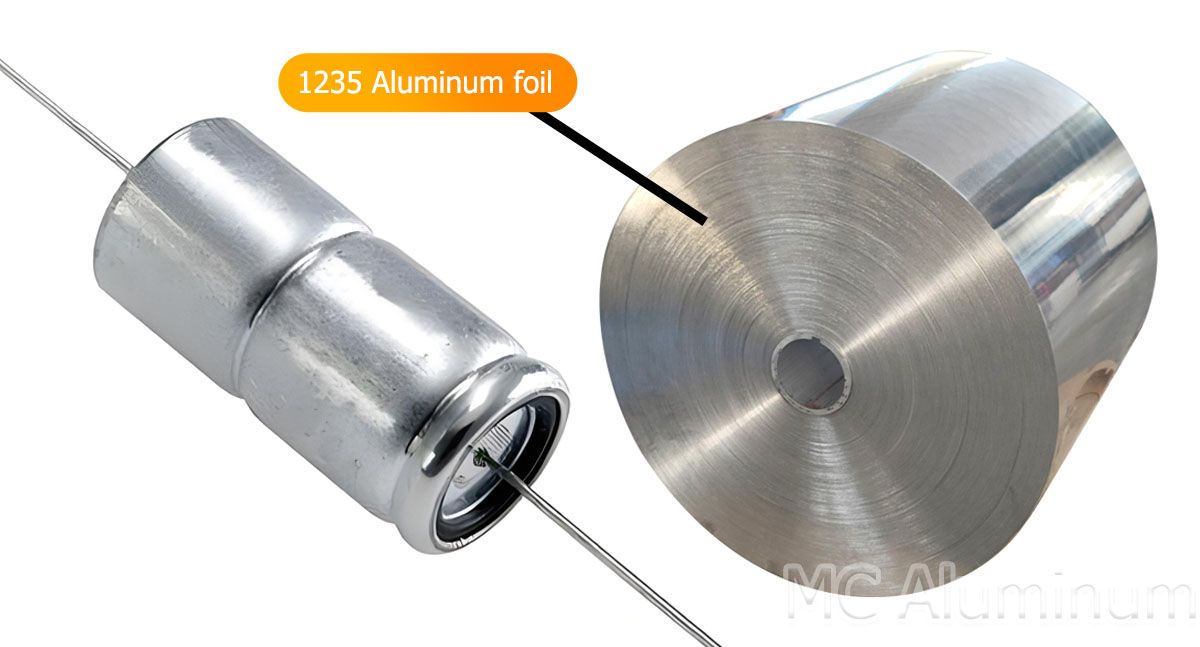
1235 capacitor aluminum foil is an aluminum foil material based on high-purity aluminum, offering good electrical conductivity and processing performance. It is widely used in aluminum electrolytic capacitors, electronic components, and other applications that require reliable conductivity and high dimensional accuracy.
During capacitor manufacturing, aluminum foil does more than conduct electricity. Its surface condition, purity, thickness uniformity, and mechanical properties can directly affect subsequent etching, formation, and winding processes. This article provides a detailed introduction to 1235 capacitor aluminum foil.
What Is 1235 Capacitor Aluminum Foil?
1235 is an industrial pure aluminum alloy in the 1xxx series and has a relatively high aluminum content. Compared with aluminum alloys containing higher levels of alloying elements, 1235 aluminum foil provides good electrical conductivity, ductility, and plasticity. Its low alloying level also makes it suitable for continuous processing operations such as rolling, slitting, and winding.
1235 aluminum foil can be supplied in different thicknesses, widths, and tempers according to specific application requirements. For capacitor-related applications, the material requires strict rolling and surface-quality control in order to achieve uniform thickness and stable surface quality.
1235 capacitor-grade aluminum foil is produced through precision rolling, annealing, and purification processes. It is specially designed as an electrode substrate for aluminum electrolytic capacitors and is generally divided into two categories: anode aluminum foil and cathode aluminum foil. In the market, the 1235 alloy is commonly used for capacitor cathode foil.
For aluminum electrolytic capacitors, aluminum foil is typically used together with etching and formation processes. As an electrode material, the surface characteristics of the foil affect its effective surface area and the subsequent formation of the dielectric oxide film. Therefore, material quality control is especially important.
Common Temper Conditions
O Temper
O temper refers to the fully annealed condition. After cold rolling, the foil is fully annealed at approximately 200–300°C, eliminating dislocations and producing uniform, equiaxed grains. Elongation is typically above 20% and can reach as high as 37%.
Anode foil usually enters the etching process in the O temper condition. Uniform grain structure and dispersed second-phase particles, such as Fe and Si, are beneficial to the uniform nucleation and growth of etching pits.
For example, when 1235D is annealed at approximately 460°C, the second-phase particles and grains can become relatively fine—about 1.19 μm and 9.09 μm, respectively—while elongation can reach approximately 37.4%. Annealing temperatures that are too low or too high may negatively affect etching uniformity.
H18 Temper
H18 is a full-hard temper, meaning that the foil is not annealed after the final rolling process. It typically has a tensile strength of 140–180 MPa, a yield strength of 120–150 MPa, and an elongation below 5%.
Although H18 aluminum foil has limited formability, it offers strong resistance to deformation. Cathode foil generally does not require deep etching and mainly needs to withstand winding tension and high-speed processing. Therefore, H18 can be a suitable choice for certain cathode foil applications.
H18 is also a common general supply temper for 1235 aluminum foil, with a mature and well-established supply chain.
H22 and H24 Tempers
H22 and H24 are partially annealed tempers. The aluminum foil is cold rolled close to the final thickness and then subjected to low-temperature annealing. Cold-work hardening is partially relieved, but the material is not fully recrystallized, achieving a balance between strength and ductility.
H22 is often used as an intermediate supply temper for cathode foil. It provides sufficient stiffness and tensile strength while reducing the edge-cracking risk associated with overly brittle H18 material.
H24 is a half-hard temper, typically featuring a tensile strength of 125–145 MPa and elongation of approximately 8%–15%. It is suitable for light bending and slitting operations and can also be used for low-voltage cathode foil or as an intermediate processing temper.
Specifications of 1235 Capacitor Aluminum Foil
| Product | Aluminum foil for electrolytic capacitors | ||||
| Alloy | 1235 | ||||
| Temper | H18,O | ||||
| Thickness | 0.006–0.20 mm, customizable | ||||
| Thickness tolerance | 0.0045mm | ±5% | |||
| 0.0050mm | |||||
| 0.0055mm | |||||
| 0.0060mm | +2%,-5% | ||||
| Width | 50–1650 mm, slit to customer requirements | ||||
| Width tolerance | ≤400mm | ±0.5mm | |||
| >400mm | ±1.0mm | ||||
| Length | 1,000–16,000 mm | ||||
| Coil outer diameter | ≤Φ350mm | ≤Φ550mm | |||
| Connector (nose/coil) | Width | ≤200 | ≤300 | 300~350 | >350 |
| Joint | 0 | ≤1 | ≤2 | ≤5 | |
| Tensile Strength | H18 | 40-95Mpa | |||
| O | ≥115Mpa | ||||
| Relax | ≤1 meter | ||||
| Pinhole | 0.0045mm | ≤8,000 units/m² | |||
| 0.0050mm | ≤4,000 units/m² | ||||
| 0.0055mm | ≤2,000 units/m² | ||||
| 0.0060mm | ≤1,000 units/m² | ||||
| Pinhole diameter | ≤0.2 mm | ||||
| Surface | Bright finish or specified surface condition | ||||
| Surface Quality | Clean and flat; free from obvious oil stains, scratches, cracks, dents, and other defects | ||||
| Edge Condition | Precision slitting with controlled burrs and edge defects | ||||
| Applications | Aluminum electrolytic capacitors, electrode materials, and electronic components | ||||
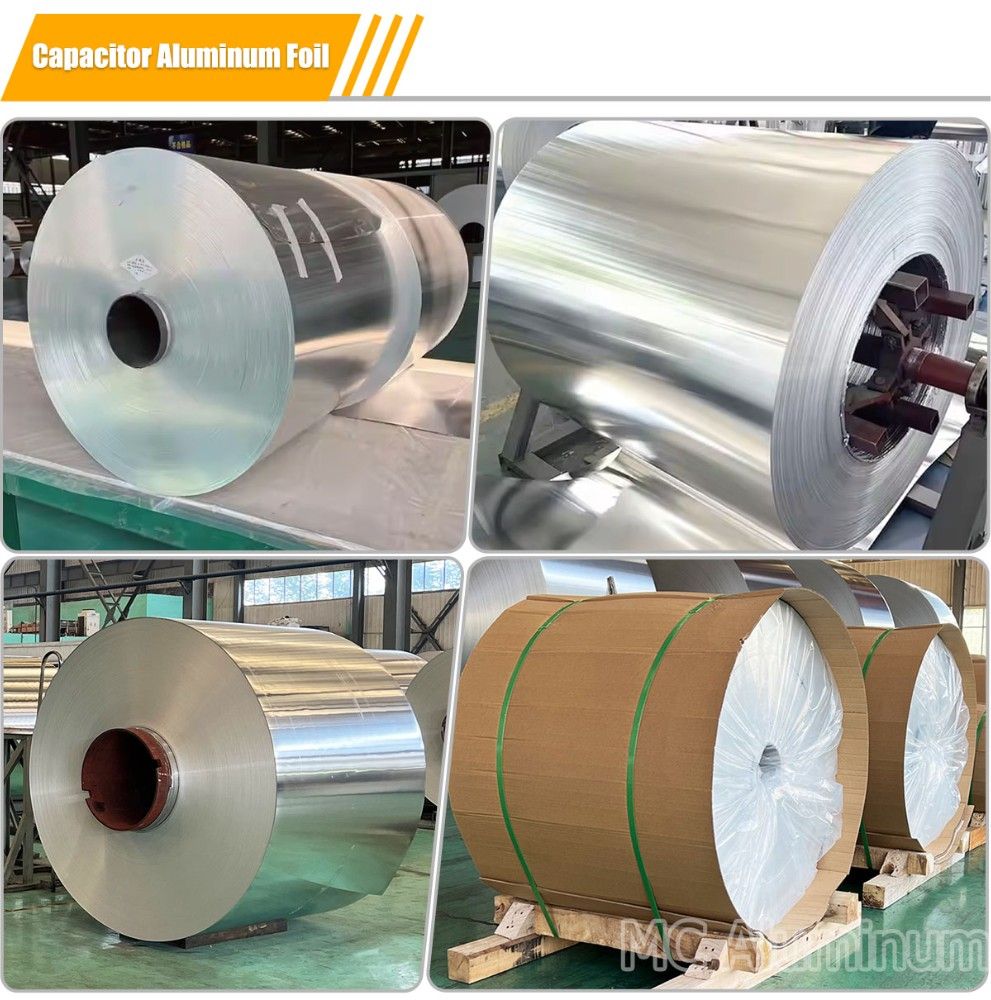
| Packaging | Wooden cases, pallets, or export-standard packaging | ||||
| MOQ | 3 tons | ||||
Why Is 1235 Aluminum Foil Suitable for Capacitors?
1. High Aluminum Content
1235 aluminum foil has a high aluminum content, enabling good electrical conductivity. For capacitor electrode materials, stable conductivity helps meet the current-transmission requirements of electronic components.
Its high aluminum content also provides good ductility and processing adaptability, supporting continuous rolling and precision slitting requirements.
2. Good Electrical Conductivity
1235 aluminum foil provides reliable conductivity while maintaining lightweight characteristics and thin-gauge capability. It can meet the fundamental conductivity requirements of capacitor aluminum foil.
For electronic components that require stable long-term operation, consistent material properties also help improve manufacturing consistency.
3. Excellent Ductility and Plasticity
1235 capacitor foil has good ductility and plasticity. It can adapt to the processing requirements of thin aluminum foil, including rolling, slitting, and winding, while helping reduce the risk of foil breakage during high-speed production.
4. Good Rolling and Processing Performance
Capacitor aluminum foil generally requires high thickness precision and stable flatness. 1235 aluminum foil is suitable for continuous cold-rolling production. Through multiple rolling passes, it can gradually reach the required thickness, providing stable raw material for subsequent slitting and capacitor manufacturing.
5. Excellent Etching Properties and High Specific Surface Area
Cathode foil generally requires electrochemical etching to create a large number of micropores on the aluminum foil surface. This increases the effective surface area and improves capacitor capacitance.
The relatively uniform microstructure of 1235 alloy helps produce fine and evenly distributed etching pores. This can steadily improve specific capacitance and meet the capacitance requirements of low-voltage capacitors.
6. Stable Surface Quality
High-quality 1235 aluminum foil requires strict control of defects such as oil contamination, scratches, dents, pinholes, and edge cracks. Stable surface quality can reduce the risk of abnormalities during subsequent etching, formation, and winding processes.
7. Significant Cost Advantage
Compared with 4N high-purity aluminum cathode foil, 1235 aluminum has slightly lower purity but can still meet the electrochemical performance requirements of low-voltage aluminum electrolytic capacitors. It offers lower raw material costs and is a cost-effective choice for cathode foil in consumer electronics and general power-supply capacitors.
Application Areas of 1235 Capacitor Aluminum Foil
1235 capacitor foil is widely used in the following applications:
Consumer electronics: capacitors used in power adapters, chargers, televisions, and computer motherboards;
Lighting industry: electrolytic capacitors in LED driver power supplies;
Industrial control and home appliances: auxiliary capacitors in inverters, air-conditioner control boards, and washing-machine control boards;
New energy support systems: low-voltage filter capacitors in small energy-storage modules and battery management systems;
Communication equipment: aluminum electrolytic capacitors for power filtering in routers and network switches.
The Role of 1235 Aluminum Foil in Aluminum Electrolytic Capacitors
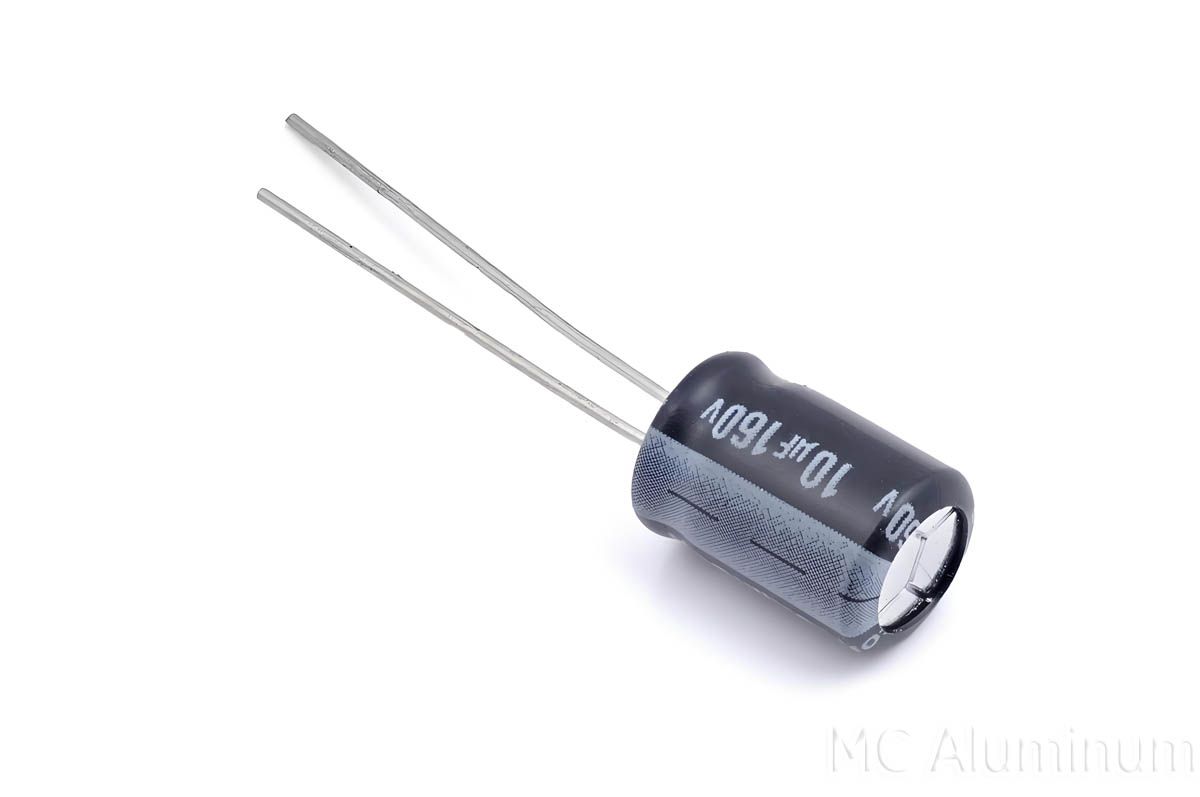
Aluminum electrolytic capacitors generally use aluminum foil as the electrode material. A capacitor structure is formed through the combination of aluminum foil, electrolyte, and a dielectric oxide film.
During manufacturing, the aluminum foil first undergoes appropriate surface treatment and etching processes. By increasing the effective surface area of the foil, the capacitance performance of the final capacitor can be improved.
The foil then undergoes a formation process, during which an electrically insulating aluminum oxide film is created on its surface. This oxide film serves as the dielectric layer of the capacitor.
As a result, the purity, surface condition, crystal structure, and processing performance of aluminum foil can all influence downstream manufacturing processes.
For 1235 aluminum foil, its good processing performance meets the requirements of continuous production of thin-gauge materials, while its stable surface quality supports subsequent etching and formation operations.
Simplified Production Process of 1235 Capacitor Aluminum Foil
From aluminum slab to finished product, 1235 capacitor aluminum foil is manufactured through a precise process combining metallurgy, rolling, and heat treatment.
1. Cast-Rolling / Hot-Rolling Stock Preparation
Aluminum is melted and cast according to the chemical composition requirements of the 1235 alloy. Impurity elements are controlled to produce qualified aluminum slabs or rolling stock.
2. Multi-Pass Cold Rolling
The material is repeatedly precision rolled to gradually reduce it to the target thickness. During this stage, flatness and thickness tolerance are carefully controlled.
3. Annealing Treatment
For O temper foil, full annealing is performed to eliminate rolling stress, soften the foil, and control the internal grain structure in preparation for subsequent etching.
4. Surface Cleaning and Purification
Rolling oil and other contaminants are removed, and residual oil levels on the foil surface are controlled.
5. Slitting
The aluminum foil is slit into narrow widths according to the requirements of capacitor manufacturers.
6. Inspection and Packaging
Finished foil is inspected for thickness, tensile strength, elongation, and surface quality. Samples may also undergo etching verification. The finished products are then delivered in vacuum moisture-proof packaging.