
With the rapid development of the electric vehicle industry, battery energy density, charging speed, cycle life, and safety have become key areas of competition. As more battery manufacturers shift their attention from active materials alone to the "invisible" supporting components within battery cells, carbon-coated aluminum foil is rapidly evolving from an optional material into a standard solution for high-performance batteries.
What Is Carbon-Coated Aluminum Foil?
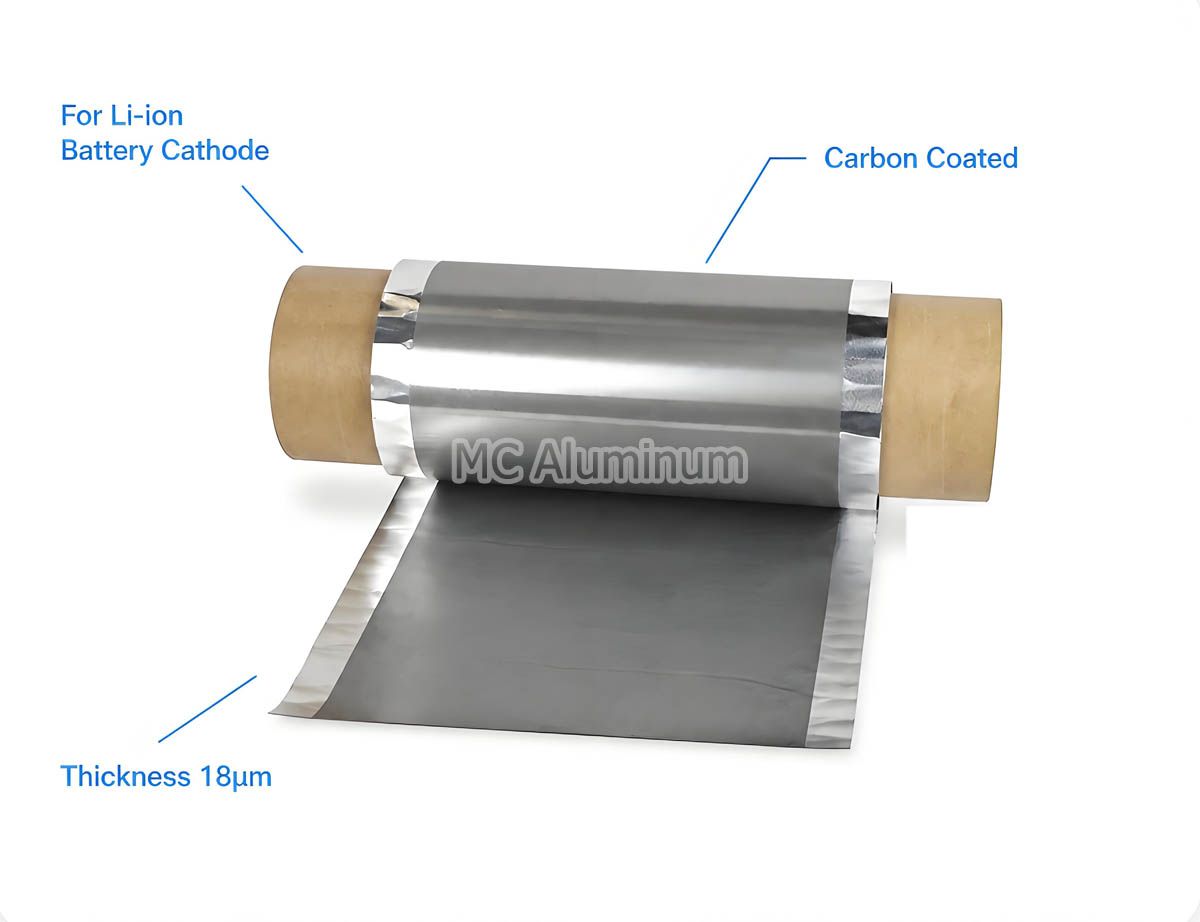
Carbon-coated aluminum foil is a composite current collector made by uniformly applying a conductive carbon layer-typically graphite or carbon black-onto high-purity aluminum foil. The carbon layer is generally only 1–3 microns thick.
Carbon coatings can also improve mechanical properties, including scratch resistance, wear resistance, and, in some cases, structural strength.
They can act as a barrier layer, protecting the underlying material from corrosion, oxidation, and even harmful ultraviolet radiation. Certain carbon coatings also offer unique thermal properties, enabling efficient heat dissipation or, depending on the application, functioning as micro-heating elements. In short, carbon coatings are versatile tools that improve the functionality, durability, and performance of a wide range of products.
This coating enhances aluminum foil performance in several ways:
Improved conductivity: Creates a continuous pathway for electron transport, reduces internal resistance, and improves battery performance.
Enhanced adhesion: The carbon layer acts as an interfacial bonding layer, helping electrode materials adhere firmly to the foil. This reduces delamination and supports efficient charge transfer.
Increased surface area: The textured carbon-coated surface provides more anchoring sites for active materials, helping maximize battery capacity.
In lithium-ion traction batteries, aluminum foil is commonly used as the cathode current collector. After cathode active materials are coated onto the aluminum foil surface, the foil collects electrons and conducts current to the external circuit.
Compared with bare aluminum foil, a carbon coating can form a more stable interface between the aluminum substrate and the electrode active material, helping improve contact and reduce interface-related resistance. Studies indicate that carbon-coated current collectors can improve adhesion between active materials and aluminum foil while reducing charge-transfer resistance.
Carbon Coating Methods
Aluminum foil is an ideal material for battery current collectors. However, bare aluminum foil still has limitations when meeting the requirements of high-performance batteries. Conductive carbon coatings have therefore become increasingly important. At present, there are three mainstream coating methods.
1. Chemical Vapor Deposition (CVD)
CVD involves placing aluminum foil in a controlled temperature and pressure environment. Hydrocarbon gases are introduced, allowing the carbon source to decompose and deposit on the aluminum foil surface, forming a conductive carbon layer.
Advantages:
Precise control over coating thickness and uniformity
Suitable for ultra-thin coatings and applications requiring high consistency
Challenges:
Relatively slow deposition rate
High equipment and processing costs
Limited mass-production efficiency
Suitable for:
High-end research and development, batteries with specialized structures, or applications requiring extremely high coating precision.
2. Electrophoretic Deposition (EPD)
EPD uses an electric field to drive charged carbon particles toward the aluminum foil surface, where they are deposited to form a coating.
Advantages:
Faster and more cost-effective than CVD
Relatively simple process
Challenges:
More difficult to precisely control coating thickness and uniformity
Maintaining consistency in large-area production can be challenging
Suitable for:
Cost-sensitive applications, applications with relatively flexible uniformity requirements, or current collectors with special shapes.
3. Solution Coating Process
The solution coating process involves applying carbon-based ink or slurry to the aluminum foil surface, followed by drying and curing to form a carbon coating. Common coating methods include gravure coating, micro-gravure coating, and slot-die coating.
Advantages:
Flexible process and relatively low cost
Compatible with roll-to-roll continuous production
Suitable for large-scale manufacturing
Challenges:
Aluminum foil pretreatment is usually required to achieve optimal adhesion
Slurry formulation, drying profile, and curing conditions must be carefully optimized
Suitable for:
The mainstream mass-production route for carbon-coated aluminum foil used in power batteries, particularly for lithium iron phosphate and ternary lithium battery systems.
Main Functions of Carbon-Coated Aluminum Foil in EV Batteries
Carbon-coated aluminum foil is mainly used as a cathode current collector. Its primary role is to optimize the electrode interface and improve overall battery performance.
1. Lower Interfacial Contact Resistance
The surface conductive carbon layer forms a uniform conductive network and increases the effective contact area between the active material and aluminum foil. This reduces interfacial impedance and energy loss while improving high-current output performance.
2. Improved Electrode Adhesion
Carbon coatings provide appropriate surface roughness and wettability, improving bonding between cathode slurry and aluminum foil. This helps reduce powder shedding, cracking, and edge lifting, while improving manufacturing yield. It is especially suitable for thick electrodes and high-compaction-density processes.
3. Better Rate Capability and Fast-Charging Performance
By optimizing electron-conduction pathways and reducing internal contact resistance within the electrode, carbon-coated aluminum foil can support improved high-rate charge/discharge performance and fast-charging capability.
However, fast-charging performance is also influenced by many factors, including cathode and anode materials, electrolyte formulation, cell structure, and thermal management. Carbon-coated aluminum foil should therefore be matched with the overall battery design.
4. Improved Cycle-Life Stability
The conductive coating can serve as a buffer layer and conductive transition layer between aluminum foil and the cathode material. It helps maintain stable interfacial contact during long-term cycling and improves cycling consistency in LFP, NCM, and other battery chemistries.
5. Enhanced Battery Manufacturing Consistency
High-quality carbon-coated aluminum foil should offer uniform coating distribution, stable sheet resistance, reliable adhesion, and good coil flatness. These properties help reduce coating-process variation and improve electrode-processing yield and batch-to-batch consistency.
Which Battery Chemistries Can Use Carbon-Coated Aluminum Foil?
Carbon-coated aluminum foil is primarily used as a cathode current collector in lithium-ion batteries. It can be selected and customized according to battery chemistry, manufacturing route, and performance requirements.
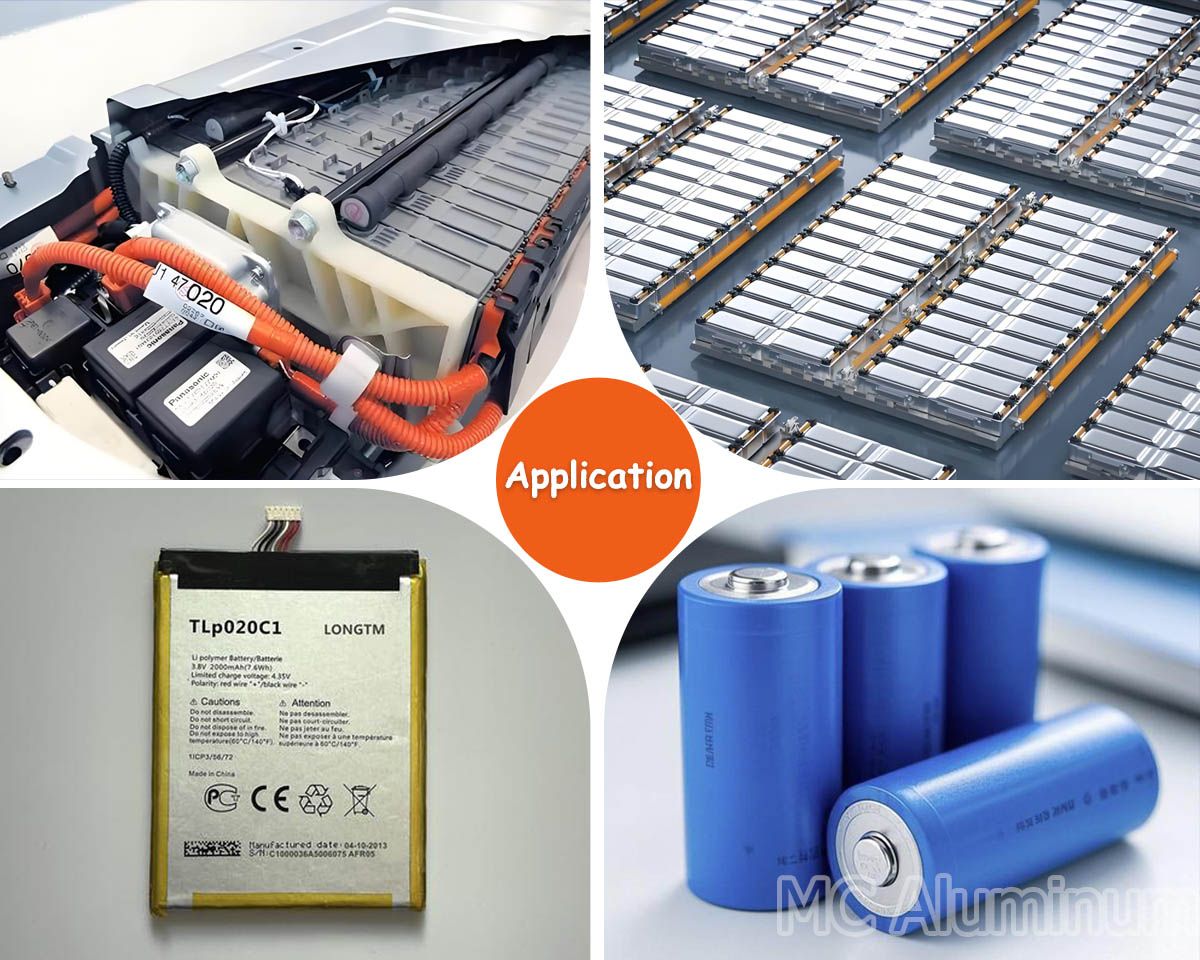
Common applications include:
Lithium Iron Phosphate Batteries (LFP)
Lithium iron phosphate offers high safety, long cycle life, and relatively stable cost. It is widely used in battery electric vehicles, commercial vehicles, energy-storage systems, and electric two-wheelers.
Because LFP has relatively low intrinsic electronic conductivity, carbon-coated aluminum foil can help improve cathode interfacial conductivity and electrode manufacturing stability.
Ternary Lithium Batteries (NCM/NCA)
Ternary lithium batteries offer high energy density and are commonly used in passenger vehicles requiring longer driving range. For high-nickel NCM materials, single-crystal ternary materials, and high-compaction cathode designs, carbon-coated aluminum foil can help improve electrode adhesion and interfacial conductivity, supporting high-energy-density cell designs.
Lithium Manganese Oxide Batteries (LMO)
Lithium manganese oxide batteries provide good rate capability and cost advantages. They can be used in certain power batteries, hybrid electric vehicles, and specialized power-supply applications.
Carbon-coated aluminum foil can improve contact between active materials and the current collector, making it suitable for battery products requiring power output and cycling stability.
Sodium-Ion Batteries and Emerging Energy-Storage Batteries
As sodium-ion battery commercialization accelerates, functional aluminum foil current collectors are receiving increasing attention. Carbon-coated aluminum foil can be developed for different cathode materials, electrolyte systems, and manufacturing processes, providing an optional current-collector solution for sodium-ion and next-generation energy-storage batteries.
Production Process of Carbon-Coated Aluminum Foil
High-quality carbon-coated aluminum foil depends not only on the aluminum foil substrate, but also on the carbon slurry system and coating process.
A typical production process includes:
Battery-Grade Aluminum Foil → Surface Treatment → Carbon Slurry Preparation → Precision Coating → Drying/Curing → Surface Inspection → Slitting → Packaging
The carbon slurry formulation typically requires balanced consideration of conductive materials, binders, dispersing systems, and solvents.
During coating, the following factors require close control:
Carbon-layer thickness
Coating uniformity
Coating weight
Surface resistance
Coating adhesion
Aluminum foil substrate thickness
Coil width
Edge quality
Pinholes and surface defects
For power-battery manufacturers, stable coil quality and batch-to-batch consistency are just as important as achieving a specific laboratory performance metric.
Carbon Coatings in Lithium-Ion Batteries
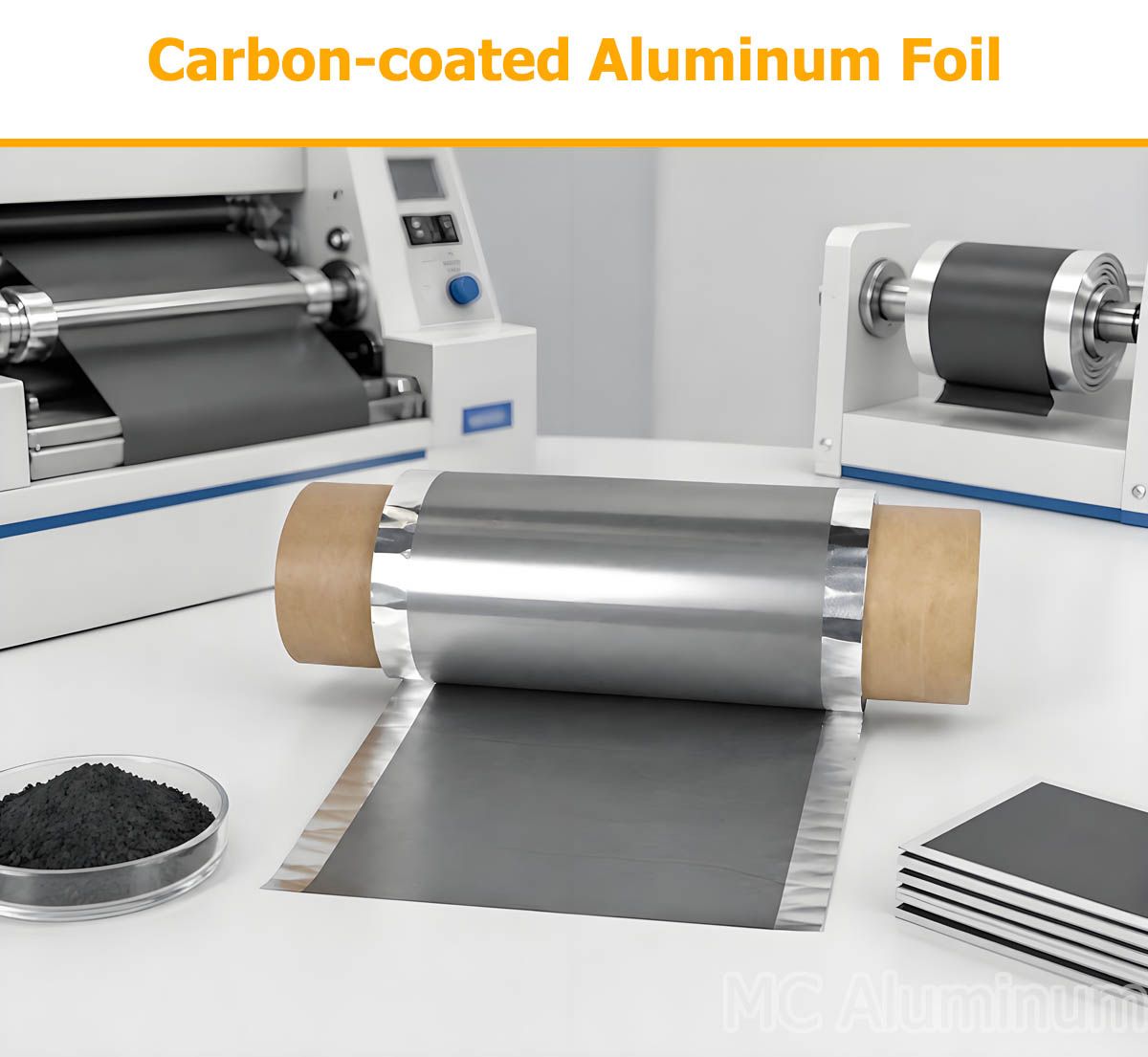
In lithium-ion batteries, carbon coatings are mainly applied to the surface of cathode current collector aluminum foil. The coating typically consists of conductive carbon materials, binders, and other functional components.
The main advantage of carbon coatings is their ability to enhance electrical conductivity, converting non-conductive or poorly conductive interfaces into efficient electron-conduction pathways.
Carbon coatings contribute to innovation in EV battery electrode films. They can improve battery performance, extend driving range, and increase service life, thereby supporting the development of sustainable transportation.
Key benefits include:
Improved interfacial conductivity: Enhances electron transfer between cathode active materials and aluminum foil.
Enhanced adhesion: Strengthens bonding between cathode materials and the current collector, reducing the risk of material shedding during cycling.
Reduced interfacial impedance: Optimizes electrode/current collector contact and supports improved high-rate charging and discharging performance.
Improved corrosion resistance: The carbon layer can reduce direct contact between aluminum foil and electrolyte or other media, improving interfacial stability.
Better cycling stability: A stable electrode interface helps maintain structural integrity during long-term charge and discharge cycles.
For these reasons, carbon-coated aluminum foil is particularly suitable for power lithium-ion batteries, EV batteries, and battery systems with high requirements for rate performance and interfacial stability.
Why Choose Our Carbon-Coated Aluminum Foil?
MC Aluminum produces carbon-coated aluminum foil using advanced precision-coating technology. Nano-scale conductive carbon materials are uniformly and firmly coated onto the surface of high-purity aluminum foil, offering the following key features:
1.Excellent Electrical Conductivity
Optimized carbon-slurry formulations provide low resistivity and high electrical conductivity, effectively reducing battery ohmic resistance and charge-transfer resistance.
2.Outstanding Adhesion
Through surface pretreatment and specialized binder systems, the carbon coating forms a strong bond with the aluminum foil substrate. The coating offers high peel strength and can meet demanding calendering and winding process requirements.
3.Uniform and Consistent Coating Quality
Precision coating equipment is used to control coating-thickness tolerance within a narrow range, helping ensure batch-to-batch consistency and stable battery performance.
4.Broad Compatibility
Our products are suitable for various cathode systems, including lithium iron phosphate, ternary materials, and lithium manganese oxide. They are also compatible with silicon-based anodes and next-generation solid-state battery architectures.
5.Customizable Specifications
Single-sided or double-sided coating options are available. Aluminum foil thickness and coating thickness can be flexibly adjusted according to customer requirements to meet the needs of different battery designs.