
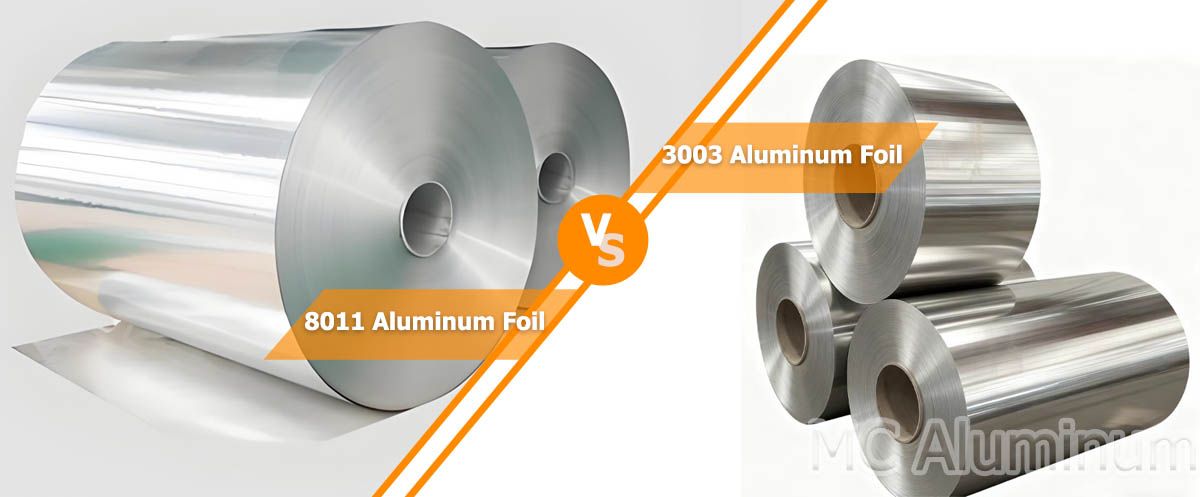
In the aluminum processing industry, 8011 aluminum foil and 3003 aluminum foil are two widely used materials, especially in packaging, food, pharmaceutical, and industrial applications. Each has its own unique properties and suitable application scenarios. Below, we will take an in-depth look at the differences between them to help you better understand and choose the right type of aluminum foil.
Differences in Alloy Composition
8011 Aluminum Foil: Multi-Purpose General Alloy
8011 aluminum foil belongs to the 8xxx series alloy. It is based on pure aluminum with relatively high additions of Fe (iron) and Si (silicon). The addition of iron and silicon gives it high tensile strength and toughness while maintaining excellent stamping and elongation properties.
3003 Aluminum Foil: Anti-Rust Rigid Alloy
3003 aluminum foil belongs to the typical 3xxx series aluminum-manganese alloy. Its main alloying element is Mn (manganese). The addition of manganese makes 3003 a material with excellent anti-rust performance and good work-hardening capability.
Chemical Elements (%)
| Alloy | Si | Fe | Cu | Mn | Mg | Cr | Zn | Ti | Other:Each | Other:total | Al |
| 8011 | 0.50-0.90 | 0.6-1.0 | 0.10 | 0.20 | 0.05 | 0.05 | 0.10 | 0.08 | 0.05 | 0.15 | remainder |
| 3003 | 0.6 | 0.7 | 0.05-0.20 | 1.0-1.5 | - | - | 0.1 | - | 0.05 | 0.15 | remainder |
3003 alloy relies on manganese to enhance its strength, while 8011 alloy uses iron and silicon to balance overall performance.
Mechanical Properties
1. Tensile Strength
3003 aluminum foil has higher tensile strength than 8011 aluminum foil. This makes it stronger and more suitable for structural applications.
| Temper | 3003 | 8011 |
| O | 80–135 MPa | 60–110 MPa |
| H14 | 140–180 MPa | 120–150 MPa |
| H18 | 170–200 MPa | 150–180 MPa |
| H24 | 140–190 MPa | 120–170 MPa |
2. Yield Strength
3003 aluminum maintains higher yield strength in all temper conditions and offers better resistance to deformation under load.
| Temper | 3003 | 8011 |
| H24 | 55–90 MPa | 35–60 MPa |
3.Hardness
| Alloy | Hardness (HB) |
| 3003 | 50-60 |
| 8011 | 30-45 |
Conclusion
If the product requires higher hardness and better support, 3003 aluminum foil is preferred.
If flexibility and forming performance are more important, 8011 aluminum foil has more advantages.
Corrosion Resistance
3003 aluminum foil is a classic anti-rust aluminum material. The manganese element helps form a dense oxide film, giving it strong resistance to acid, alkali, salt spray, and moisture corrosion. It is suitable for humid and corrosive environments, such as air-conditioning heat exchangers, outdoor insulation materials, and chemical containers.
8011 aluminum foil also has good corrosion resistance and can handle daily humid environments. However, long-term exposure to acids, alkalis, or high-salt-spray environments may cause slight corrosion. Therefore, it is more suitable for dry and clean packaging applications.
Temperature Resistance
3003 aluminum foil can withstand long-term temperatures from -40°C to 180°C, and short-term temperatures up to 250°C. Manganese improves its high-temperature stability, allowing it to be directly heated over an open flame or baked in an oven. When used for aluminum foil containers or barbecue trays, it does not deform easily or release harmful substances.
8011 aluminum foil can withstand long-term temperatures from -40°C to 150°C, and short-term temperatures up to 200°C. It is suitable for medium- and low-temperature applications, such as refrigerated packaging and room-temperature sealing. Long-term high-temperature exposure may cause softening and reduce stiffness.
Cost
Because manganese is more expensive than iron and silicon, the cost of 3003 aluminum foil is generally 10%–15% higher than that of 8011 aluminum foil.
For packaging applications that require good barrier performance and flexibility while remaining cost-sensitive, 8011 aluminum foil is the "king of cost performance."
For industrial applications with strict requirements for strength, heat resistance, and corrosion resistance, and where the budget is sufficient, the long-term stability of 3003 aluminum foil is more economical.
Application Scenarios
(1) Applications of 3003 Aluminum Foil
Containers / Food Service: Single-compartment rigid aluminum foil food containers, oven trays, and pressure cooker components (resistant to deformation at high temperatures);
Air Conditioning / Heat Exchange: Aluminum foil for AC evaporators and condensers, and heat exchangers (resistant to humid heat and corrosion);
Construction / Industrial: Aluminum honeycomb cores, building insulation and soundproofing materials, chemical liquid storage tanks, and power battery casings (characterized by high strength and impact resistance).
Honeycomb Aluminum Foil: For aluminum honeycomb cores-used in architectural decoration or as core materials in vehicle sandwich structures-where requirements for hardness and structural integrity are extremely rigorous, Alloy 3003 is the preferred choice.
(2) Applications of 8011 Aluminum Foil
Food Packaging: Milk powder lid films, laminated pouches for coffee and tea, retort pouches for cooked foods, and household foil for grilling and baking (ideal for complex shapes);
Pharmaceutical Packaging: PTP pharmaceutical foil (blister packaging), tubes for medicinal ointments, and laminated films for powdered medications (featuring high-barrier properties to prevent moisture ingress);
Daily Necessities & Electronics: Cigarette inner liners, cosmetic bottle caps, cable shielding foil, and tape substrates (for flexible shielding and sealing applications).
Sealing Films & Cap Materials: Including caps for *Baijiu* (Chinese liquor) and wine, as well as easy-peel sealing films for various cosmetic products and canned foods.
When Should You Choose 3003 Aluminum Alloy?
1.Complex Shapes Requiring Deep Drawing
The manganese content of 3003 aluminum foil, usually 1.0%–1.5%, gives it a wider forming tolerance. For containers with narrow corners, greater depth, or multiple forming processes, 3003-O temper with an elongation of about 30% can tolerate smaller die clearances without cracking.
2.Acidic Food Applications
The manganese element in 3003 aluminum alloy gives it better corrosion resistance than pure aluminum alloys. For containers used for tomato products or vinegar-pickled foods, food-grade 3003 aluminum foil can provide the necessary barrier protection.
3.Heat-Resistant Applications
3003 is suitable for thermal cycling applications. Airline meal containers need to be repeatedly heated to 200°C for 15–20 minutes during in-flight service. Therefore, the excellent thermal stability and strength retention of 3003 under thermal stress make it a standard choice for airline catering.
When Should You Choose 8011 Aluminum Alloy?
1.Simple Tray Geometry
For containers with smooth curves, shallow depth, and standard proportions, 8011 aluminum alloy offers sufficient formability due to its higher elongation under the same temper condition. A deep drawing value of 6.5 mm or higher confirms that 8011 aluminum alloy can be processed into simple shapes.
2.Household Aluminum Foil Products
In addition to containers, 8011 aluminum foil dominates the household aluminum foil market because it offers the best balance between cost and performance. Its thermal conductivity, around 190–210 W/m·K, still performs excellently in cooking applications.
3.Large-Scale Production Applications
For example, when producing millions of disposable food containers, material cost becomes a key factor in economic efficiency. Raw material cost accounts for 60% to 75% of the total manufacturing cost of containers. 8011 aluminum foil has a lower price per kilogram, which can save significant costs in mass production while still meeting the performance requirements of standard applications.
Product Quality Standards
Both 8011 and 3003 aluminum alloys comply with international standards for food contact and packaging.
| Standard | Description |
| ASTM B209 | Aluminum sheet and plate specification |
| FDA 21 CFR 177.1390 | Food contact compliance |
| EU 10/2011 | European food contact materials |
| ISO 9001 | Quality management systems |
| RoHS | Environmental compliance |
8011 Aluminum Foil and 3003 Aluminum Foil for Sale
3003 and 8011 aluminum foils each have their own suitable markets. 3003 aluminum foil offers better strength and rigidity, making it ideal for containers and cookware. 8011 aluminum foil provides better formability and lower cost, making it dominant in food and pharmaceutical packaging.
MC Aluminum specializes in supplying high-quality 8011 aluminum foil and 3003 aluminum foil. Our products are widely used in food, pharmaceutical, and industrial manufacturing fields. We support global export and customized requirements, and customers are welcome to visit our factory for inspection.