
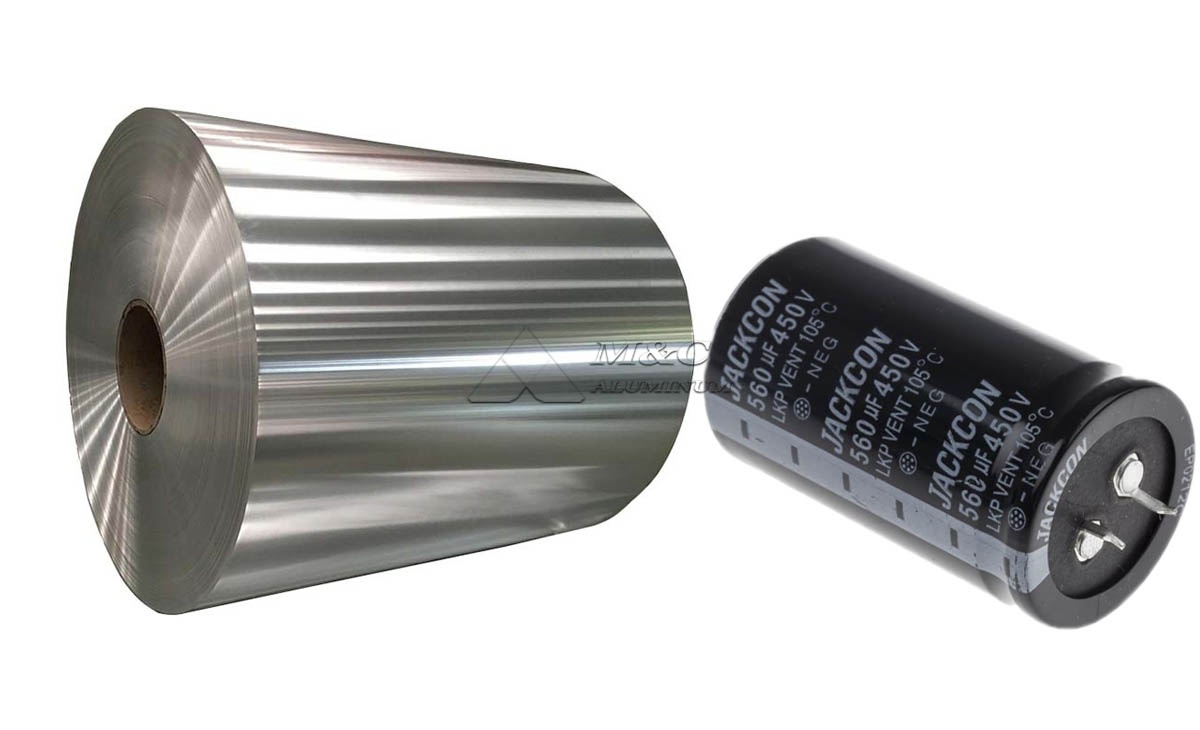
As a manufacturer of precision rolled aluminum products, we produce 5 μm 1070 aluminum foil for electrolytic capacitor applications requiring high aluminum purity, controlled thickness, stable surface quality, and reliable roll consistency. This ultra thin aluminum foil is designed for capacitor-related processing where material uniformity can directly affect downstream etching, forming, winding, impregnation, and electrical performance.
1070 aluminum foil is a commercially pure aluminum grade with a minimum aluminum content of 99.70 percent. Its high conductivity, good processability, and controlled impurity level make it a practical material for selected electrolytic capacitor foil applications. At a thickness of 5 μm, the foil requires disciplined rolling control, careful tension management, and clean slitting practices to maintain stable quality from coil to coil.
Why 1070 Aluminum Foil Is Used in Capacitor Applications
Electrolytic capacitors rely on aluminum materials that can support consistent electrochemical processing and maintain stable characteristics during conversion and assembly. Depending on the capacitor design and subsequent processing route, 1070 aluminum foil can be used where high purity aluminum, low contamination, and a uniform rolled surface are required.
The principal advantages of 5 μm 1070 aluminum foil include:
High aluminum content suitable for electrical and electrochemical applications.
Thin-gauge capability for compact capacitor structures and specialized component designs.
Good workability during precision slitting, winding, laminating, and other downstream operations.
Controlled surface cleanliness to reduce the risk of contamination during processing.
Stable coil geometry and edge quality for automated production lines.
Traceable manufacturing records covering alloy, thickness, width, temper, and inspection results.
Our factory evaluates each production order according to the customer's application requirements. For capacitor aluminum foil, nominal thickness alone is not sufficient. Surface condition, thickness variation, mechanical behavior, roll winding quality, and residual rolling oil must be considered together.
Typical Technical Parameters
The following table shows typical supply parameters for our 5 μm 1070 aluminum foil. Final specifications can be adjusted according to agreed technical requirements, application conditions, and customer drawings.
| Item | Typical Specification |
|---|---|
| Alloy | 1070 aluminum alloy |
| Aluminum content | Minimum 99.70 percent |
| Nominal thickness | 5 μm, 0.005 mm |
| Thickness tolerance | Subject to agreed gauge control requirements |
| Temper | O, H18, H19, or customized temper |
| Width range | Customized slit width, subject to mill capability |
| Coil inner diameter | 76 mm, 150 mm, 152 mm, or as specified |
| Coil outer diameter | According to customer handling equipment and coil weight requirements |
| Surface | Mill finish, clean and uniform |
| Rolling oil residue | Controlled according to agreed application requirements |
| Edge condition | Trimmed edge or slit edge, burr controlled |
| Pinhole control | Inspected according to thickness and customer quality standard |
| Packaging | Moisture-protective export packaging with coil identification |
Typical Chemical Composition of 1070 Aluminum
| Element | Typical Requirement |
|---|---|
| Aluminum, Al | Minimum 99.70 percent |
| Iron plus Silicon, Fe + Si | Controlled within applicable alloy standard |
| Copper, Cu | Controlled trace level |
| Manganese, Mn | Controlled trace level |
| Magnesium, Mg | Controlled trace level |
| Zinc, Zn | Controlled trace level |
| Titanium, Ti | Controlled trace level |
| Other elements | In accordance with applicable standard or customer agreement |
Actual chemical composition is verified through mill testing and recorded in the material certificate. Where customers have specific limits for iron, silicon, or other residual elements, we can assess the requirement before production scheduling.
Manufacturing Process for 5 μm 1070 Aluminum Foil
Producing ultra thin aluminum foil at 5 μm requires more than reducing thickness through repeated rolling. It requires stable process control through casting, hot rolling, cold rolling, foil rolling, annealing where required, slitting, inspection, and packaging.
We begin with controlled 1070 aluminum feedstock and manage composition consistency before rolling. The material is processed through multiple rolling stages to achieve the specified gauge. During foil rolling, our production team monitors thickness profile, strip flatness, rolling pressure, lubricant condition, and strip tension. These controls are essential because a small variation becomes more significant at ultra thin gauge.
After rolling, the foil is processed according to the specified temper. For soft temper applications, annealing parameters are managed to achieve the required formability and handling characteristics. For harder tempers, we control rolling reduction and coil tension to maintain stable mechanical properties.
Precision slitting is then performed according to the required width. The slitting process is important for electrolytic capacitor foil because poor edge quality can create winding instability, dust generation, or handling problems on high-speed conversion equipment. We inspect slit edges, coil alignment, and winding tightness before final packing.
For customers sourcing additional high-purity aluminum grades, our 1060 Aluminium Foil can also be evaluated for applications where alloy composition and processing requirements differ from 1070.
Surface Quality and Cleanliness Control
For capacitor aluminum foil, the surface is a functional part of the material rather than only an appearance requirement. Surface contamination, excessive rolling oil, scratches, dents, folds, oxide irregularities, or embedded particles may affect downstream treatment and manufacturing efficiency.
Our quality control process for 5 μm 1070 aluminum foil includes visual inspection and process-based checks for:
Surface uniformity and rolling marks.
Oil stain and contamination control.
Edge damage, burr formation, and slit quality.
Coil telescoping and loose winding.
Thickness consistency across the width and along the coil.
Pinhole condition according to the agreed inspection method.
Packaging integrity before export shipment.
Where the foil will undergo etching, forming, coating, or lamination, customers should provide the relevant process conditions during technical review. This helps us recommend the appropriate temper, surface condition, coil dimensions, and packing method.
Suitability for Electrolytic Capacitor Processing
5 μm 1070 aluminum foil may be selected for specialized electrolytic capacitor applications where compactness, low material mass, and controlled electrical properties are important. The final suitability depends on the capacitor type, electrolyte system, etching process, formation voltage, foil role, and the customer's production route.
In capacitor manufacturing, foil can be processed further through chemical etching to increase effective surface area, electrochemical formation to develop a dielectric oxide layer, and winding or stacking into the capacitor element. Each stage imposes different requirements on the base foil.
We therefore work from the viewpoint of a foil manufacturer: our responsibility is to provide stable base material with agreed alloy chemistry, gauge, temper, surface condition, and coil quality. The customer remains responsible for validating performance in their specific etching, forming, coating, and capacitor assembly process.
For customers that require different foil grades for adjacent industrial applications, our broader Products range includes aluminum foil solutions in multiple alloys, tempers, and thickness ranges.
Packaging and Delivery Requirements
Ultra thin aluminum foil must be protected against moisture, mechanical damage, dust, and deformation during storage and transportation. We use export-oriented packaging designed to maintain coil condition throughout international delivery.
A typical packing configuration includes moisture-resistant wrapping, protective paper or film layers, reinforced edge protection, palletized support, and clear coil labeling. Each label can include alloy, thickness, width, temper, net weight, coil number, production batch, and inspection reference.
For sea shipment, we recommend dry and enclosed storage conditions. Coils should be kept away from condensation, corrosive materials, and direct contact with wet floors or walls. During handling, lifting equipment should be compatible with the coil core size and coil weight to avoid edge damage or telescoping.
Quality Documentation and Order Support
As a 1070 aluminum foil manufacturer, we can provide documentation according to the purchase agreement, including mill test certificates, packing lists, commercial invoices, coil identification records, and inspection data where specified. Before production, we confirm the key requirements for alloy, thickness, tolerance, width, temper, coil dimensions, surface standard, and package configuration.
For 5 μm aluminum foil, early technical confirmation is especially important. Small differences in winding method, tension requirement, slit width, or downstream processing can affect the most suitable production route. Our engineering and quality teams review these details before release to production.
Conclusion
Our 5 μm 1070 aluminum foil is manufactured for electrolytic capacitor applications that require high-purity aluminum, precision gauge control, clean surfaces, and stable slit coil quality. By controlling each stage from alloy preparation through rolling, slitting, inspection, and export packaging, we supply ultra thin capacitor aluminum foil tailored to defined technical requirements and downstream processing conditions.