
In modern HVAC systems, automotive heat dissipation, and industrial refrigeration, the efficiency of heat exchangers directly determines the Energy Efficiency Ratio (EER) and service life of the equipment.
As the core material for heat exchanger fins, 8011, 3102, 3104, 1100, and 3003 hydrophilic coated aluminum foil have become the preferred choice for high-performance global heat exchange systems due to their excellent material properties and advanced surface treatment technologies.
This article focuses on 3003 hydrophilic coated aluminum foil, which is widely used in HVAC fin applications.
What Is 3003 Hydrophilic Coated Aluminum Foil?
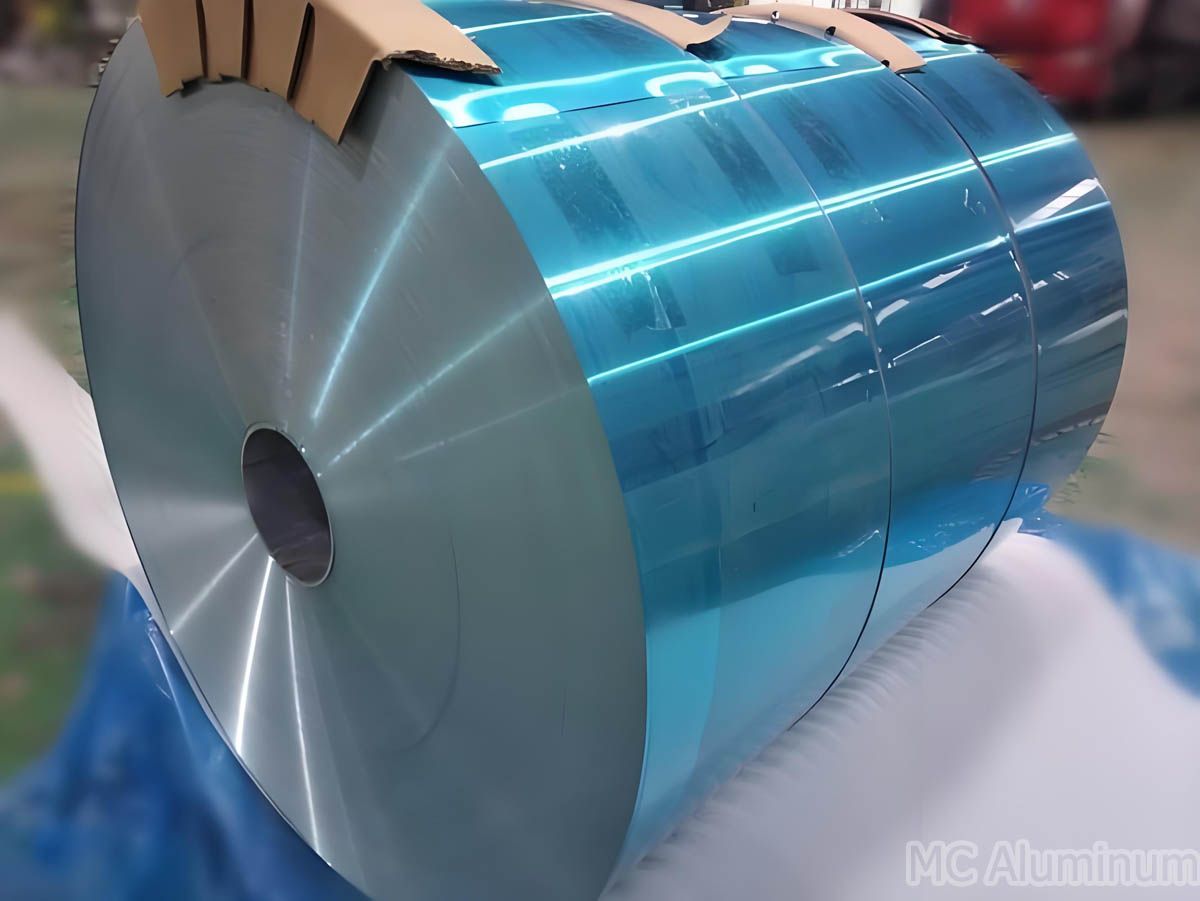
3003 hydrophilic coated (painted) aluminum foil is a heat-exchanger-dedicated foil made from Al-Mn series 3003 anti-rust aluminum alloy as the substrate. It is produced through surface pretreatment followed by the curing of a special water-based and/or organic hydrophilic coating. Its key functions are to rapidly spread condensate water, suppress water bridging, improve heat-transfer efficiency, enhance corrosion resistance, and reduce noise.
3003 hydrophilic coated aluminum foil was developed as a fin material for heat exchangers, used for stacked fins and active humidity-management pads. It combines a structured heat-transfer surface with humidity management.
Hydrophilic Coating Process:
Pretreatment: Degreasing → alkaline cleaning/etching → acid pickling → chemical conversion (chromate treatment / chromium-free passivation) to ensure coating adhesion.
Coating type: Organic resin composite coating (containing hydrophilic functional groups such as PVA and acrylic copolymers); typical dry film thickness is 0.3–0.8 μm.
Curing: Hot-air drying + high-temperature curing (180–220°C) to form a continuous, dense hydrophilic film.
Performance indicators: Water contact angle ≤ 15° (excellent grades can reach 5°); condensate forms a uniform water film rather than droplets; hydrophilicity decays slowly during long-term use.
Key Advantages for HVAC Fin Applications
1. Significantly Improved Heat Transfer Efficiency
Condensed water spreads evenly into a film, eliminating "water bridges" between fins, reducing airflow resistance, and improving efficiency by 10–15% compared to bare foil.
2. Strong Corrosion Resistance & Anti-White Powder
The coating isolates moisture and salts, preventing oxidation and eliminating "white powder" contamination in air ducts.
3. Low Noise & Long Service Life
No water droplet vibration or dripping noise; durable coating extends maintenance cycles by over 50%.
4. Excellent Formability
3003 base alloy combined with flexible coating allows high-speed stamping without cracking or coating peeling, suitable for complex fin geometries.
5. Environmentally Friendly & Compliant
Chromium-free coatings and water-based systems comply with RoHS, REACH, and other environmental regulations, with no excessive VOC emissions.
6. Lower Lifecycle Cost
Although coated foil has a higher initial cost, it reduces maintenance, cleaning frequency, and replacement costs over time.
Specifications
| Alloy | 3003 |
| Temper | H22 / H24 / H26 / O |
| Thickness | 0.08mm – 0.20mm |
| Width | 100mm – 1600mm |
| Length | 1000mm – 16000mm |
| Coating Thickness | 1.0μm – 3.0μm |
| Coating Type | Single-side / Double-side |
| Color | Blue / Gold |
| Contact Angle | Initial ≤10° / After aging ≤25° |
| Coating Hardness | ≥2H |
| Salt Spray Resistance | ≥500 hours |
| Tensile Strength | ≥140 MPa |
| Elongation | ≥2% |
| Standard | ASTM / GB |
| MOQ | 1–3 tons |
Thickness Range for HVAC Applications
The typical thickness range of 3003 hydrophilic aluminum foil is 0.08–0.20 mm, with width customized according to heat exchanger molds.
Compared to 1100 pure aluminum, it offers approximately 20% higher strength, along with excellent corrosion resistance and formability.
| Thickness | Application |
| 0.08 – 0.10 mm | Common for residential air conditioner evaporators |
| 0.10 – 0.15 mm | Standard range for most HVAC systems |
| 0.15 – 0.20 mm | Used for condensers or industrial applications requiring higher durability |
| Up to 0.30 mm | For heavy-duty heat exchangers |
For high-speed stamping, thickness tolerance is critical. High-quality suppliers maintain ±0.005 mm tolerance to ensure consistent forming performance.
Typical Applications
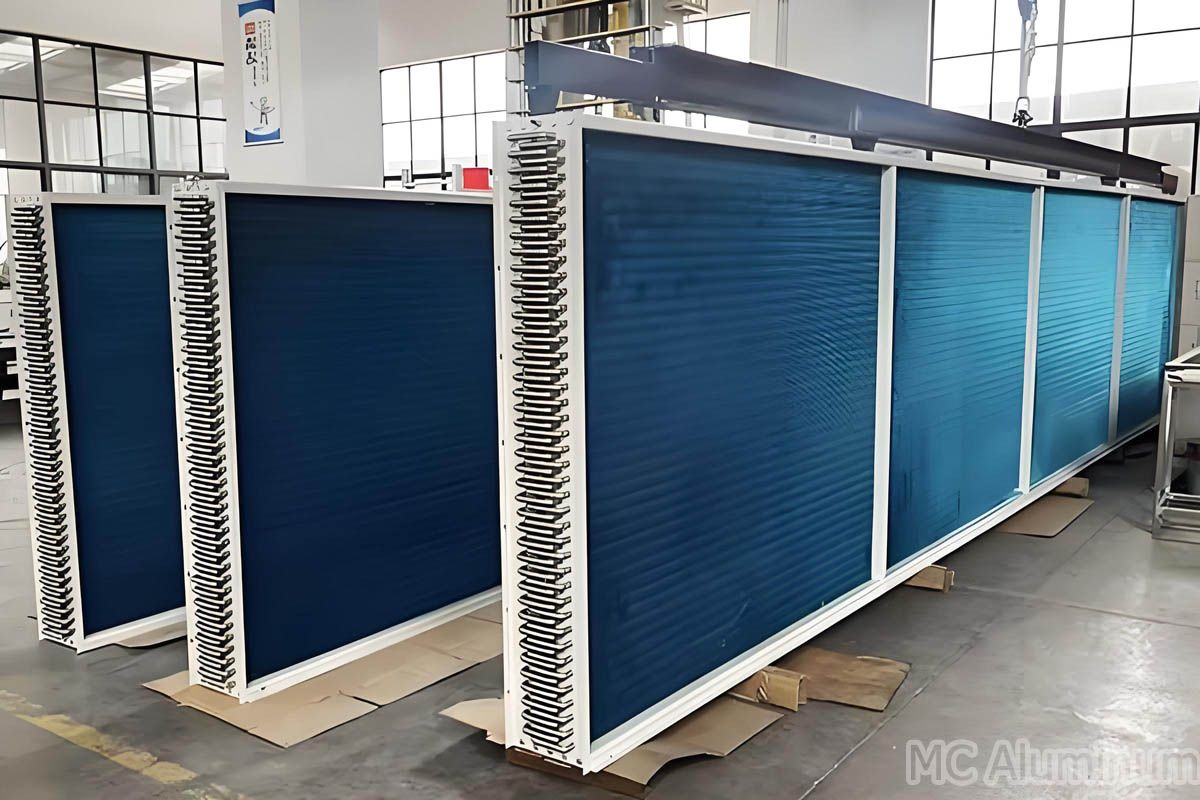
Evaporator and condenser fins for residential and commercial air conditioners, heat pumps, and dehumidifiers
Heat exchange systems for cold chain equipment, precision air conditioning, and automotive HVAC
Heat recovery cores for fresh air systems and closed cooling towers
Tube-fin structures in industrial coolers and compact heat exchangers
Manufacturing Process of 3003 Hydrophilic Coated Aluminum Foil
Raw Material Preparation
High-quality 3003 aluminum alloy ingots are cast and hot-rolled into thick plate, then processed through multiple cold-rolling passes. Tension and surface quality are controlled to obtain aluminum foil at the required thickness.Cleaning and Pretreatment
Before coating, the foil must be thoroughly cleaned to remove rolling oil, oxides, and contaminants. The steps include: degreasing (using alkaline/acid solutions to remove organic residues), multi-stage deionized water rinsing, optional light etching (to improve coating adhesion), and finally applying a thin chemical conversion coating (chromium-free or chromate-based) to enhance corrosion resistance and promote coating adhesion.Application of the Hydrophilic Coating
After pretreatment, the foil is fed into a coating line. The hydrophilic solution is applied by roller coating (precise thickness control, uniform coating) or curtain coating (high coating consistency).Baking and Curing
After coating, the foil passes through a high-temperature oven to evaporate and remove the solvent/water carrier, then undergoes curing under precisely controlled temperature and dwell time. During curing, the coating chemically reacts to form a durable hydrophilic film. The curing temperature and residence time directly affect coating performance.Slitting
After curing, the coated foil is slit accurately into narrow coils according to customer specifications for HVAC fin manufacturers.Quality Control
Strict quality inspection is implemented throughout production, including measurement of foil and coating thickness; contact angle testing (to verify hydrophilicity); adhesion testing (cross-hatch/tape test); corrosion resistance testing (salt spray test); visual inspection; and mechanical property testing to ensure the product meets required standards.
Comparison with Other Fin Materials
| Feature | 3003 Hydrophilic Coated Aluminum Foil | 8011 Hydrophilic Coated Aluminum Foil | 1100-O Aluminum Foil | Bare Aluminum 3003 | Copper Fins |
| Cost | Moderate (initial higher cost, but long-term savings) | Moderate (similar to 3003 hydrophilic) | Low | Low | High |
| Thermal Conductivity | Excellent (approx. 193 W/m·K) | Excellent (approx. 193 W/m·K) | Excellent (approx. 222 W/m·K) | Excellent (approx. 193 W/m·K) | Superior (approx. 385 W/m·K) |
| Corrosion Resistance | Excellent (due to barrier coating) | Excellent (due to barrier coating) | Good, but susceptible to pitting in humid/polluted | Good, but susceptible to pitting in humid/polluted | Good, but susceptible to formicary corrosion in certain environments |
| Hydrophilicity/Drainage | Excellent (smooth, continuous film drainage) | Excellent (smooth, continuous film drainage) | Poor (water bridging common) | Poor (water bridging common) | Poor (water bridging common) |
| Mold/Odor Resistance | Excellent (inhibits growth by preventing moisture accumulation) | Excellent (inhibits growth by preventing moisture accumulation) | Poor (fosters growth due to water retention) | Poor (fosters growth due to water retention) | Poor |
| Weight | Lightweight | Lightweight | Lightweight | Lightweight | Heavy |
| Energy Efficiency | Superior (maintains efficiency, higher COP/EER) | Superior (maintains efficiency, higher COP/EER) | Good, but degrades with water bridging | Good, but degrades with water bridging | Good, but degrades with water bridging |
| Lifespan | Extended | Extended | Moderate | Moderate | Moderate to good |
| Formability/Strength | Good formability, moderate strength (H tempers) | Good formability, lower strength (often O temper for flexibility) | Excellent formability, low strength (O temper) | Good formability, moderate strength (H tempers) | Good |