
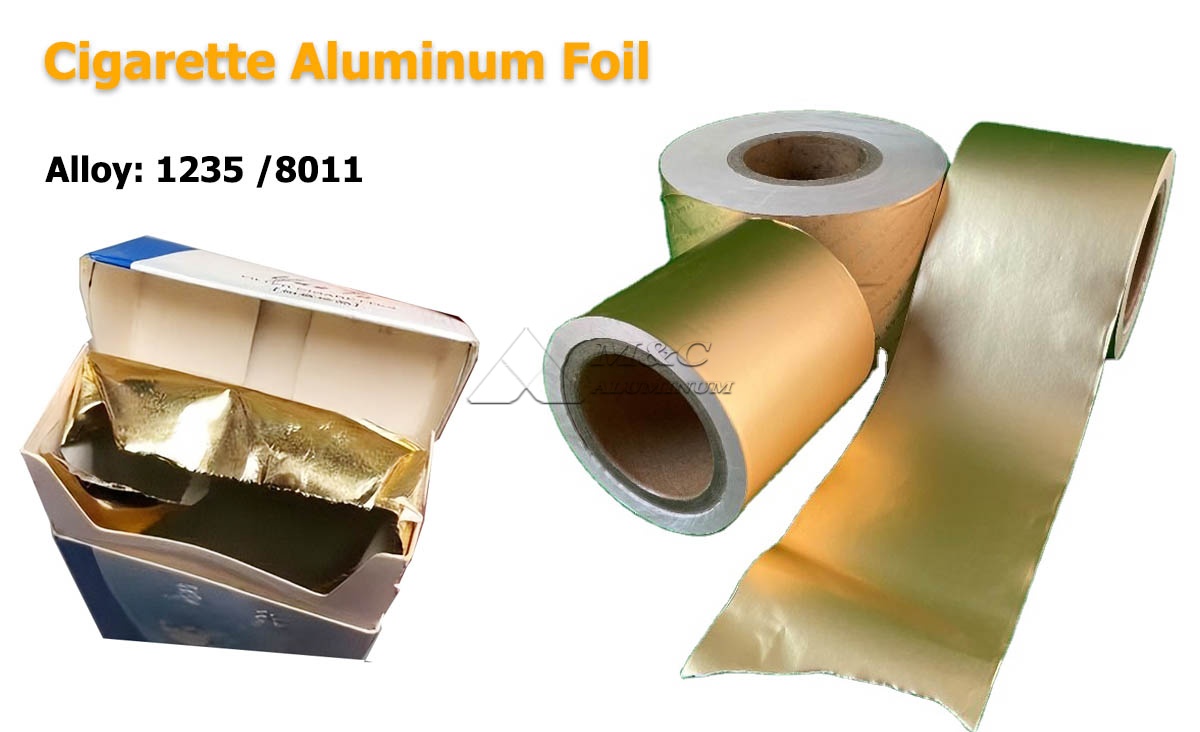
As an aluminum foil manufacturer, we produce 1235 aluminum foil for cigarette lining paper with controlled alloy composition, stable thickness tolerance, clean surface quality, and reliable lamination performance. This material is widely used as the aluminum foil layer in cigarette inner liner paper, where it helps improve moisture resistance, aroma retention, folding performance, and the appearance of cigarette packaging.
Cigarette lining paper is not a simple decorative material. It is a functional packaging component that must run smoothly on high-speed printing, laminating, slitting, and cigarette packing equipment. For this reason, the aluminum foil used for cigarette lining paper must meet strict requirements in thickness uniformity, surface cleanliness, pinhole control, wettability, and mechanical stability. Our production is designed around these requirements, from aluminum ingot selection and rolling process control to final inspection and export packaging.
What Is 1235 Aluminum Foil For Cigarette Lining Paper?
1235 aluminum foil is a high-purity aluminum foil material commonly used in flexible packaging. Its aluminum content is generally not less than 99.35 percent, giving it good ductility, stable barrier properties, and excellent suitability for lamination with paper. In cigarette lining paper applications, 1235 aluminum foil is usually supplied in O temper, which provides the softness required for embossing, folding, and forming during cigarette packaging.
The typical structure of cigarette lining paper is paper, adhesive, aluminum foil, and sometimes printing or coating layers depending on the final design. The aluminum foil layer is very thin, but it has an important influence on barrier performance and packaging appearance. It blocks light, helps reduce moisture exchange, supports aroma preservation, and gives the inner liner a bright metallic finish.
Compared with many general-purpose packaging foils, 1235 O aluminum foil for cigarette lining paper requires more careful control of surface oil, roll profile, edge quality, and web tension. Even small defects may affect lamination, printing registration, or packing efficiency. As a factory, we focus on producing foil that can match downstream converting lines and the operating requirements of tobacco packaging plants.
Why 1235 Alloy Is Suitable For Cigarette Inner Liner Paper
The selection of 1235 aluminum foil is based on its balance of purity, flexibility, and processability. High-purity aluminum has good rolling performance and can be processed into thin gauges with stable thickness. This is important because cigarette lining paper commonly uses thin aluminum foil to maintain cost efficiency while still achieving the required barrier and appearance.
Another advantage is its compatibility with paper lamination. The foil surface can be controlled to support adhesive bonding, coating, and printing processes. With proper surface treatment and rolling oil control, 1235 aluminum foil provides stable dyne values and good wetting behavior for common adhesives used in cigarette packaging aluminum foil conversion.
For applications requiring related foil solutions, our 1235 Aluminum Foil product range can be supplied according to different thickness, width, temper, and surface requirements. For cigarette-specific material selection, our Cigarette Packaging Aluminum Foil is manufactured with particular attention to lamination and high-speed packing performance.
Main Technical Parameters
The following table shows common specifications for 1235 aluminum foil used in cigarette lining paper. Final parameters can be adjusted according to customer converting equipment, laminate structure, and quality standards.
| Item | Typical Specification |
|---|---|
| Alloy | 1235 |
| Temper | O, soft temper |
| Aluminum content | 99.35 percent min. |
| Thickness range | 0.006 mm to 0.009 mm, common 0.0065 mm and 0.007 mm |
| Thickness tolerance | According to agreed standard, commonly +/- 3 percent to +/- 5 percent |
| Width range | 200 mm to 1700 mm, customized by order |
| Roll inner diameter | 76 mm or 152 mm |
| Roll outer diameter | According to customer equipment requirement |
| Surface | One side bright, one side matte, clean and uniform |
| Pinhole control | Controlled according to thickness and customer standard |
| Wettability | Suitable for paper lamination and coating processes |
| Surface oil | Low and controlled for adhesive bonding |
| Edge quality | Smooth slit edge, no serious burrs or cracks |
| Core material | Steel, aluminum, or paper core according to order |
| Application | Cigarette lining paper, cigarette inner liner, tobacco packaging laminate |
| MOQ | 1-3 tons |
Manufacturing Process In Our Factory
Our production of aluminum foil for cigarette inner liner begins with qualified aluminum raw material and controlled melting and casting. Chemical composition is checked to confirm that the alloy meets the requirements of 1235 aluminum foil. The cast material is then processed through hot rolling or cast rolling routes, followed by cold rolling, intermediate annealing if required, foil rolling, final annealing, slitting, and packaging.
During foil rolling, thickness control is a critical step. Thin cigarette lining foil must have a stable gauge across the full width and along the full coil length. We use online thickness monitoring and rolling parameter control to reduce deviation. Stable thickness helps downstream laminators achieve consistent bonding and helps packaging lines maintain stable folding and forming behavior.
Final annealing is also important. For 1235 O aluminum foil, the annealing process must remove work hardening and provide the required softness. At the same time, it must help control residual rolling oil and surface condition. If oil residue is too high, adhesive bonding may be affected. If the foil is too soft or the coil tension is unstable, wrinkles and web breaks may occur during converting. Our annealing and rewinding processes are controlled to balance softness, cleanliness, and coil stability.
Surface Quality Requirements
Cigarette lining paper is a visible packaging material, so aluminum foil surface quality directly affects the final product. The foil should have a uniform metallic appearance without obvious stains, corrosion, holes, heavy roll marks, wrinkles, or serious color difference. For printed or embossed lining paper, surface uniformity is particularly important because defects may become more visible after lamination and finishing.
Surface cleanliness is another key factor. The foil must be suitable for adhesive coating and paper lamination. Excessive oil, dust, or oxide contamination may reduce bond strength. In our production, we control rolling oil, filtration, annealing parameters, and workshop handling to maintain a clean foil surface. Before shipment, coils are inspected for surface defects, roll condition, edge quality, and labeling accuracy.
Barrier Performance And Packaging Function
The function of 1235 aluminum foil for cigarette lining paper is not limited to appearance. It contributes to the protective performance of cigarette packaging. Aluminum foil has excellent barrier properties against light, oxygen, water vapor, and odor transmission. In a properly laminated structure, it helps reduce external influence on tobacco quality and supports aroma retention during storage and distribution.
Cigarette products may pass through different climates during international transportation and retail storage. The inner liner must help reduce moisture fluctuation and protect the tobacco from excessive drying or moisture absorption. Although the overall barrier performance depends on the complete packaging structure, the aluminum foil layer is one of the most important components. Stable foil thickness and low defect levels help maintain consistent packaging performance.
Lamination And Converting Suitability
For cigarette lining paper manufacturers, the aluminum foil must perform well during lamination with base paper. Important converting requirements include good unwinding behavior, stable web tension, controlled surface wettability, and reliable bonding with adhesive. The foil should not generate frequent web breaks, telescoping, blocking, or severe wrinkling during high-speed operation.
We supply coils with controlled winding tension and neat roll shape to support smooth processing. Slitting is carried out according to customer width requirements, with attention to edge quality and coil alignment. Proper packaging is used to protect the foil from moisture, dust, mechanical damage, and oxidation during transportation.
Some customers require foil for plain lining paper, while others need material for printed, embossed, colored, or coated cigarette inner liner. These downstream processes require different emphasis on surface condition, mechanical properties, and roll dimensions. As a manufacturer, we can discuss the process route and supply specification before production so that the foil matches the final packaging structure.
Quality Control And Inspection
Quality control is implemented at each stage of production. Chemical composition is tested before rolling. During rolling, thickness, shape, and surface condition are monitored. After annealing and slitting, finished coils are inspected for size, appearance, roll condition, and mechanical performance. For export orders, we provide inspection records according to agreed requirements.
Common inspection items include alloy verification, thickness measurement, width measurement, tensile properties, elongation, pinhole evaluation, wettability, surface cleanliness, and coil appearance. Packaging inspection is also necessary because cigarette lining foil is thin and sensitive to impact and humidity. Each coil is identified with product information such as alloy, temper, thickness, width, batch number, net weight, and gross weight.
Our quality control objective is not only to meet a numerical standard, but also to ensure consistency between batches. Stable batch quality helps customers reduce trial adjustments, improve lamination yield, and maintain reliable supply for cigarette packaging production.
Packaging For Export Delivery
1235 aluminum foil for cigarette lining paper is usually exported in coil form. Depending on the order, coils can be packed vertically or horizontally with moisture-proof film, protective board, edge protection, and strong wooden cases or pallets suitable for sea transportation. Export packaging is designed to protect the foil from water vapor, collision, deformation, and contamination.
Before loading, we check coil labels, packing lists, and shipping marks to reduce errors during warehouse handling and customs clearance. For customers with specific storage or handling conditions, we can coordinate packaging details in advance, including core type, roll weight, pallet size, and container loading plan.
How To Select The Right Specification
When selecting 1235 aluminum foil for cigarette lining paper, buyers should consider not only the alloy and thickness, but also the complete converting process. Important information includes final laminate structure, paper grammage, adhesive type, lamination speed, required roll width, roll weight limit, core inner diameter, printing or embossing requirements, and applicable quality standard.
For example, thinner foil can reduce material consumption, but it requires better pinhole control and more precise lamination operation. Wider coils may improve production efficiency, but they require stable roll profile and tension. Brightness, matte side quality, and surface energy may also influence printing or coating appearance. By confirming these parameters before production, we can supply foil that is better matched to the customer's engineering and production needs.
Conclusion
1235 aluminum foil for cigarette lining paper is a specialized packaging material that requires strict control of alloy purity, thickness, softness, surface cleanliness, pinhole level, and coil quality. As a factory and manufacturer, we produce 1235 O aluminum foil for cigarette inner liner applications with attention to both material performance and downstream converting stability.
For international cigarette packaging paper producers, tobacco packaging converters, and B2B buyers, consistent foil quality is essential for stable lamination, clean appearance, reliable barrier performance, and efficient high-speed packing. We can manufacture and supply customized 1235 aluminum foil according to thickness, width, roll weight, core size, surface requirement, and export packaging standard.