
3003 aluminum foil belongs to the typical Al-Mn aluminum-manganese alloy series and is a widely used anti-rust aluminum material. Through H14 temper processing, meaning strain-hardened to a half-hard condition, this aluminum foil retains the excellent anti-rust performance of the 3000 series while achieving significantly higher strength than 1000 series pure aluminum foil, along with better tensile strength and elongation performance.
Chemical Composition (%)
| Alloy | Si | Fe | Cu | Mn | Mg | Cr | Zn | Ti | Other:each | Other:total | Al |
| 3003 | 0.6 | 0.7 | 0.05-0.20 | 1.0-1.5 | - | - | 0.1 | - | 0.05 | 0.15 | remainder |
Key Features of 3003 Aluminum Alloy
Strength is approximately 10%-20% higher than pure aluminum
Good corrosion resistance, especially suitable for humid environments
Excellent ductility and processing performance
Stable surface quality, suitable for further processing
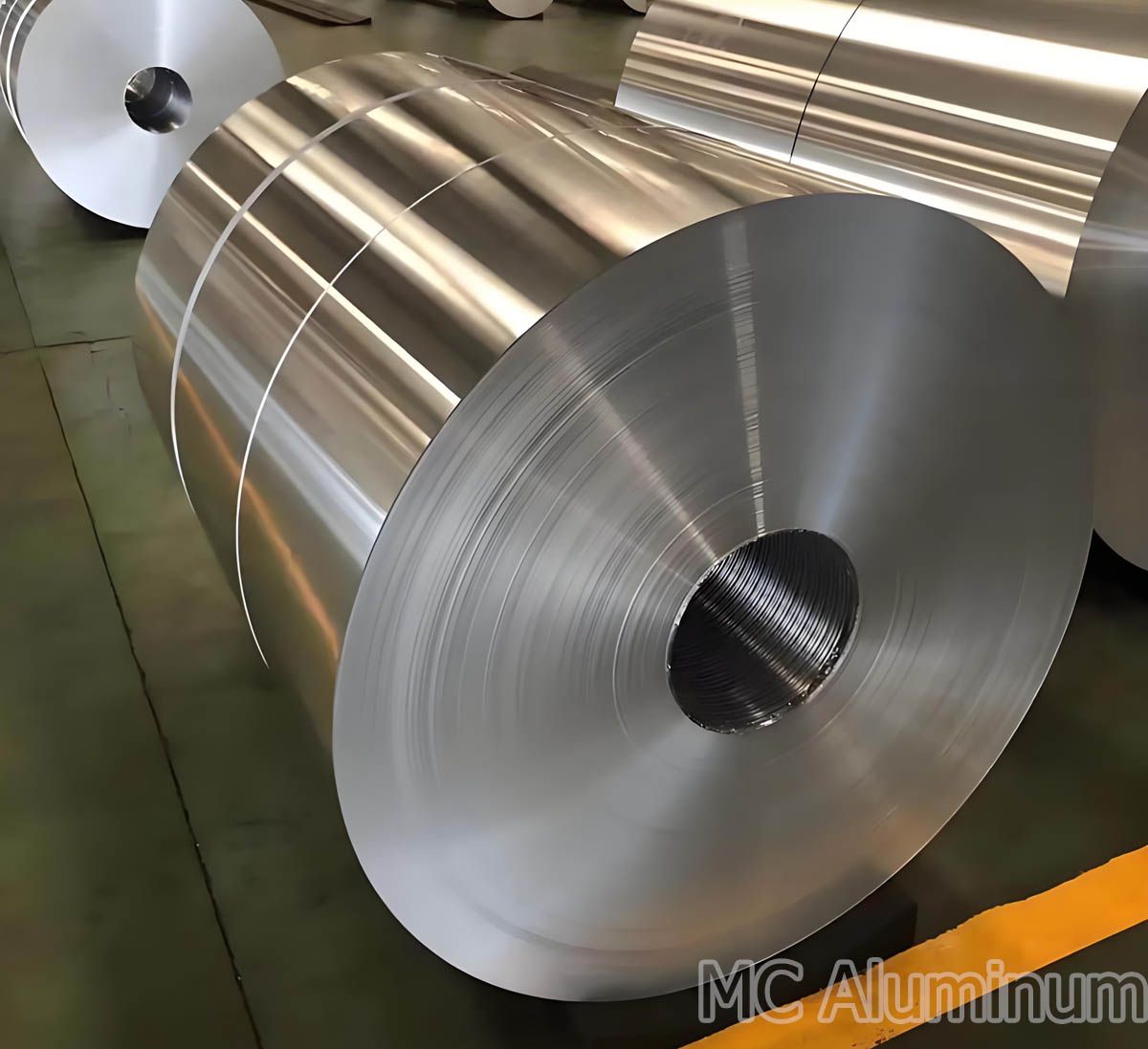
3003-H14 aluminum foil features a clean surface, uniform color, no pinholes, high flatness, excellent formability, and outstanding corrosion resistance. It is an ideal material for modern industry, architectural decoration, electronics and electrical appliances, and high-end packaging applications.
Technical Parameters of 3003 Aluminum Foil
| Item | Specification |
| Alloy | 3003 |
| Temper | H14 |
| Thickness Range | 0.02 mm – 0.20 mm |
| Width Range | 100 mm – 1600 mm |
| Tolerance | Thickness tolerance ≤ ±5%, width tolerance ≤ ±1 mm |
| Coil Inner Diameter | Customizable, commonly 300–600 mm |
| Surface | Single bright side / double bright side / coated / laminated treatment |
| MOQ | 1–3 tons |
Physical Properties
| Parameter | Value |
| Density | 2.70 g/cm³ |
| Thermal Conductivity | 237 W/(m·K) |
| Electrical Conductivity | ≥95% IACS |
| Elastic Modulus | 69 GPa |
Mechanical Properties — H14 Temper
| Parameter | Value |
| Tensile Strength | ≥180 MPa |
| Yield Strength | ≥125 MPa |
| Elongation | 10%–15% |
| Hardness, Rockwell | ≥55 HRB |
Performance Advantages of 3003 H14 Aluminum Foil
1. Corrosion Resistance
As a classic anti-rust aluminum material, 3003 H14 aluminum foil can form a dense and stable oxide protective layer on the surface. It can effectively resist corrosion from the atmosphere, fresh water, humid environments, and weak acid or alkaline media. It is especially suitable for food packaging and industrial protective environments.
2. Thermal and Electrical Conductivity
Although manganese is added, 3003 aluminum still retains the excellent thermal conductivity of aluminum. This makes it highly suitable for industrial equipment and electronic components requiring efficient heat transfer.
3. Mechanical Properties and Formability
Thanks to the H14 half-hard temper, 3003-H14 aluminum foil achieves an excellent balance between hardness and plasticity. It provides sufficient rigidity and support, resists deformation, and also offers excellent deep drawing and stamping performance. During subsequent slitting, bending, and stamping processes, it is less likely to crack or wrinkle.
4. Stable Surface Quality
During production, 3003-H14 aluminum foil undergoes strict degreasing and surface brushing processes to ensure good flatness, no black spots, no scratches, and an oil-brush test reaching Grade A dyne value.
5. Safety
The material is safe, non-toxic, and fully compliant with food-grade and pharmaceutical-grade contact standards.
6. Good Weldability
3003 aluminum alloy is suitable for various welding methods such as argon arc welding and brazing. The welded joints are strong and highly sealed, making it convenient for component assembly and sealing processing.
Applications of 3003 Aluminum Foil
1. Packaging Industry
Used for aluminum foil bags, vacuum bags, aluminum foil containers, bottle cap materials, and packaging for food, medicine, and cosmetics. With excellent barrier properties and safety, it provides moisture resistance, light shielding, and freshness preservation to protect product quality.
2. Electronics and New Energy
Used for power battery shells, water-cooling plates, electronic heat sinks, electromagnetic shielding materials, honeycomb substrates, and more. It meets the requirements of heat dissipation, shielding, and structural support, contributing to lightweight and efficient new energy and electronic equipment.
3. Construction and Insulation
Used for building insulation panels, waterproof membranes, thermal insulation and moisture-proof layers, sound insulation materials such as those for viaducts and high-speed railways. It is lightweight, corrosion-resistant, heat-insulating, and moisture-proof, improving building energy efficiency and durability.
4. Industrial and Daily-Use Products
Used for automobile fuel tanks, heat shields, cookware, reflectors, nameplates, cold storage flooring, small appliance fins, and more. It combines durability with ease of processing, making it suitable for various industrial and daily-use applications.
Comparison: 3003 H14 vs. 3003 H24 Aluminum Foil
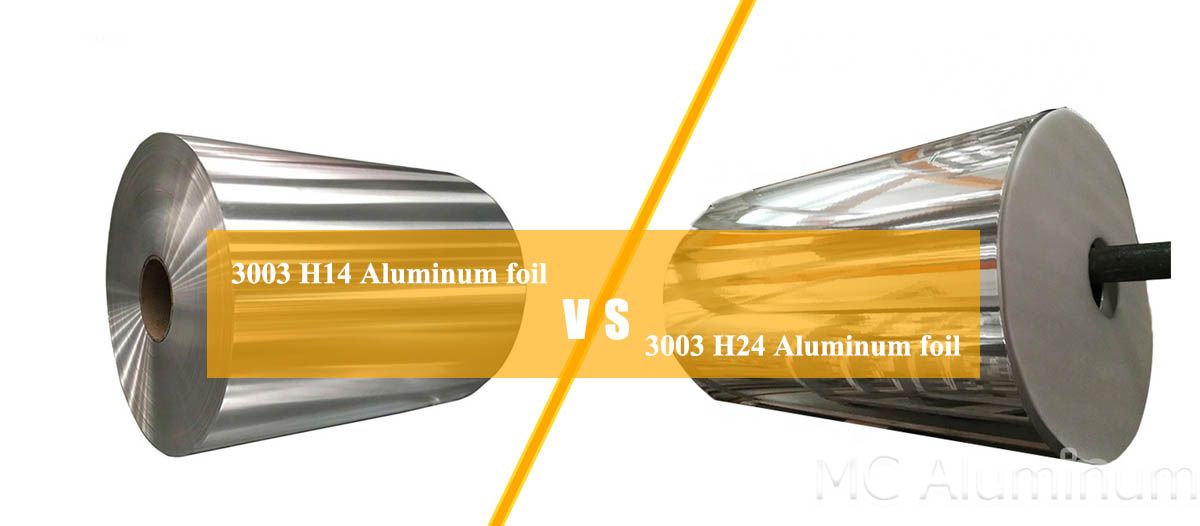
The essential difference between H14 and H24 lies in the degree of strain hardening and tempering treatment, which directly affects strength, ductility, and application scenarios.
| Comparison Item | 3003 H14 Aluminum Foil | 3003 H24 Aluminum Foil |
| Temper Definition | Half-hard temper, after strain hardening and partial annealing | Strain-hardened and then stabilized, partially tempered |
| Processing Route | Cold rolling → partial annealing | Cold rolling → stabilization treatment, low-temperature tempering |
| Strength Level | Medium strength | Slightly higher than H14, more stable |
| Tensile Strength | 120–160 MPa | 140–180 MPa |
| Yield Strength | ≥95 MPa | ≥110 MPa |
| Elongation | Good, about 3%–5% | Slightly lower, about 2%–4% |
| Formability | Excellent, suitable for deep drawing and stamping | Good, but slightly inferior to H14 |
| Hardness | Medium | Slightly higher, more resistant to deformation |
| Stability, Aging Resistance | General | More stable, less prone to performance fluctuation |
| Surface Processing Adaptability | Excellent, suitable for printing and lamination | Excellent |
| Deformation Resistance | General | Stronger, suitable for applications requiring higher structural stability |
| Typical Applications | Food packaging, lunch boxes, flexible packaging | Industrial packaging, structural parts, containers requiring higher strength |
Packaging and Transportation
Inner Packaging: moisture-proof paper + plastic film
Outer Packaging: wooden case or pallet
Protective Measures: oxidation resistance, extrusion protection, pollution prevention
Suitable for sea transportation and long-distance transportation.