
The global aluminum foil container market is projected to grow from USD 1.688 billion in 2025 to USD 2.541 billion by 2031, with a CAGR of 7.1%. Another report forecasts the market will reach approximately USD 3.5 billion by 2033, at a CAGR of 5.2%.
This growth reflects the rapid expansion of food delivery, airline catering, and ready-to-eat meal industries, along with the global trend of replacing plastic with aluminum for sustainable packaging.
As a professional aluminum foil manufacturer, MC Aluminum focuses on alloys in the 3000 series (3003, 3004) and 8000 series (8011, 8006) for food container applications. Below is a detailed introduction to 3003 container aluminum foil.
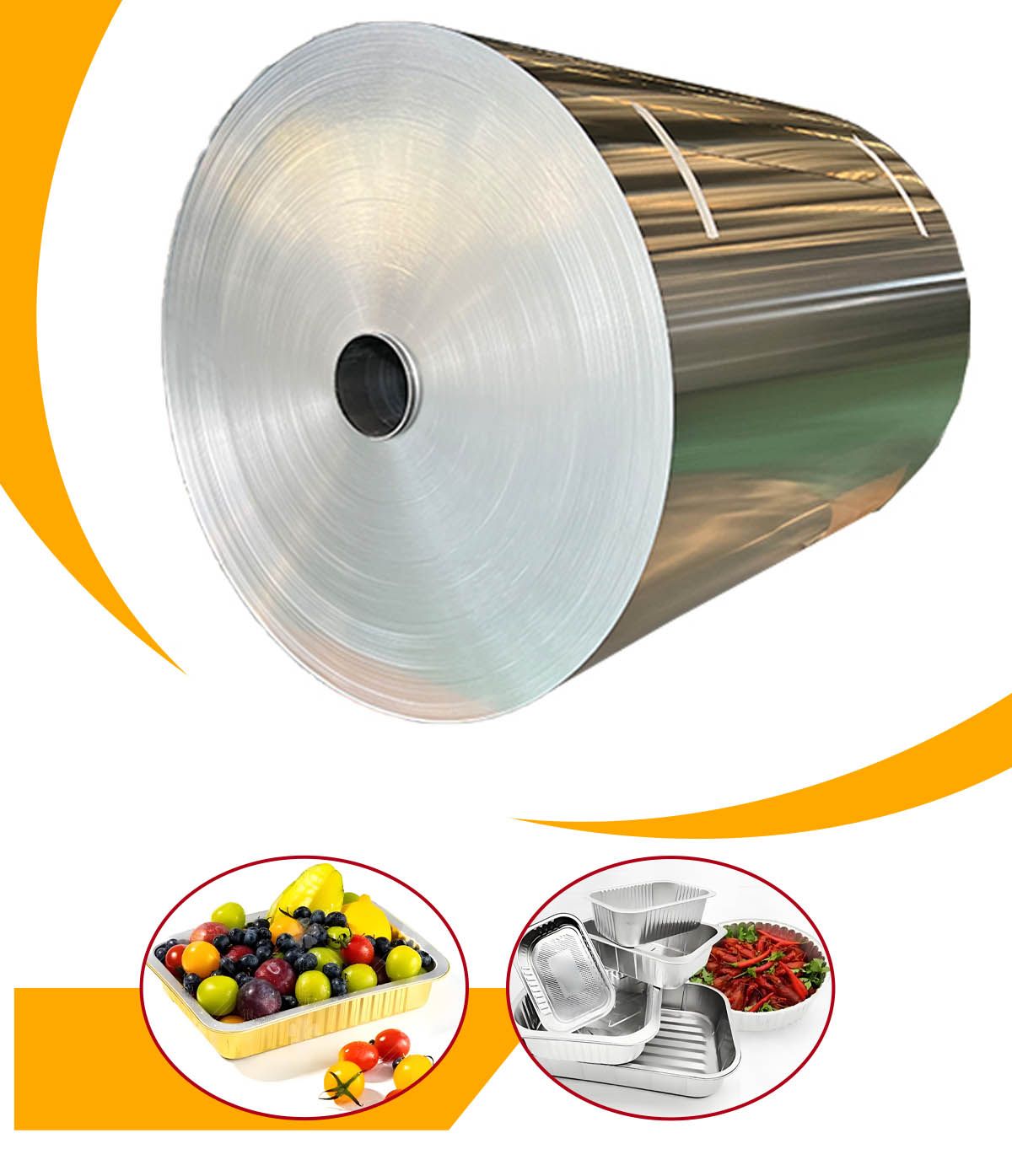
3003 Aluminum Foil for Food Containers
3003 aluminum foil is a rust-resistant Al-Mn alloy, containing 1.0%–1.5% manganese, and is widely recognized as a classic grade for food contact applications.
Compared with pure aluminum (1000 series) and 8011 aluminum foil, it offers a balanced combination of strength, corrosion resistance, and formability, making it ideal for the entire lifecycle of food containers, including stamping, sealing, heating, and transportation.
Common Tempers:
O state (annealed state): Good flexibility, suitable for deep drawing.
H22 / H24 state: Possesses certain strength while maintaining good machinability.
3003 vs 8011: How to Choose?
A common question is: what is the difference between 3003 and 8011?
| Property | 3003 Aluminum Foil | 8011 Aluminum Foil |
| Hardness & Rigidity | Higher, more stable after forming | Softer, more flexible |
| Application | Single-compartment trays, flat containers | Multi-compartment, complex shapes |
| Yield Rate | Up to 95% in H24 temper | Better adaptability for multi-cavity forming |
| Thickness | 0.03–0.20 mm | 0.03–0.20 mm |
| Cost | Slightly higher | Lower |
Industry Insight:
3003 is ideal for single-compartment containers and rigid trays
8011 is better for multi-compartment and complex-shaped containers
3004 aluminum foil: The “Upgraded Version” of 3003
It is worth mentioning 3004 aluminum foil, which further improves the strength of 3003 and has excellent heat resistance and processability. It is particularly suitable for scenarios with higher strength requirements, such as pre-cooked food packaging and self-heating food containers.
Specifications of 3003 Container Foil
| Alloy | 3003 |
| Temper | O, H22, H24 |
| Thickness | 0.03 mm – 0.20 mm |
| Width | 100 mm – 1600 mm |
| Tensile Strength | 140–170 MPa (H24) |
| Elongation | ≥9% (can reach over 20% in practice) |
| Surface Quality | Oil-free, pinhole-free, scratch-free |
| Form | Jumbo rolls |
| MOQ | 1–3 tons |
Advantages of 3003 Aluminum Foil for Food Containers
Excellent Formability: 3003 alloy boasts extremely high elongation and tensile strength. During stamping, even with complex edge designs and deep-drawing requirements, it maintains uniform wall thickness, reducing scrap rates.
Barrier Properties: A key characteristic of aluminum foil as a packaging material is its excellent barrier properties, effectively blocking air, water, and light, thus maintaining or extending the shelf life and freshness of food. Combined with a leak-proof design, even soupy dishes can be safely delivered.
High and Low Temperature Resistance: It can be directly heated in ovens, microwaves, steamers, and open flames (from -40℃ to 400℃) without needing to be changed containers, suitable for reheating pre-cooked dishes, grilling, baking, and other scenarios.
Lightweight and Robust: Aluminum foil food containers are both lightweight and portable, yet possess sufficient structural strength. They stack efficiently without taking up much space and are not easily deformed or damaged during transportation.
Safe, Hygienic, and Odorless: Aluminum foil food containers are non-toxic and odorless, do not react chemically with food, and do not migrate harmful substances. Safe and reliable for storing acidic, alkaline, or oily foods.
100% Recyclable: Aluminum foil can be recycled an unlimited number of times, with a recycling rate exceeding 95%. Recycling energy consumption is only 5% of that used in primary aluminum production, reducing carbon emissions by 95%.
Applications of 3003 Aluminum Foil
Food Delivery & Takeaway
The largest application segment, offering lightweight, sealed, and customizable packaging.
Airline & Railway Catering
High-end application with excellent heat resistance and uniform heating performance, widely used by major airlines.
Ready Meals & Self-Heating Foods
A rapidly growing segment where 3004 foil is also widely applied.
Supermarket Fresh Food and Baking
Baking trays, baking molds, and frozen food packaging to meet all needs from baking to freezing.
How High-Quality 3003 Foil Is Produced
(1) Production Process
Upstream (Foil Stock Production):
Aluminum ingot → Melting & alloying → Continuous casting & rolling → Cold rolling → Annealing → Slitting
Downstream (Container Forming):
Jumbo roll → Feeding → Stamping (one-step forming) → Inspection → Sterilization & packaging
(2) Key Process Control Points
Degreasing Process
If the residual oil on the aluminum foil surface exceeds the standard, it will produce odors or even blistering during subsequent food container stamping or coating processes. We use a high-temperature annealing degreasing process to ensure that the material surface meets the "Grade A of the water brushing test".
Sheet shape control
Aluminum foil must be as flat as paper. If the sheet has wavy edges or central bulges, it will frequently jam on the fully automatic stamping machine. We use an online sheet shape analyzer to monitor in real time to ensure flatness.
Pinhole rate monitoring
Although 3003 is relatively thick, we still adhere to stringent pinhole detection for extremely thin specifications to ensure 100% protection against light, oxygen, and moisture.
FAQ
Q1: Why is 3003 aluminum foil suitable for food containers?
It offers higher strength than pure aluminum while maintaining excellent ductility, making it ideal for high-speed stamping with low cracking rates.
Q2: Is 3003 aluminum foil safe for direct food contact?
Yes. It is food-grade, non-toxic, odorless, and does not react with food.
Q3: Can 3003 foil containers be used in microwaves?
Not recommended, as metal reflects microwaves. However, they are suitable for ovens and steam heating.
Q4: What is the difference between 3003 and 8011 foil?
3003 has higher strength and better formability, while 8011 is more cost-effective and flexible for standard containers.
Q5: Can 3003 aluminum foil be used for freezing?
Yes. It performs well at low temperatures without becoming brittle, making it suitable for cold chain logistics.
Q6: Are aluminum foil containers environmentally friendly?
Yes. Aluminum is fully recyclable and aligns with global sustainability trends, offering a greener alternative to plastic packaging.