
Capacitor aluminum foil is a core material in the manufacture of aluminum electrolytic capacitors. Its surface condition, specific surface area, pore structure, and subsequent formation performance directly determine the capacitor's capacitance, size, voltage resistance, loss characteristics, and service life.
Electrochemical etching is the most important production process for aluminum electrolytic capacitor anode foil and cathode foil. It converts smooth, high-purity aluminum foil into high-specific-surface-area electrode foil. In a chloride-based electrolyte system, precisely applied electrical signals create dense etching pits and tunnel structures on the aluminum foil surface in a controlled manner. This significantly increases the effective reaction area and directly affects the specific capacitance, impedance, service life, and stability of the capacitor. It is a fundamental material technology supporting the miniaturization of aluminum electrolytic capacitors used in consumer electronics, new energy systems, industrial control, and automotive electronics.
Principle of the Electrochemical Etching Process
The base material is ultra-high-purity electrolytic aluminum foil, generally containing more than 99.99% aluminum, also known as 4N aluminum. After annealing pretreatment, the foil obtains a well-organized crystal orientation structure, providing the basis for directional etching.
The aluminum foil is immersed in a mixed electrolyte containing hydrochloric acid and chloride salts. An external power source is connected to form an electrolytic circuit. Due to the strong penetration capability of chloride ions, the natural oxide film on the aluminum surface is broken down. Localized pitting corrosion preferentially occurs at grain boundaries and impurity sites, forming initial etching pits.
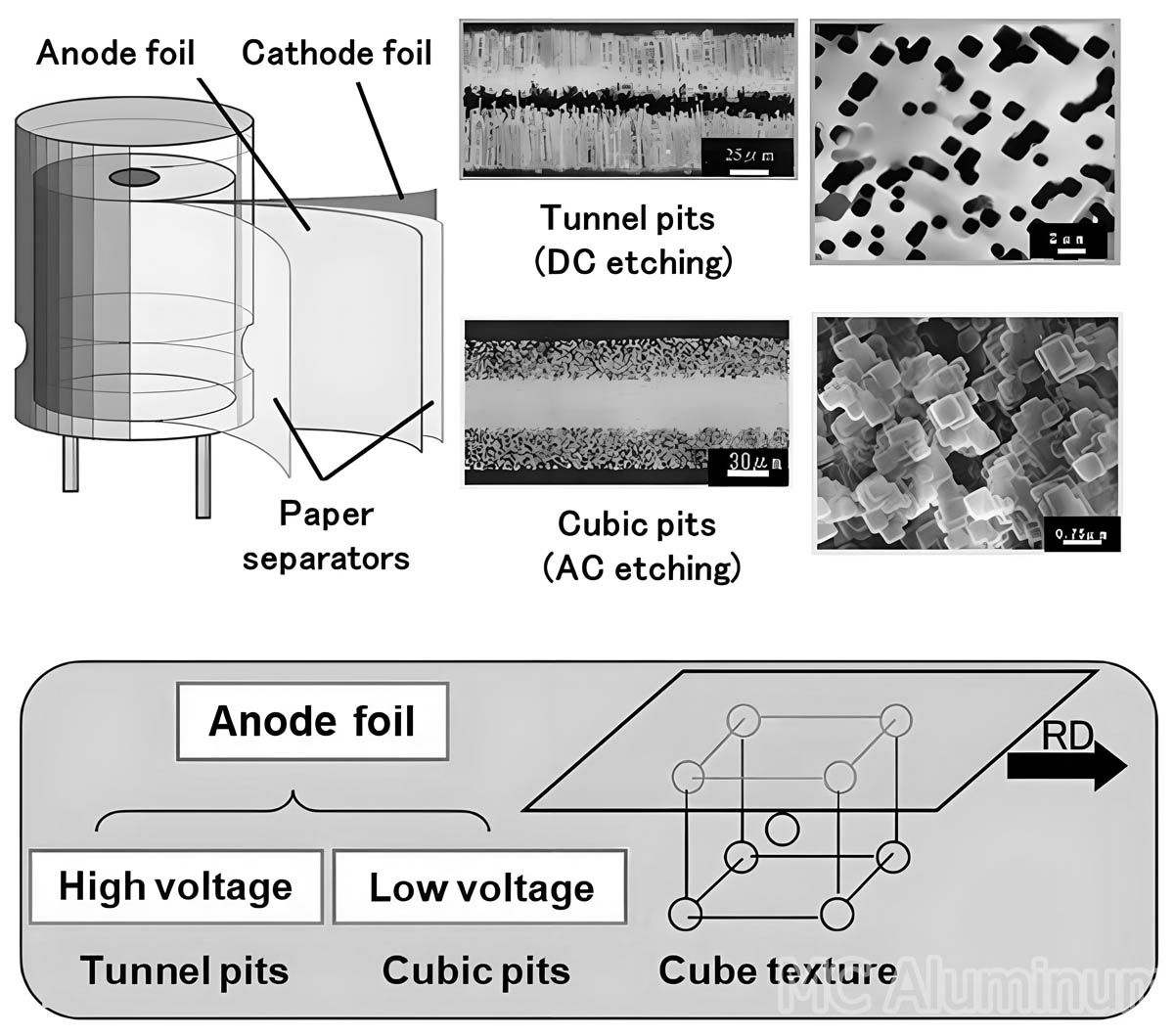
Under the continued guidance of the electric field, these etching pits grow inward along specific crystallographic directions, gradually developing into tunnel-shaped pores or sponge-like microporous structures. This process greatly increases the effective surface area of the aluminum foil.
DC Etching: Etching pores grow directionally in the vertical direction, forming independent, long, straight tunnel pores. The pores are relatively larger in diameter and have thicker walls, making this process suitable for medium- and high-voltage anode foil.
AC Etching: Anodic dissolution and cathodic reduction occur alternately, producing fine, interconnected sponge-like micropores with very high pore density. This process is suitable for low-voltage anode foil and cathode foil and can achieve a higher surface-area enlargement ratio.
Complete Production Process
A complete electrochemical etching line generally operates in a continuous strip-processing mode. Aluminum foil passes through each functional tank section at a controlled and uniform speed. The main process steps are as follows:
1. Pretreatment Cleaning
A combination of alkaline cleaning and acid cleaning is used to remove rolling oil, grease, oxide layers, and rolling defects from the aluminum foil surface. This activates the foil surface and ensures uniform pit initiation during subsequent etching.
Effective pretreatment helps prevent localized uneven etching, missed etching, black spots, and other surface defects.
2. Primary Electrochemical Pit Initiation ( Core Etching Stage )
The aluminum foil enters an etching tank containing a chloride electrolyte. Depending on the product type, direct current, alternating current, or variable-frequency superimposed current is applied.
Initially, a relatively high current density is used to rapidly induce a large number of pitting centers. The current density is then adjusted to control the longitudinal growth of the pores. This stage determines pore density, pore diameter, and pore depth, making it the key process for controlling specific capacitance.
3. Secondary Pore-Widening Etching
After pit initiation, the foil enters a pore-widening tank. Temperature, acidity, and ion concentration are controlled to modify the initial etched pores and optimize their inner diameter.
This process prevents micropore blockage and balances specific capacitance with compatibility in the subsequent formation process. For high-voltage foil, the focus is on maintaining open and continuous tunnel pores. For low-voltage foil, the process further increases micropore density.
4. Rinsing and Dechlorination Post-Treatment
Multi-stage rinsing with purified water is used to thoroughly remove residual chloride ions, aluminum ions, and aluminum powder from the foil surface and internal pore channels.
Residual chloride ions can cause defects in the oxide film formed during the later formation process, resulting in increased leakage current and capacitor failure. Therefore, chloride removal is a key quality-control point. Some processes may also include passivation, water washing, and thermal sealing treatment to suppress self-corrosion of the foil surface.
5. Drying, Inspection, and Rewinding
The etched foil is dried uniformly at low temperature to avoid moisture remaining in the pore channels. Online inspection is then conducted for specific capacitance, impedance, appearance, and weight loss.
Foils with uneven etching, pinholes, strip breakage, or other defects are removed. Finally, the qualified foil is precision-rewound for transfer to the formation process.
Core Product Advantages
High Capacitance: The etching process increases the effective surface area of aluminum foil, improving capacitor capacitance and supporting the miniaturization of electronic components.
Stable Performance: Uniform pore structures and consistent etching quality help improve capacitance consistency and long-term operational stability.
Good Voltage Resistance and Low Leakage Current
A dense and stable oxide film can provide good voltage resistance and low leakage current, making the foil suitable for high-reliability applications.
Easy Processing: The foil offers good winding performance and sufficient mechanical strength, making it suitable for automated capacitor production lines.
Customizable Specifications: Different etched aluminum foil specifications can be customized according to requirements for capacitance, voltage resistance, dimensions, and end-use applications.
Application Fields
Consumer Electronics: Etched anode foil and cathode foil for low-voltage aluminum electrolytic capacitors used in motherboards, power adapters, laptops, fast-charging modules, and related equipment.
Industrial and New Energy Systems: Medium- and high-voltage etched anode foil for photovoltaic inverters, energy storage power conversion systems, EV charging stations, and industrial frequency converters.
Automotive Electronics: Capacitor electrode foil for onboard power supplies, battery management systems, automotive lighting, and vehicle-mounted DC-DC converters.
Advanced Capacitor Products: Etched aluminum substrates for solid aluminum electrolytic capacitors, laminated capacitors, and supercapacitor-related applications.
FAQ
Q1: Will electrochemical etching etch through the aluminum foil?
A: Under normal mass-production conditions, the foil will not be etched through because current, processing time, and temperature are strictly controlled within the required process window. However, excessive current density, overly long residence time, or electrolyte imbalance may cause pinholes and strip breakage. These are considered process abnormalities.
Q2: What aluminum alloy grades are commonly used for capacitor aluminum foil?
A: Common materials include 1050, 1060, 1070, and 1235 aluminum foil. The specific grade selection depends on aluminum purity, processing properties, capacitor type, and production process requirements.
Q3: What is the difference between electrochemical etching and formation treatment?
A: Electrochemical etching is primarily used to increase the effective surface area of aluminum foil. Formation treatment is primarily used to produce an aluminum oxide dielectric film through anodic oxidation. They are different but closely related processes in the manufacture of aluminum electrolytic capacitor anode foil.
Q4: Does a higher etching enlargement ratio always mean better capacitor performance?
A: Not necessarily. Excessive etching may reduce the remaining thickness and mechanical strength of the aluminum foil. It may also negatively affect pore structure and the subsequent formation process. In actual production, capacitance, voltage resistance, leakage current, pore structure, and mechanical performance must all be considered together.
Q5: What factors mainly affect electrochemical etching?
A: The main factors include aluminum foil purity, surface condition, electrolyte composition, current density, electrolyte temperature, and etching time. Proper control of these parameters helps improve etching uniformity and product stability.